
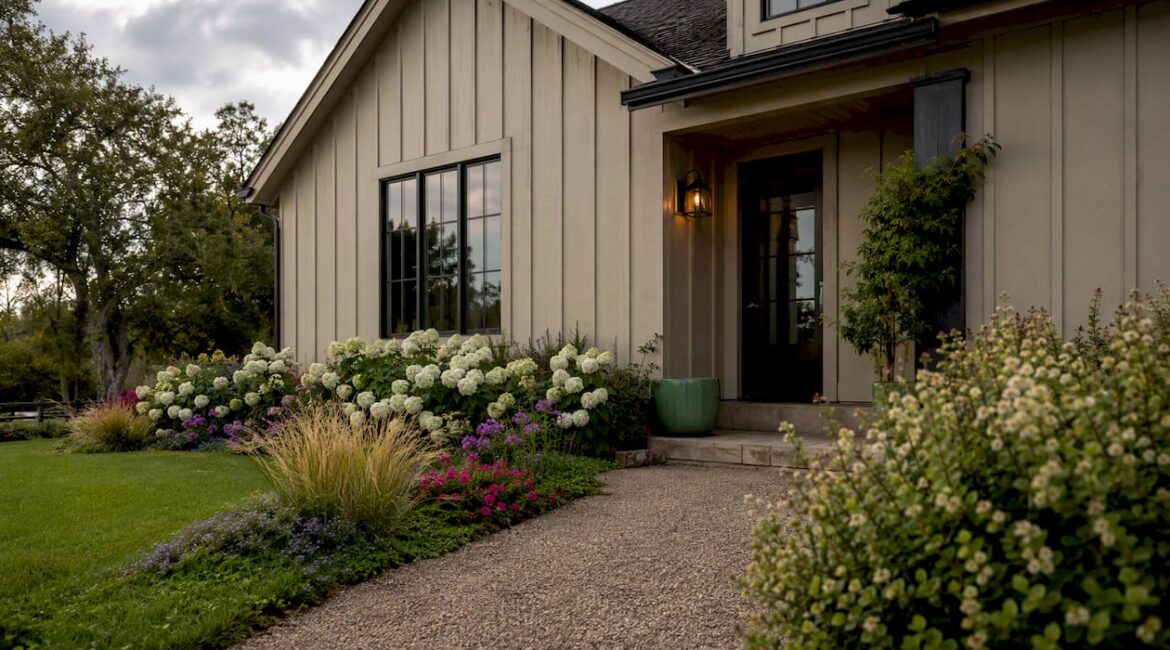
Board and batten siding is a vertical cladding system made of wide boards with narrow strips (battens) covering the seams. Pick it when you want vertical emphasis, textured curb appeal, and the freedom to choose from wood, fiber cement, vinyl, or metal.
- Best use cases: Full facades where you want to add perceived height, gable-end accents, and mixed-profile exteriors where vertical texture contrasts with horizontal lap below.
- Material tradeoff: Fiber cement and engineered wood give you low maintenance with a long lifespan; cedar gives you authentic warmth but demands regular painting or staining.
- DIY suitability: Small accent walls and interior feature walls are manageable for a skilled DIYer. Whole-house exterior installs, especially those involving complex rooflines or factory-finished panel systems, are better left to a professional contractor.
Table of Contents
- What is board and batten siding, and where did it come from?
- Which materials work best for board and batten siding?
- Where does board and batten design work best on a house?
- How much does board and batten siding cost?
- How is board and batten siding installed?
- What are the pros and cons of board and batten siding?
- How long does board and batten siding last, and what maintenance does it need?
- Board and batten vs. shiplap and horizontal lap siding: which is right for you?
- How do you choose the right material and contractor?
- When should you hire a pro for board and batten installation?
- Key Takeaways
- What homeowners get wrong about board and batten siding
- Jaghomesnow handles board and batten siding in Bucks County
- Useful sources and further reading
What is board and batten siding, and where did it come from?
Board and batten siding is a vertical exterior cladding profile in which wide boards are fastened vertically to the wall, and narrower battens are then nailed over the seams between boards to seal out water and wind. The assembly is straightforward: boards first, battens second, with the batten overlapping each seam by at least an inch on either side.
The profile has agricultural roots. American barns and farmhouses used it throughout the 19th century because rough-sawn vertical boards were cheap, fast to install, and the battens solved the seam-sealing problem without the precision joinery that horizontal lap siding required. Gothic Revival architects like Andrew Jackson Downing popularized the look for residential cottages in the 1840s and 1850s, and the style never fully disappeared.
The parts you need to visualize:
- Board: The wide vertical plank, typically 6–12 inches wide, fastened directly to the sheathing or furring.
- Batten: The narrow strip, typically 1.5–3 inches wide, nailed over the seam between two boards.
- Reveal: The exposed face of the board on either side of the batten, which determines how much of the board you see.
- Seam: The gap between adjacent boards that the batten covers.
Modern practice has shifted away from field-built individual boards toward wide factory panels with decorative battens applied on top. That change reduces seam movement, but it makes correct water-resistive barrier (WRB) and flashing details even more critical, since trapped water behind a panel system has fewer escape routes than it does behind individual boards.
Which materials work best for board and batten siding?
Pick fiber cement or composite for relatively low maintenance; pick cedar for authentic warmth if you accept higher upkeep. That general guidance covers most homeowners’ decisions, but nuances arise when pricing a project or considering your climate.
| Material | Typical Lifespan | Maintenance Level | Best Climate | Key Tradeoff |
|---|---|---|---|---|
| Cedar / solid wood | 20–40+ years | High (repaint/restain every 3–7 years) | Dry to moderate | Authentic look; moisture-sensitive |
| Fiber cement | 20–50+ years | Low (repaint every 10–15 years) | All climates | Heavier; requires professional cuts |
| Vinyl | 20–40 years | Very low | Moderate climates | Limited color options; can warp in extreme heat |
| Engineered wood | 20–30+ years | Low to moderate | Moderate to humid | Wood appearance; watch for moisture at cut ends |
| Metal (steel/aluminum) | 20–50+ years | Very low | All climates, coastal | Higher upfront cost; denting risk |
Material selection drives lifespan and maintenance more than any other single factor. Cedar can last 20–40+ years with consistent upkeep; fiber cement often reaches 20–50+ years with far less effort; metal performs best for raw longevity. Composite and engineered options are increasingly specified for exterior board and batten because they deliver a wood-like appearance with significantly lower moisture-related maintenance.
Named manufacturers worth knowing: James Hardie leads the fiber cement category and offers a product visualizer for color and profile planning. LP Building Solutions produces engineered wood options under its LP SmartSide line. Alside manufactures vinyl board and batten panels with a range of profiles and colors.
Batten and board widths change the look significantly. A classic starting point is a 1×10 board paired with a 1×3 batten. Wider boards with narrower battens read as more modern and restrained. Tighter batten spacing creates a textured, almost grated effect; wider spacing reads as elegant and contemporary. Plan your spacing on paper or a digital elevation before committing to any layout.
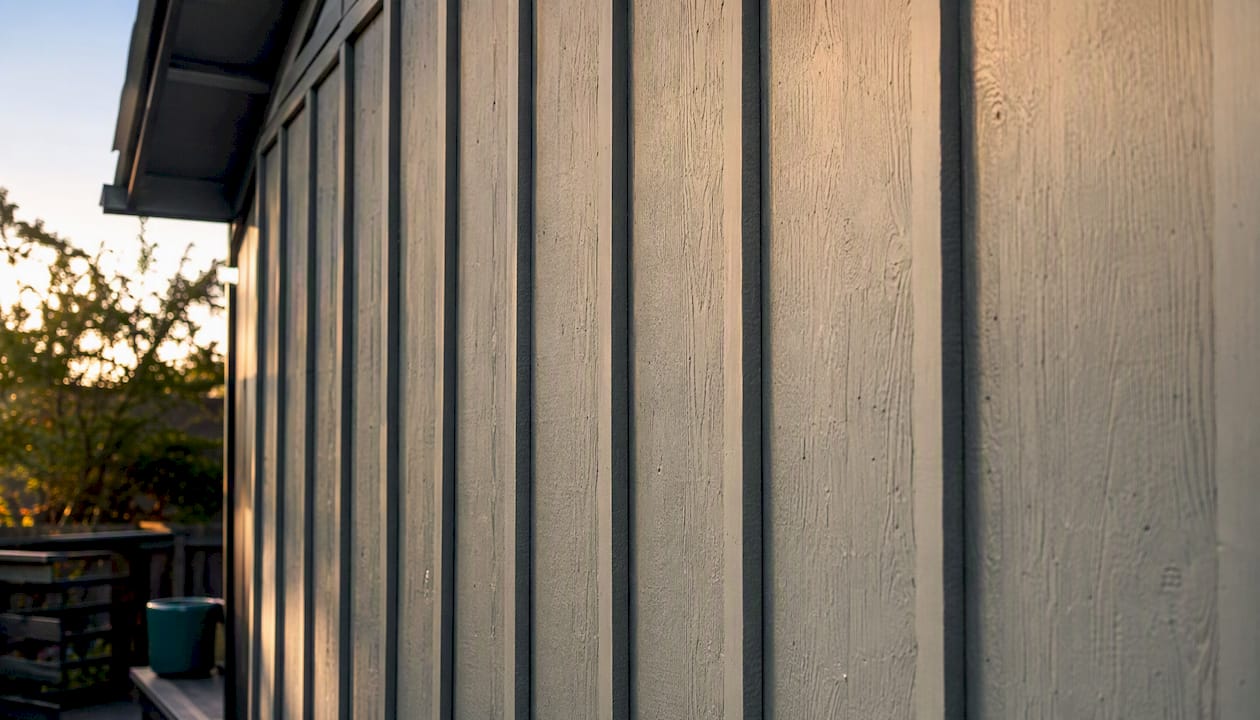
Pro Tip: Pre-finished panels and factory-applied primer coats reduce weather-dependent field finishing and deliver more consistent color across a large facade. If you are using fiber cement, ask your contractor about factory-finished options before ordering materials.
Where does board and batten design work best on a house?
Board and batten reads as vertical texture. Use it for full facades, gable fields, or as an accent zone to add perceived height to a smaller home. Design experts note that the vertical rhythm is one of the profile’s greatest architectural strengths: it can make a modest ranch feel taller and mask wall imperfections that horizontal siding would highlight.
Practical pairing recommendations:
- Full facade with horizontal base: Run board and batten from the roofline down to a belt course, then switch to horizontal lap or shiplap on the lower field or porch skirt. This layered approach avoids a single-style look and adds visual weight at the base.
- Gable-end accent: Apply the vertical profile only to gable fields while keeping horizontal lap on the main body. The contrast draws the eye upward and gives the roofline definition.
- Modern farmhouse exterior: Use wide boards (10–12 inches) with narrow battens (2 inches) in a muted palette. Darker battens against a lighter board color create shadow lines that read as crisp and contemporary.
- Accent wall or entry surround: A single board and batten panel flanking a front door or framing a garage bay adds texture without committing to a full re-side.
James Hardie’s design guidance recommends pairing the profile with another siding profile to avoid an overly trend-specific look and to achieve a more timeless elevation. That advice holds regardless of material.
Color and contrast tips worth keeping in mind:
- Darker battens on a lighter board field create depth and a modern shadow-line effect.
- Matching battens to the board color reads as traditional and seamless.
- A contrasting trim color at windows and corners anchors the vertical lines and prevents the facade from feeling flat.
- Wider reveals (more board exposed between battens) feel elegant and open; tighter reveals feel textured and rustic.
How much does board and batten siding cost?
Installed, board and batten siding typically runs $5–$13 per square foot, with most whole-house projects falling between $8,500 and $22,000 for a 2,000 sq ft home depending on material and complexity. Vinyl sits at the low end; cedar and metal push toward the top.
The main cost drivers:
- Material choice: Vinyl is the most affordable; fiber cement and engineered wood land in the mid-range; solid cedar and metal cost more per square foot.
- Home complexity: Two-story homes, multiple dormers, bay windows, and intricate trim details all add labor hours.
- Removal of existing siding: Tear-off and disposal of old siding adds cost and sometimes reveals sheathing repairs underneath.
- Finishing: Field-painted or stained siding adds labor; factory-finished panels reduce it.
- Local labor rates: Labor costs vary by region. Bucks County and the greater Philadelphia area carry rates that reflect the local cost of living.
Cost snapshot: A 1,700–2,000 sq ft home using vinyl board and batten might run $8,500–$12,000 installed. The same home in fiber cement lands closer to $12,000–$18,000. Cedar or metal at the high end can reach $20,000–$22,000 or beyond, depending on detailing.
Additional line items to budget for: permits (required in most Pennsylvania municipalities), disposal fees, flashing and trim material, and any sheathing repairs uncovered during installation. Angi’s cost data shows that materials account for 40%–90% of total project cost depending on the material chosen, which is a wide range that reflects just how much material selection drives the final number.
How is board and batten siding installed?
For an average homeowner, a small exterior accent wall or interior feature wall is a realistic DIY project. A whole-house exterior install, particularly one involving two stories, complex rooflines, or factory-finished fiber cement panels, is a job for a licensed contractor. The stakes are high: flashing, WRB, and corner detailing are where most long-term failures originate, and mistakes there are expensive to fix.
The installation sequence
- Prep and inspection: Assess the existing sheathing for rot, damage, or inadequate nailing. Repair before anything goes on top.
- Install the WRB: Apply a house wrap or building paper over the sheathing, lapping seams correctly (upper layers over lower layers) and taping all seams.
- Flash windows, doors, and penetrations: This step is non-negotiable. Improper flashing at openings is the leading cause of water intrusion behind vertical siding.
- Install furring or backing (if required): Some installations use horizontal furring strips to create a drainage plane behind the siding.
- Install the wide boards vertically: Fasten with corrosion-resistant nails or screws, leaving a small expansion gap between boards. Keep the bottom edge at least 6 inches above grade.
- Cover seams with battens: Nail battens centered over each seam, overlapping the board edges by at least 1 inch on each side.
- Install flashing and trim at corners, windows, and rooflines: Use pre-bent metal flashing or manufacturer-approved trim pieces.
- Finish and seal: Prime all cut ends before painting or staining. Apply a quality exterior finish rated for the material.
Tools you will need: circular saw, level, chalk line, corrosion-resistant fasteners, caulk gun, and a ladder or scaffolding for anything above the first floor. A full house re-side typically takes a professional crew 1–2 weeks; a DIYer tackling a single accent wall might spend a weekend.
Common mistakes to avoid:
- Skipping the expansion gap: Wood and engineered wood expand and contract. No gap means buckling.
- Bottom edge too close to grade: Siding that sits within 6 inches of soil or mulch wicks moisture and rots quickly.
- Inadequate batten overlap: A batten that only covers the seam by half an inch will open up as the boards move seasonally.
- Painting over unprimed cut ends: Cut ends are the most vulnerable point on any wood or fiber cement product. Prime them before installation, not after.
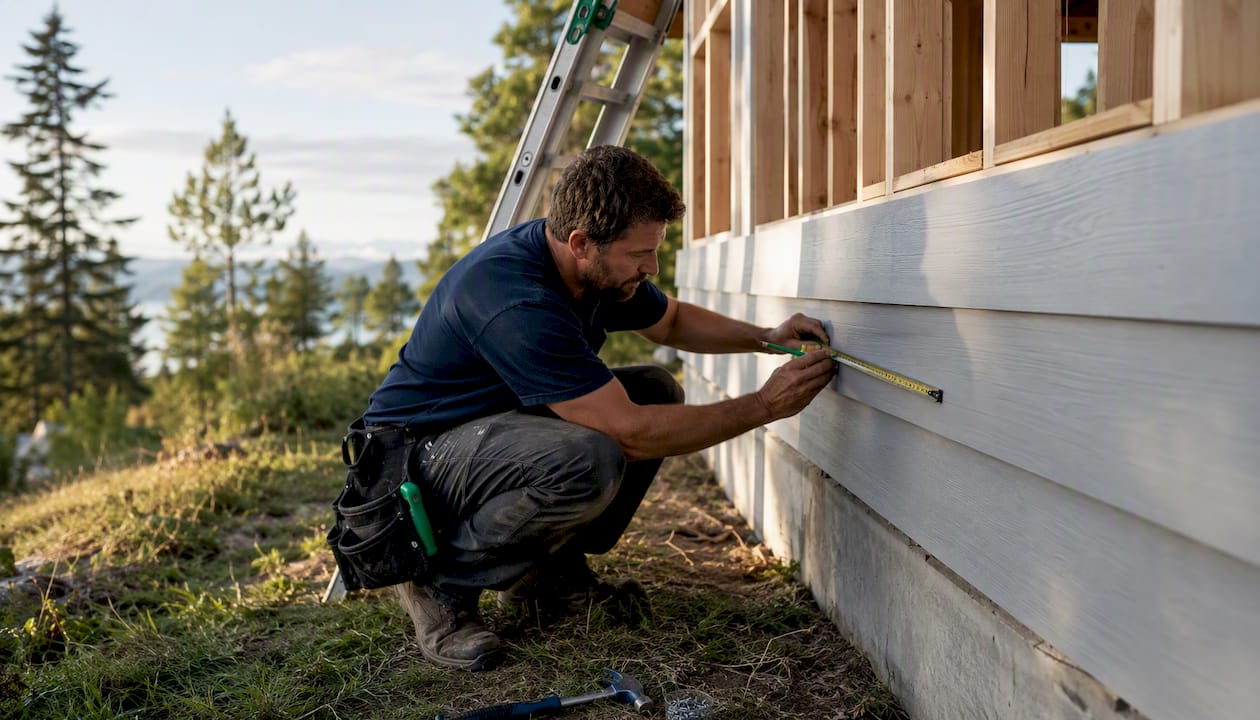
Pro Tip: Measure each batten location individually rather than using a single template across the whole run. Walls and panels are rarely perfectly uniform, and a template that works at one end of the wall will be off by a quarter inch at the other.
What are the pros and cons of board and batten siding?
Board and batten delivers high curb appeal and strong vertical emphasis, but it costs more in labor than horizontal lap siding and demands more attention to water management details. That tradeoff is worth it for most homeowners who want a distinctive exterior, but it is worth going in with clear expectations.
Pros:
- Adds perceived height and architectural interest, especially on smaller or one-story homes.
- Works across a wide range of architectural styles: farmhouse, modern, craftsman, and colonial.
- Available in multiple materials, so you can match your maintenance tolerance and budget.
- The vertical profile can mask wall imperfections that horizontal siding would highlight.
- Strong resale appeal, particularly in markets where modern farmhouse and transitional styles are popular.
Cons:
- Labor-intensive installation compared to horizontal lap siding, which typically means a higher installed cost.
- Water management requires careful flashing and WRB detailing; errors are costly to repair.
- Solid wood options require repainting or restaining on a regular cycle.
- Vinyl board and batten can warp in extreme heat and offers limited color options compared to paintable materials.
- The profile can look dated if applied as a single-style treatment across the entire facade without a complementary profile.
How long does board and batten siding last, and what maintenance does it need?
Lifespan varies by material; maintenance frequency is what drives long-term cost. Cedar installations that are painted regularly can have a long service life, while those neglected may require replacement sooner. Fiber cement and metal siding handle deferred maintenance better but still benefit from upkeep.
Material-specific expectations:
- Cedar and solid wood: Repaint or restain every 3–7 years depending on sun exposure and climate. Inspect annually for cracked caulk, open seams, and paint failure.
- Fiber cement: Repaint every 10–15 years. Inspect caulk at seams and penetrations annually. Very low maintenance otherwise.
- Vinyl: Wash annually. Inspect for warping, cracking, or fading. Color cannot be changed without replacement.
- Engineered wood: Inspect cut ends and bottom edges annually for moisture infiltration. Repaint on a cycle similar to fiber cement.
- Metal: Inspect for dents, scratches, and rust at fastener points. Touch up paint as needed. Longest service life of any common option.
Yearly and multi-year maintenance checklist:
- Inspect all caulk at windows, doors, corners, and seam junctions every spring.
- Check flashing at rooflines and above windows after any major storm.
- Look for paint failure, bubbling, or staining on the sheathing visible at the bottom edge of the siding.
- Clear debris from behind battens and at the base of the wall to prevent moisture accumulation.
- For wood siding, probe suspect areas with a screwdriver: soft spots indicate rot that needs immediate attention.
Warning signs that demand action: open seams where battens have pulled away from boards, water staining on interior walls adjacent to exterior siding, paint failure concentrated at the bottom of boards (a sign of moisture wicking from grade), and any visible rot or soft spots in wood or engineered wood. Catching these early saves thousands in repair costs. Bucks County homeowners should pay particular attention after winter, when freeze-thaw cycles stress caulk and flashing more than any other season.
Board and batten vs. shiplap and horizontal lap siding: which is right for you?
Choose vertical board and batten when you want to add height, texture, and a modern or farmhouse character. Choose horizontal lap or shiplap when you want a traditional, low-profile look or when your home’s architecture reads better with horizontal lines.
The core differences:
- Visual direction: Vertical siding draws the eye upward; horizontal siding emphasizes width and ground connection.
- Perceived height: Board and batten makes a home feel taller. Horizontal lap makes it feel wider and more grounded.
- Water shedding: Horizontal lap siding sheds water naturally by gravity. Vertical siding relies on correct flashing and WRB to manage water at seams.
- Installation complexity: Horizontal lap is generally faster to install and more forgiving of minor framing irregularities. Vertical siding requires more precise layout and flashing work.
- Cost tendency: Horizontal lap is typically less expensive to install due to lower labor hours per square foot.
| Use Case | Recommended Profile | Rationale |
|---|---|---|
| Small one-story home | Board and batten | Vertical lines add perceived height |
| Coastal or rain-heavy climate | Horizontal lap | Gravity-assisted water shedding; simpler seam management |
| Modern or farmhouse build | Board and batten | Matches contemporary and transitional architectural styles |
| Traditional colonial or cape | Horizontal lap | Consistent with historical profile and proportions |
| Mixed-style exterior | Both (layered) | Pair vertical upper field with horizontal lower field for depth |
How do you choose the right material and contractor?
Match material to climate and maintenance appetite; match contractor to experience with the specific material and vertical profiles. That pairing matters more than price alone.
Questions to ask every contractor during the estimate
- How many board and batten installations have you completed in the past two years, and can you show photos or references?
- What WRB product do you specify, and how do you detail it at windows and doors?
- How do you handle flashing at the roofline and above window heads?
- Do you pull permits for siding work in this municipality?
- What is your warranty on labor, and how does it interact with the manufacturer’s material warranty?
- What is your timeline, and how do you handle weather delays?
- Do you offer factory-finished panels, or will finishing be done in the field?
Red flags to watch for in bids:
- Vague or missing flashing details (“we’ll figure it out on site”).
- No references or photos of completed board and batten work.
- A price significantly below the other bids without a line-item explanation.
- No mention of permits or a suggestion that permits are unnecessary.
- A single lump-sum bid with no material or labor breakdown.
Bid comparison checklist: When comparing 2–3 bids side by side, confirm each one includes the same scope: tear-off and disposal, WRB, flashing at all openings, material brand and grade, finish type (field vs. factory), permit fees, and a written warranty. A bid that omits any of these is not a comparable bid.
For local homeowners weighing siding selection factors like climate, budget, and long-term maintenance, working with a contractor who knows the regional conditions is a genuine advantage.
When should you hire a pro for board and batten installation?
Hire a professional for whole-house installs, complex rooflines, or any project using factory-finished panel systems where correct flashing details are non-negotiable. The gap between a DIY result and a professional result on a full exterior is not just cosmetic: it is the difference between a 30-year installation and one that starts showing water damage in five.
What a professional contractor delivers that DIY rarely matches:
- A site assessment that identifies sheathing damage, moisture issues, and framing irregularities before siding goes on.
- Correct WRB installation with taped seams and proper lapping at all transitions.
- Engineered flashing details at windows, doors, rooflines, and penetrations.
- Access to factory-finished panels that deliver consistent color and reduced field finishing time.
- Permit management and code compliance, which protects your home’s resale value.
- A written labor warranty that backs the installation, separate from the material warranty.
Jaghomesnow (JAG Home Enhancements) specializes in fiber cement siding installation across Bucks County and surrounding areas, handling everything from material selection and permit management to professional installation and custom color matching. If you are considering board and batten for your home, getting a local estimate from a contractor who knows the regional climate and code requirements is the right first step. Ask for references, confirm the warranty terms, and verify that the bid includes a full flashing and WRB scope.
Key Takeaways
Board and batten siding is a durable, versatile vertical cladding system that rewards careful material selection and professional installation, with installed costs typically ranging from $5–$13 per square foot depending on material and home complexity.
| Point | Details |
|---|---|
| Material drives lifespan | Cedar lasts 20–40+ years with maintenance; fiber cement reaches 20–50+ years with far less upkeep. |
| Installed cost range | Most whole-house projects run $8,500–$22,000 for a 2,000 sq ft home, with material choice as the biggest variable. |
| DIY vs. pro decision | Small accent walls are DIY-friendly; whole-house installs with complex rooflines require a licensed contractor. |
| Flashing is the critical detail | Water intrusion at windows, doors, and rooflines is the leading cause of long-term failure in vertical siding. |
| Jaghomesnow for local installs | JAG Home Enhancements handles fiber cement board and batten installation in Bucks County, including permits, material selection, and labor warranty. |
What homeowners get wrong about board and batten siding
The three mistakes I see most often on board and batten projects are skipping the layout plan, underestimating the flashing scope, and choosing material based on upfront cost alone.
Layout is where most DIY projects go sideways. Homeowners measure the wall, divide by batten spacing, and assume the math will work out symmetrically at both ends. It rarely does. The right approach is to start from the center of each wall section and work outward, adjusting reveal widths slightly so the end reveals are equal. That one adjustment is the difference between a facade that looks intentional and one that looks like it ran out of room.
Flashing scope is where professional bids sometimes disappoint. A contractor who gives you a vague answer about window head flashing or who plans to rely on caulk alone at the roofline is telling you something important about their experience with vertical siding. Caulk is a secondary defense, not a primary one. The WRB and metal flashing are what keep water out for decades.
On material selection: the homeowner who chooses cedar because it costs less per board than fiber cement often spends more over ten years once you account for repainting. If your maintenance tolerance is low, fiber cement or engineered wood is the honest choice, even if the upfront number is higher.
One design tip you can apply right now: before you commit to batten spacing, tape paper strips to your wall at the planned intervals and step back 30 feet. What looks right on paper often looks too tight or too wide at full scale. That five-minute test has saved more than a few homeowners from a layout they would have regretted.
Jaghomesnow handles board and batten siding in Bucks County
If you have worked through this guide and decided that board and batten is the right profile for your home, the next question is who installs it correctly. For homeowners in Bucks County, Montgomery County, and the surrounding areas, Jaghomesnow (JAG Home Enhancements) is the local contractor built for exactly this project.
We specialize in fiber cement siding installation and siding replacement, including board and batten profiles in fiber cement and vinyl. Every project includes a site inspection, material selection guidance, permit management, professional installation, and a written labor warranty. We handle the flashing details, the WRB, and the finishing work that separates a 30-year installation from one that fails in five. You can also explore our exterior siding painting tips for finishing guidance if you are planning a refresh on existing siding.
Request an estimate from Jaghomesnow and get a line-item bid that covers every scope item discussed in this guide.
Useful sources and further reading
- What Is Board and Batten Siding? (The Spruce): Clear definition and structural overview of the profile, useful for understanding the assembly.
- Board and Batten Siding Cost (This Old House): Cost data and pricing strategy guidance, including average per-square-foot figures.
- Board and Batten Siding Cost (Angi): National cost ranges and material-specific pricing breakdowns.
- How Much Does Board and Batten Siding Cost? (HomeGuide): Installed cost ranges and example project totals for different home sizes.
- The Essential Guide to Board and Batten Siding (James Hardie): Manufacturer-backed design guidance on batten spacing, profile pairing, and material selection.
- Board and Batten Siding: Materials, Sizing, and Cost Guide (Modern Mill): Detailed material comparison with lifespan and maintenance data.
- How to DIY a Board and Batten Wall in 10 Easy Steps (Bob Vila): Practical step-by-step installation guidance for DIY projects.
- What Is Board and Batten Siding and Why Is It Appearing in So Many Homes? (Realtor.com): Design trend context and architectural correction benefits.
- Fiber Cement Siding Installation in Bucks County, PA (Jaghomesnow): Local service context for fiber cement board and batten installation in the greater Philadelphia area.
- Choosing the Best Siding for Your Home (Jaghomesnow): Local guidance on siding selection factors for Bucks County homeowners.
Recommended
- Choosing the Best Siding for Your Home in Southampton, Richboro, Churchville or Holland, PA – JAG Home Enhancements
- How Winter Weather Impacts Your Home’s Exterior — and What Bucks County Homeowners Can Do Now – JAG Home Enhancements How Winter Weather Impacts Your Home’s Exterior in Bucks County, PA | JAG Home Enhancements
- Composite Decking vs Wood Decking | Bucks County Deck Builders
- Fiber Cement Siding Installation Bucks County PA | JAG Home Enhancements