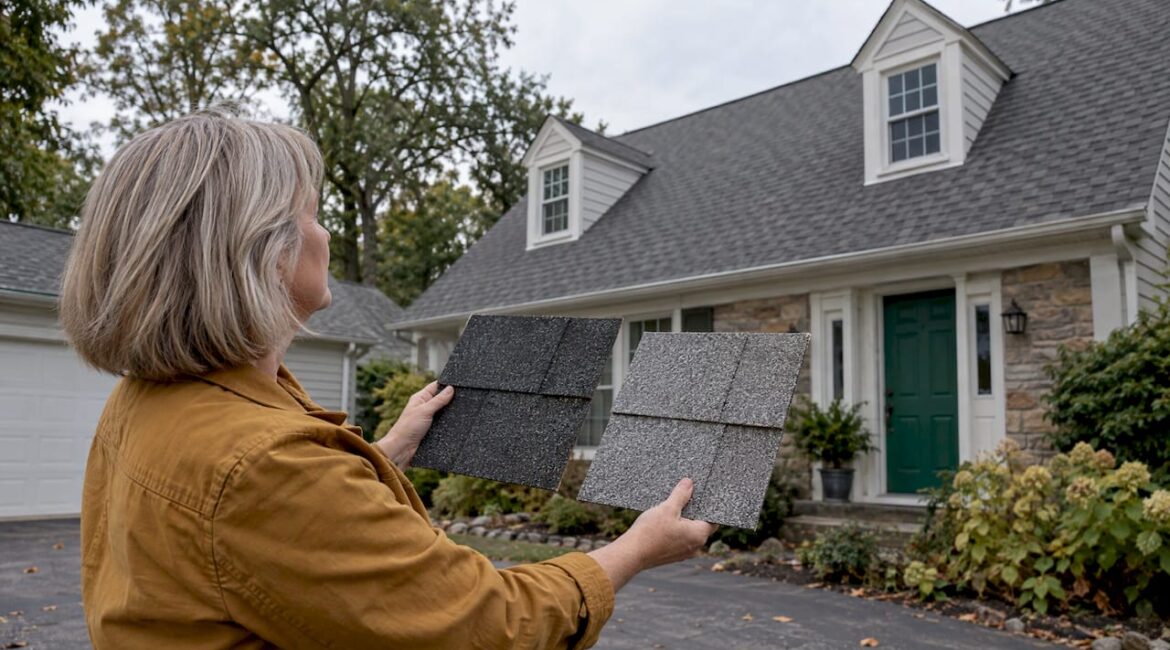
A light roof keeps a house cooler and saves the most energy in hot climates. A dark roof absorbs more heat, which matters less where winters are long. In Bucks County, a mixed climate with hot summers and cold winters, the energy gap is modest, so shingle quality, attic ventilation and how the color suits your house usually matter more than light versus dark.
This guide explains what the research says about heat, energy costs and shingle life. It also covers what shows up on the roof after a few years, and how to choose a color you will still like when the roof is ten years old.
TL;DR
- Dark roofs run much hotter in summer. Lawrence Berkeley National Laboratory measured a black roof 54°F warmer than a white one on a summer afternoon.
- Energy savings from a light roof are largest in hot climates. Bucks County is in a mixed-humid zone, where the benefit is small for newer, well-insulated homes.
- Shingle life depends more on attic ventilation than on color, and experts disagree on how much color matters.
- Light roofs show algae streaks and dirt more. Dark roofs hide them but look hotter in the sun.
- Pick a neutral from the manufacturer’s current core palette, check any HOA rules, and match your siding, brick and trim.
Table of Contents
- Why roof color changes how hot your house gets
- Does a light roof lower energy bills?
- Where Bucks County falls on the map
- Dark does not have to mean hot
- Do dark shingles wear out faster?
- Appearance, dirt and upkeep
- Which colors people actually pick
- Compare the options side by side
- How to choose for your house
- Our perspective
- Plan your roof with JAG Home Enhancements
- FAQ
- Sources
Why roof color changes how hot your house gets
Dark surfaces absorb sunlight and turn it into heat. Light surfaces reflect more of it. That is the whole principle, and the numbers are large. The Heat Island Group at Lawrence Berkeley National Laboratory (LBNL) reports that on a summer afternoon a black roof was measured 54°F warmer than a white roof.
The same group found that a cool-colored roof reflecting 35% of sunlight stays about 22°F cooler than a conventional roof that looks the same but reflects only 10%. Reflectivity, not just color, is what counts.
A Florida field study makes the point inside the house. The Florida Solar Energy Center compared six side-by-side homes. The attic under standard dark shingles reached 110°F on a typical day, while attics under highly reflective white roofing rose to about 90°F. White systems also ran roughly 20°F cooler at the roof surface.
A hot attic pushes heat down into the rooms below, and your air conditioner works harder to remove it.
Does a light roof lower energy bills?
In hot climates, yes, and by a meaningful amount. The U.S. Department of Energy says that in warm or hot climates swapping a conventional dark roof for a cool roof can cut annual air-conditioning use of a single-story building by up to 15%. The Florida study measured cooling energy reductions of 18% to 26% from white reflective roofs.
Those are warm-climate results. Pacific Northwest National Laboratory (PNNL), which runs the DOE’s Building America research program, summarizes a simulation study of typical U.S. homes. It found total heating and cooling savings of about 6% to 12% for homes with relatively cool roofs and walls in warmer climate zones, after counting any added heating energy.
What about winter?
A reflective roof also bounces away some winter sun that would have warmed the house a little. The DOE guide notes this heating penalty exists, but even in mixed climates it can be smaller than the summer savings. The Cool Roof Rating Council explains that the winter penalty is usually small because winter sun is lower and weaker, days are shorter, skies are cloudier, and snow can cover the roof anyway.
A 2007 review in the journal Energy & Buildings, hosted by the EPA, found the heating penalty was smaller than the cooling reduction across the studies it examined.
Where Bucks County falls on the map
The DOE’s climate region guide places Bucks County in the mixed-humid climate, IECC zone 4A. That is the middle of the range: hotter and more humid than New England, cooler than the Southeast.
PNNL’s guidance for that zone is specific. Cool roofs are clearly appropriate in the hottest zones (1A through 3B). In zones 3C, 4A and 4B, the benefits are generally marginal for new homes but worthwhile for older homes with less insulation. Better insulation reduces the effect of roof color on indoor conditions. Less insulation increases it.
What that means for a typical Bucks or Montgomery County house:
- Older home, thin attic insulation, ductwork in the attic: roof color can make a noticeable difference to summer comfort. PNNL found savings were higher for homes with attic air handlers or ductwork.
- Newer home, well-insulated and ventilated attic: color has a small effect on your bill. Choose by looks and durability.
- Finished attic rooms or a second-floor bedroom that runs hot: a lighter or cool-rated roof helps, and so does fixing ventilation.
Dark does not have to mean hot
Color to your eye is only part of the story. About half of the sun’s energy arrives as invisible near-infrared light. PNNL’s Building America team explains that special coatings can make any color, including dark ones, highly reflective in the near-infrared, so a cool roof does not need to be white.
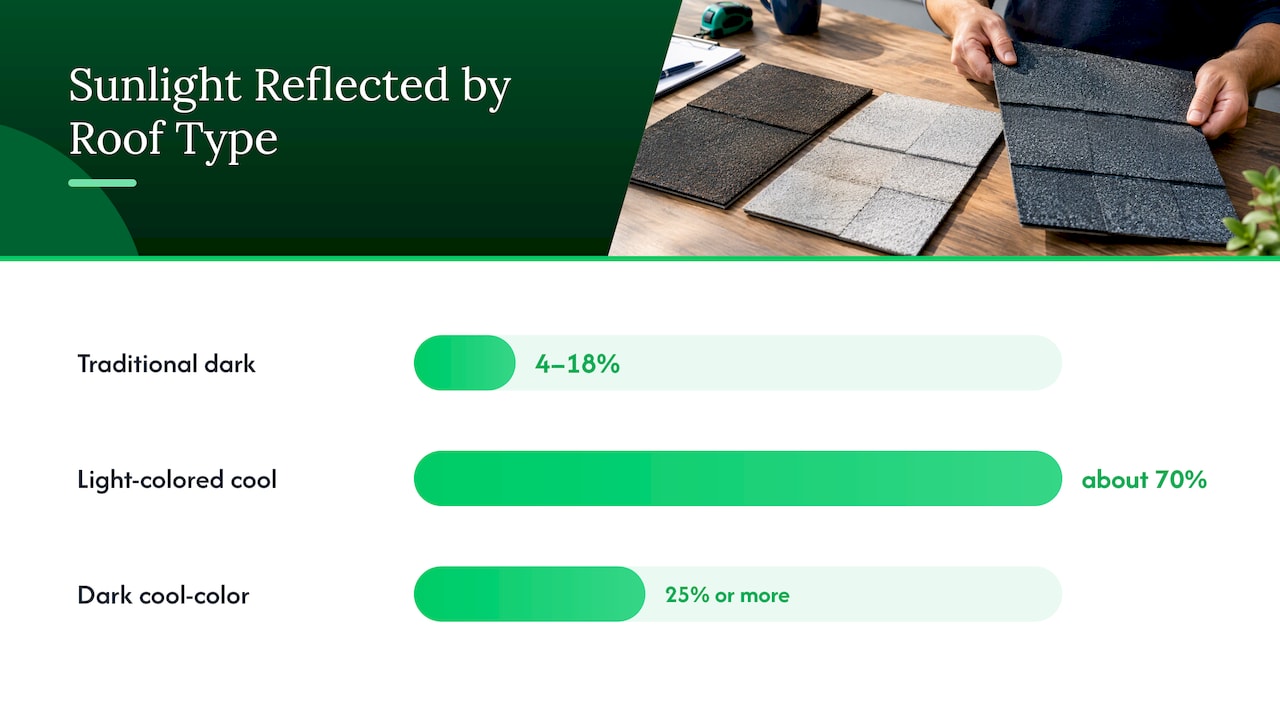
The Cool Roof Rating Council’s technical brief puts numbers on it. Traditional dark steep-slope roofing reflects about 4% to 18% of sunlight, light-colored cool roofs about 70%, and newer dark “cool color” shingles 25% or more. The brief notes that homeowners often prefer darker looks on sloped roofs, which is why manufacturers developed these shingles.
When you compare shingles, look for a cool roof rating or the ENERGY STAR cool roof designation. The Building America Solution Center notes that ENERGY STAR certifies roofing products for reflectivity through its Cool Roof designation. A charcoal shingle with a cool rating can outperform a standard medium-tone one.
A truly cool roof also needs high thermal emittance, meaning it releases absorbed heat efficiently as infrared radiation. Ratings list both numbers.
Do dark shingles wear out faster?
This is the question where honest sources disagree. A roundup of the evidence reports that one major shingle manufacturer found no lifespan difference when the attic is properly ventilated, some studies say heat shortens the life of dark shingles, and others say UV rays matter more. Almost every expert in that roundup agrees on one thing: proper attic ventilation extends shingle life.
The Building America Solution Center states that lighter-colored asphalt shingles tend to last longer because they absorb less heat. InterNACHI, the home inspectors’ association, says darker roofs absorb more heat, which speeds the loss of volatile oils and increases thermal cycling. It also lists slope, orientation, climate and ventilation as factors.
The practical takeaway is that color is one influence among several. A dark roof over a poorly vented attic is a worse bet than a medium roof over a well-vented one. If you are weighing this, read our guide on why roofing ventilation matters in Bucks and Montgomery counties. Warranty terms are also worth understanding before you sign, and we explain them in roofing warranties for homeowners.
Appearance, dirt and upkeep
This is where light and dark roofs differ most in daily life.
Light roofs show growth
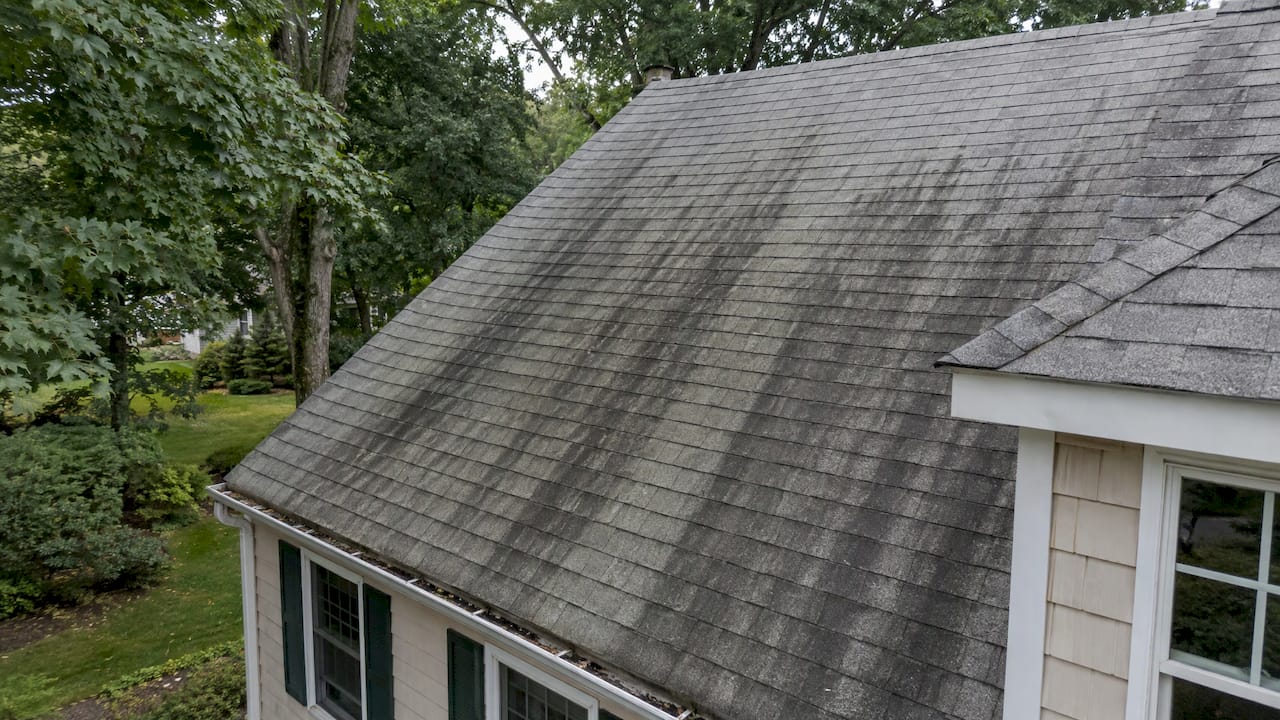
The dark streaks that appear on many asphalt roofs are usually algae. Rain carries the algae down the slope, creating streaks that are especially visible on light-colored shingles, often starting on shaded or north-facing sections. The discoloration is mostly cosmetic. Bucks County’s humid summers and tree-lined lots give algae plenty to work with.
Bob Vila’s 2026 guide quotes a color expert who says white can be difficult on a visible pitched roof because dirt shows more easily over time and it limits paint and trim options. White works better on flatter, less visible roofs.
Dark roofs hide wear but show other things
Dark shingles mask dirt and streaking well. They can make a large home look more grounded and pair easily with white, cream and gray siding. In bright sun they can look stark on a small house, and they show pale debris, bird droppings and some fading over time.
Glare
A bright white or silvery roof can reflect glare at taller neighbors. The LBNL group notes that where glare could disturb occupants of taller neighboring buildings, a nonwhite cool-colored roof is more appropriate. That mostly applies to dense townhouse streets and low-rise additions.
Which colors people actually pick
GAF’s 2026 color article says Charcoal, Weathered Wood and Pewter Gray are its top three best-selling shingle colors, with Charcoal leading by a wide margin. The same Bob Vila guide says light gray or dark gray are the most versatile choices for resale.
The popular colors are neutral, which is the point. A neutral roof works with the brick, stone or siding you have now and the siding you may choose later. If you are also planning exterior updates, our look at siding color trends helps you pick colors that work together.
On value, a new roof is a solid investment. The 2025 Cost vs. Value Report, as summarized by The Roofing Brief, prices an asphalt shingle replacement at $31,871 with $21,501, or 68%, recouped. That national figure does not isolate color, and the same page says no national study measures color’s own effect on resale. Buyers respond to a roof that looks clean, current and well matched to the house.
Compare the options side by side
| Factor | Light roof (white, light gray, tan) | Dark roof (charcoal, black, deep brown) | Dark cool-color roof |
|---|---|---|---|
| Summer roof heat | Lowest | Highest | Lower than standard dark |
| Cooling savings | Largest in hot climates | None | Meaningful, depends on rating |
| Winter heat gain | Slightly less | Slightly more | Slightly less than standard dark |
| Shows algae and dirt | Most | Least | Least |
| Typical look | Airy, can look bright on tall roofs | Traditional, bold, grounded | Same as dark |
| Best fit in Bucks County | Older homes with hot upper floors | Homes with brick, stone or dark trim | Homeowners who want dark and lower heat |
How to choose for your house
Work through these in order.
- Start with the attic. If rooms upstairs run hot, or ducts run through the attic, ventilation and insulation come first, and a lighter or cool-rated shingle adds to the effect. Our ventilation guide explains what proper airflow looks like.
- Look at what cannot change. Brick, stone, a stucco finish, gutters and window frames all stay. Hold shingle samples against them in daylight, morning and late afternoon.
- Check shade and trees. Heavy shade and humid summers mean more algae. If your roof sits under mature trees, a medium or dark blend hides streaking better.
- Pick a current core color. If the manufacturer discontinues a color, future repairs may not match. The Roofing Brief recommends choosing a neutral from the maker’s current core palette so later repairs stay matchable, and a cool-rated version in hot climates.
- Check HOA and township rules. Some communities restrict shingle colors or require approval.
- Think about the winter. Snow cover makes color irrelevant for weeks at a time, and ice dams come from heat escaping the attic, not shingle color. If that worries you, see our guide to stopping ice dam roof damage.
- Consider storm resistance. Color is cosmetic, but shingle impact rating is not. We compare options in impact resistant shingles, Class 3 vs. Class 4.
If you are not yet sure whether the roof needs replacing, roof repair vs. replacement walks through the decision. Timing matters too: see the best window for Bucks County roofs.
Our perspective
Homeowners often ask us whether they should go light or dark, as though one answer fits everyone. The better question is what the roof sits on. Color is the most visible choice, but ventilation, flashing, decking and installation quality decide whether the roof performs for years.
When we talk with homeowners, we focus on honest recommendations and clear communication. We walk through the choices, show how the shingle will sit against your siding and trim, and explain the trade-offs in plain terms. For most Bucks County homes, a well-chosen neutral in a current color line gives you a roof that looks right now and stays easy to match later.
We also manage the project from the first consultation to the final walk-through and keep the job site clean and safe. A good color choice deserves a careful installation.
Jeff
Plan your roof with JAG Home Enhancements
JAG Home Enhancements provides roofing replacement, roof repair and storm damage services, along with siding, windows and exterior renovations, for homeowners in Bucks County, Montgomery County and nearby areas. We offer personalized service and manage your project from consultation through completion, so the color decision, the materials and the installation come together in one plan. See our roofing and exterior services to get started.
FAQ
Is it better to have a lighter or darker roof?
It depends on climate and your house. In hot regions, a lighter or cool-rated roof saves the most energy. In a mixed climate like Bucks County, the savings are modest for well-insulated homes, so appearance, algae resistance and matching your exterior often decide the choice.
Does a darker roof make a house hotter?
Yes, the roof surface and attic run hotter. LBNL measured a black roof 54°F warmer than a white one on a summer afternoon. How much of that reaches your living space depends on insulation and attic ventilation. Cool-color dark shingles reduce the gap.
What is the most popular roof color?
GAF’s 2026 article lists Charcoal, Weathered Wood and Pewter Gray as its three best-selling shingle colors, with Charcoal well ahead. Neutrals dominate because they suit most siding and brick colors and are easier to match for repairs.
Do light roofs show dirt more?
Yes. Algae streaks and dirt are most visible on light shingles, particularly on shaded or north-facing slopes. Dark shingles hide streaking better. Light roofs in humid, shaded areas need more attention to keep their look.
Sources
- Cool Roofs, Heat Island Group, Lawrence Berkeley National Laboratory
- Cool Roofs and Walls to Reduce Heat Gain, Building America, PNNL
- Guide to Cool Roofs, U.S. Department of Energy
- Cool Colored Roofs technical brief, Cool Roof Rating Council
- Cool Roof and Wall FAQs, Cool Roof Rating Council
- FSEC-CR-1220-00, Florida Solar Energy Center
- Comparative Evaluation of the Impact of Roofing Systems, Florida Solar Energy Center
- Energy & Buildings, volume 39, hosted by the EPA
- Guide to Determining Climate Regions by County, U.S. Department of Energy
- Asphalt Shingle Roofs, Building America Solution Center
- Mastering Roof Inspections: Asphalt Composition Shingles, InterNACHI
- What Color Shingles Last the Longest? Family Handyman
- Algae on Roof Shingles: Causes, Safe Removal, and Prevention
- How to Choose Roof Colors, Bob Vila
- Top Roof Color Trends for 2026, GAF
- Best Roof Color in 2026: Resale + Energy Guide, The Roofing Brief