

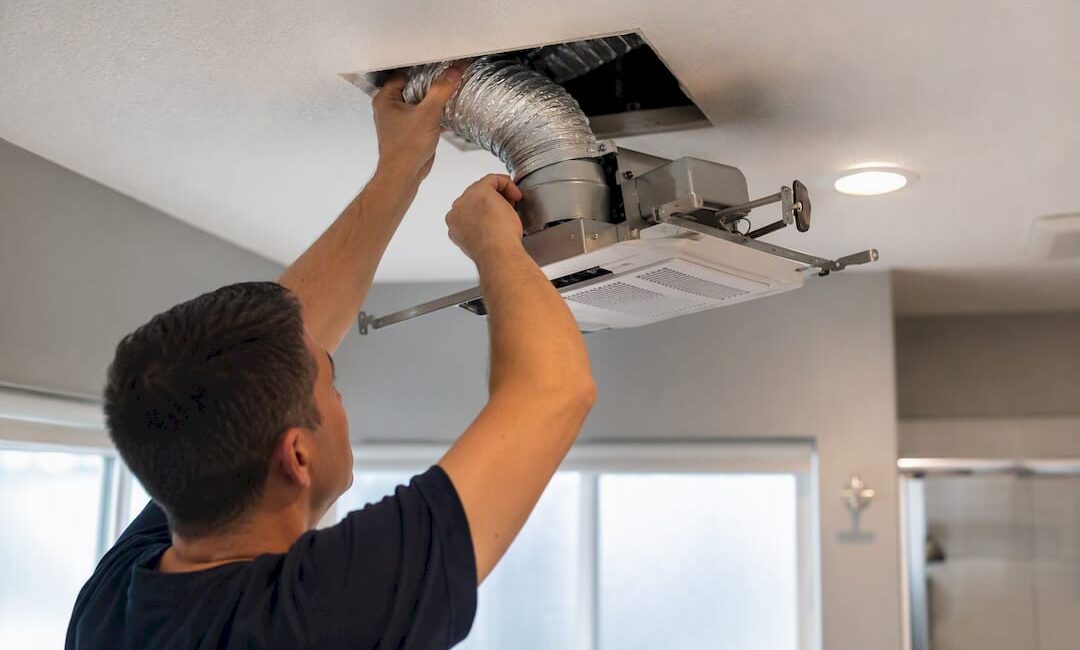
Yes — under the Pennsylvania Uniform Construction Code adopted across Bucks County, any bathroom without an operable outside window needs a mechanical exhaust fan that vents outdoors. The IRC’s Chapter 15 exhaust rules set the minimum capacity at 50 CFM for intermittent operation or 20 CFM for continuous operation, and the fan must discharge outside the building envelope, never into an attic, soffit, or crawl space.
Inspectors in Bucks County townships check three things almost every time: the fan’s rated capacity, whether the duct actually terminates outdoors, and whether the joints are sealed. Miss any one of those and you’re looking at a failed inspection and a return trip.
- Mechanical exhaust is mandatory when there’s no operable window
- Minimum rating: a capacity suitable for intermittent and continuous operation meeting code minimums
- Outdoor discharge is required, no exceptions for interior venting
- Verify your specific requirements with your township building department before you buy a fan
If you’re mid-renovation or just replacing an old fan, call your local building department or a Bucks County contractor before you commit to a model. It’s a five-minute conversation that saves a callback.
Key Takeaways
Bathroom exhaust fans in Bucks County must meet the IRC’s minimum intermittent and continuous ventilation requirements and discharge outdoors through properly sealed and supported ducting verified during a township-administered inspection.
| Point | Details |
|---|---|
| Mechanical exhaust is required | Any bathroom without an operable outside window needs a code-compliant fan per state regulation. |
| Meet the numeric minimum | Install a fan that meets the minimum intermittent or continuous ventilation capacity requirements as specified in IRC Chapter 15. |
| Outdoor termination only | Ducts must exit the building envelope, never into an attic, soffit, or crawl space. |
| Size above the minimum | Factor in duct losses and fixture size, using the roughly 1 CFM per square foot rule as a starting point. |
| Hire local expertise | Jaghomesnow handles sizing, permit filing, and inspection coordination for Bucks County bathroom fan installs. |
Where to Verify the Exact Code Language
- Read the IRC exhaust systems chapter directly for the full text
- Check your township’s ordinance, like Milford Township’s UCC adoption, for local administration details
- Confirm interpretations with your building department before installation
Table of Contents
- Where Should Bathroom Exhaust Ducts Actually Terminate?
- How Do You Size a Bathroom Fan Correctly?
- Can You Run a Bathroom Fan Continuously Instead of on a Timer?
- What Permits and Inspections Should You Expect in Bucks County?
- How a Bucks County Contractor Handles a Code-Compliant Fan Install
- Sources
Where Should Bathroom Exhaust Ducts Actually Terminate?
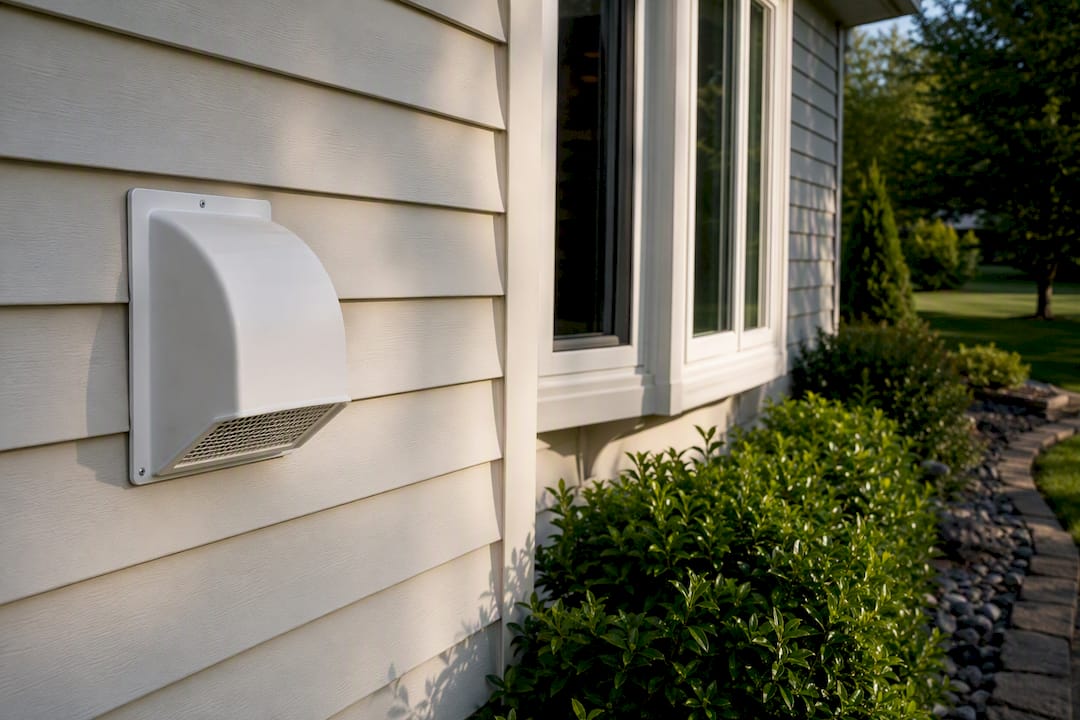
Bathroom exhaust has to terminate outdoors, and that phrase does a lot of work in an actual inspection. Venting into an attic, a soffit, a crawl space, or a wall cavity doesn’t satisfy the code, even though all four are technically “outside” the bathroom itself. Moist, warm air dumped into an attic condenses on cold framing and drives mold and rot, which is exactly what these rules exist to prevent.
Getting the ducting right the first time avoids a second trip to the jobsite:
- Choose smooth rigid or semi-rigid metal duct over flexible duct wherever the run allows it
- Keep the run as short and straight as possible, minimizing 90-degree bends
- Support the duct every few feet to prevent sagging that traps condensation
- Seal every joint with mastic rather than relying on tape alone
- Terminate with an exterior hood that includes a backdraft damper and insect screen, positioned with clearance from windows, doors, and fresh-air intakes
Pro Tip: Slope the duct slightly downward toward the exterior termination. That small grade lets condensation drain outside instead of pooling in the duct or backing up into the fan housing, a detail installation guides call out for a reason.
The most common inspection failures we see aren’t exotic. They’re fans vented into attics, duct tape used in place of mastic, missing backdraft dampers, and termination hoods mounted too close to an operable window.
How Do You Size a Bathroom Fan Correctly?
Meeting the 50 CFM intermittent or 20 CFM continuous minimum is the legal floor, not necessarily the right number for your bathroom. HVI guidance recommends roughly 1 CFM per square foot of bathroom floor area as a starting point, then bumping that up for larger fixtures.
- A standard 50 square foot bathroom needs at least 50 CFM under the rule-of-thumb method, which happens to match the code minimum
- A bathroom with a soaking tub or multi-head shower often needs additional CFM added per fixture
- Look for HVI-certified models, since third-party testing confirms the fan actually delivers its rated airflow rather than an optimistic factory number
Here’s the part most homeowners don’t realize: a fan’s rated CFM assumes ideal duct conditions. Add a few elbows, a longer run, or a cheap flexible duct, and the installed airflow can drop well below what’s printed on the box. Contractors compensate by selecting a fan rated somewhat above the code minimum, so real-world losses still land above 50 CFM. A powered flow hood test, or a professional airflow measurement during final inspection, confirms the installed fan is moving air, not just spinning.
Can You Run a Bathroom Fan Continuously Instead of on a Timer?
Continuous operation at 20 CFM is a fully legal alternative to the 50 CFM intermittent path, and it’s often the better one for humidity control in bathrooms that get heavy daily use. PA Energy Code guidance treats continuous mechanical ventilation as a recognized strategy for meeting whole-house air quality targets, not just a bathroom-specific fix.
Acceptable control setups include:
- A dedicated low-speed continuous fan running around the clock
- A dual-speed unit with continuous low speed and a manual boost for showers
- Timer or humidity-sensor controls with a required manual override switch
Noise matters more than most people expect here. HVI and ENERGY STAR guidance recommends 1.0 sone or quieter for continuous fans, since a loud fan running nonstop gets switched off within a week, code compliance or not.
What Permits and Inspections Should You Expect in Bucks County?
Most Bucks County municipalities administer the Pennsylvania UCC directly, and mechanical or electrical work tied to a bathroom fan typically requires a permit before the first duct goes in. Skipping that step risks a stop-work order mid-project, which costs far more time than the permit fee.
Inspectors generally check:
- The fan’s rated CFM against the manufacturer’s spec sheet
- Confirmed outdoor duct termination, with the hood visible from the exterior
- Sealed, supported duct joints
- Proper electrical connection, including GFCI protection where required
Contact your township building department directly to confirm local interpretations. Documentation expectations vary by township. Some ask for a spec sheet on the spot; others accept a self-certification and spot-check during final inspection. If a permit gets denied or a variance is needed, most townships route disputes through a local Board of Appeals rather than requiring a court filing.
How a Bucks County Contractor Handles a Code-Compliant Fan Install
A proper install starts before anyone touches a drill. Jaghomesnow walks through the same sequence on every bathroom fan job because skipping a step is how callbacks happen:
- Measure the bathroom’s square footage and note fixtures like a shower or jetted tub that push CFM needs higher
- Map the shortest practical duct path to an exterior wall or roof termination, checking for makeup air issues like an undercut door
- Select an HVI-certified fan sized above the code minimum to offset duct losses
- Install with sealed, supported duct and an exterior hood with a working damper, tying into GFCI-protected wiring
- Assemble documentation for inspection, including the spec sheet, HVI rating, and permit paperwork, with an airflow check available on request
Pro Tip: For a fan that will run continuously, prioritize the sone rating as much as the CFM number. A quiet fan someone actually leaves on beats a powerful one that gets switched off after a week.
A local contractor’s take on bathroom fan compliance
The failures I run into most often in Bucks County remodels aren’t complicated. It’s fans vented straight into an attic, duct tape standing in for mastic, or a fixture installed years ago with no idea it never met 55 Pa. Code § 2800.86 in the first place. Homeowners rarely know until an inspection or a mold problem forces the issue.
What surprises people is how cheap it is to fix this the right way compared to what a moisture problem eventually costs. Jaghomesnow handles the permit paperwork and the inspection coordination on every install we do, so the homeowner isn’t the one chasing a township office for answers. If your bathroom fan has never had a real airflow check, that’s worth scheduling before it becomes a bigger problem.
— Jeff
Getting Your Bathroom Fan Installed Right the First Time
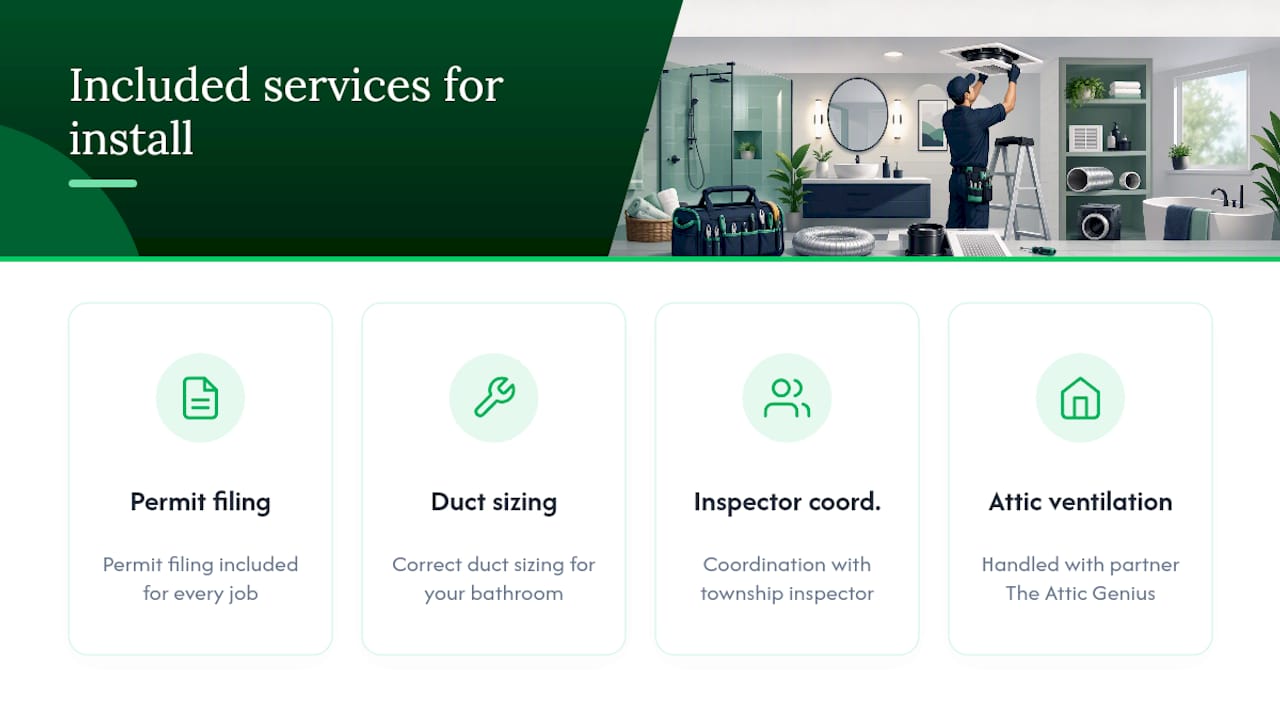
Jaghomesnow is the practical alternative to guessing your way through a fan swap or hiring a handyman who doesn’t pull permits. Every ventilation job we take on in Bucks County includes the permit filing, the correct duct sizing for your specific bathroom, and coordination with your township’s inspector, so you’re not the one on hold with the building department.

If your fan is original to the house, undersized, or venting somewhere it shouldn’t, that’s usually a sign a broader bathroom update is worth considering. Our bathroom remodeling projects across Bucks County routinely include exhaust fan upgrades as part of the scope, and we handle attic ventilation questions with partners like The Attic Genius when a fan’s duct path runs through a shared attic space.
Ready for a written estimate on a code-compliant install? Visit our guide on choosing the right remodeling contractor in Bucks County and request an assessment. We’ll measure your bathroom, size the fan correctly, and handle the permit from the first phone call.
Sources
The rules governing bathroom exhaust fans in Bucks County don’t come from a single local ordinance. They flow down from three layers: the International Residential Code, Pennsylvania’s own regulatory language, and each township’s adoption of the state’s Uniform Construction Code.
IRC Chapter 15, section M1505, is the backbone. It spells out the 50 CFM intermittent or 20 CFM continuous minimums and requires that exhaust air discharge to the outdoors, full stop. That single sentence eliminates a surprising number of “creative” installs contractors sometimes inherit from previous owners, like a fan blowing straight into the attic insulation.
On top of that, 55 Pa. Code § 2800.86 requires mechanical ventilation whenever a bathroom lacks an operable outside window. This matters for interior bathrooms and powder rooms added during a renovation, where a window simply isn’t an option.
Individual townships don’t write their own fan specifications. Instead, they adopt the Pennsylvania UCC wholesale, as Milford Township’s Ordinance No. 130 illustrates. That ordinance defines how the municipality administers permits and inspections under the statewide code, which is the model most Bucks County townships follow.
A few related codes come into play depending on the project:
- Bathroom exhaust fans — Home Ventilating Institute resources
- Mechanical Ventilation – PA Energy Code
- Bathroom exhaust fans — BASC / PNNL resource guide