

With a fixed-price contract, you pay one agreed number for a defined scope of work, and the contractor absorbs most surprises. With time and materials (T&M), you pay for the hours worked and the materials used, plus markup, so you absorb the surprises. Fixed price suits projects you can describe clearly on paper. T&M suits small repairs and work you can’t see yet. Cost-plus sits between them, and it is safest when it carries a ceiling.
This guide explains how each one bills you, where the risk lands, what Pennsylvania law requires, and how to pick for a kitchen, bathroom, deck, roof or addition.
TL;DR
- Fixed price: one agreed price for a written scope. Best when plans, finishes and scope are clear. Changes go through written change orders.
- Time and materials: you pay hourly labor plus materials, with no built-in cap. Best for small repairs, diagnostics and the “open it up and see” part of a job.
- Cost-plus: you pay actual costs plus a fee. Ask for a guaranteed maximum price so the total has a ceiling.
- In Pennsylvania, home improvement contracts over $500 must be in writing, and a T&M provision requires a written initial estimate before work starts.
- Whatever the model, insist on itemized scope, written change orders and a milestone payment schedule.
Table of Contents
- How each contract type bills you
- Where the risk lands
- The middle path: a guaranteed maximum price
- Which model fits which project
- What Pennsylvania law requires
- What to check in any contract
- A worked example
- Our perspective
- Talk through your project with us
- Practical steps before you sign
- FAQ
- Sources
How each contract type bills you
Three names come up in nearly every conversation about remodeling pricing. They are easier to compare once you see what each one actually puts on your invoice.
Fixed price (lump sum)
The contractor agrees to finish the whole project for a set price. AIA Contract Documents notes this works best when scope, schedule and expectations are clearly defined. The NAHB buyer’s guide describes a fixed bid as a bid that tells you exactly what you will pay for the finished work by a certain date.
Inside that price, the contractor has estimated labor, materials, profit and a cushion for contingencies. Consumer Reports explains that if the contractor goes over budget for a foreseeable reason, such as underestimating drywall installation, the contractor is on the hook.
Time and materials (T&M)
Labor is billed at an hourly rate, and materials are billed at cost or with a markup. Procore says that markup on materials is typically 10% to 30%, and that the hourly rate is a “loaded” rate that already includes overhead and profit. A construction law firm’s guide points out that T&M is common on small jobs, such as a plumbing replacement in a kitchen or a deck rebuild, and carries no price cap.
A T&M contract usually comes with an estimate, but the estimate is not a promise. As The Seattle Times puts it, the final bill is not guaranteed in advance.
Cost-plus
Cost-plus is T&M’s close cousin. You reimburse the contractor’s actual costs for labor and materials and add a fee, either fixed or a percentage. AIA notes that construction can begin even when the full scope isn’t completely defined. NetSuite explains the main difference: under T&M the markup is built into the rates, while under cost-plus the contractor bills expenses at cost and adds a separate profit fee.
Side by side
| Fixed price | Time and materials | Cost-plus | |
|---|---|---|---|
| What you pay | One agreed price | Hours worked plus materials | Actual costs plus a fee |
| Who carries cost overruns | Contractor, within the written scope | You | You, unless a maximum price is set |
| Cap on the total | Yes, the contract price | Usually none | Only if a guaranteed maximum is written in |
| Contingency cushion | Built into the price | None | None |
| Best for | Defined scope, finished plans | Small repairs, unknowns | Older homes, evolving design |
| Your workload | Review scope and change orders | Review timesheets and receipts | Review all receipts and logs |
Where the risk lands
The real question behind “fixed price vs. time and materials” is who pays when something goes sideways: a rotted subfloor, a pricier tile, a plumber who needs an extra day.
Under a fixed price, the contractor carries that risk, so the price includes a cushion for it. The NAHB guide observes that because of those contingency funds, a fixed bid may not be the lowest number you see. A construction law firm adds that the owner can end up paying for risks that never materialize. That is the cost of certainty, and many homeowners gladly pay it.
Under T&M or cost-plus, you carry that risk. The American Bar Association describes uncapped cost overruns and unanticipated costs as one of the biggest owner concerns in cost-plus agreements. The Seattle Times reports that T&M kitchen remodels can run 30% to 50% over the original estimate and take twice as long, and notes there is little incentive for efficiency under an hourly model.
The flip side is real too. The same Consumer Reports article quotes a North Carolina contractor who says that if you trust your contractor, cost-plus can save money. That trust has to be matched by paperwork and attention from you.
The middle path: a guaranteed maximum price
You don’t have to choose between certainty and flexibility. A guaranteed maximum price (GMP) contract combines elements of both: it caps the total cost, and the contractor covers anything above the cap. Consumer Reports notes that most cost-plus contracts come with a ceiling on additional charges. Professional accounting guidance also notes that some T&M contracts convert to a guaranteed maximum, which in essence makes them fixed price.
If a contractor proposes hourly or cost-plus billing for a large project, ask whether a ceiling can be written in. If the answer is no, treat that as important information about how much risk you are being asked to hold.
Which model fits which project
AIA suggests four questions to ask before you choose: is the scope clearly defined, how much flexibility do you want on schedule and cost, how much risk can you take on, and how should unforeseen changes be paid for. Here is how that plays out on common Bucks County projects.
Kitchens and bathrooms
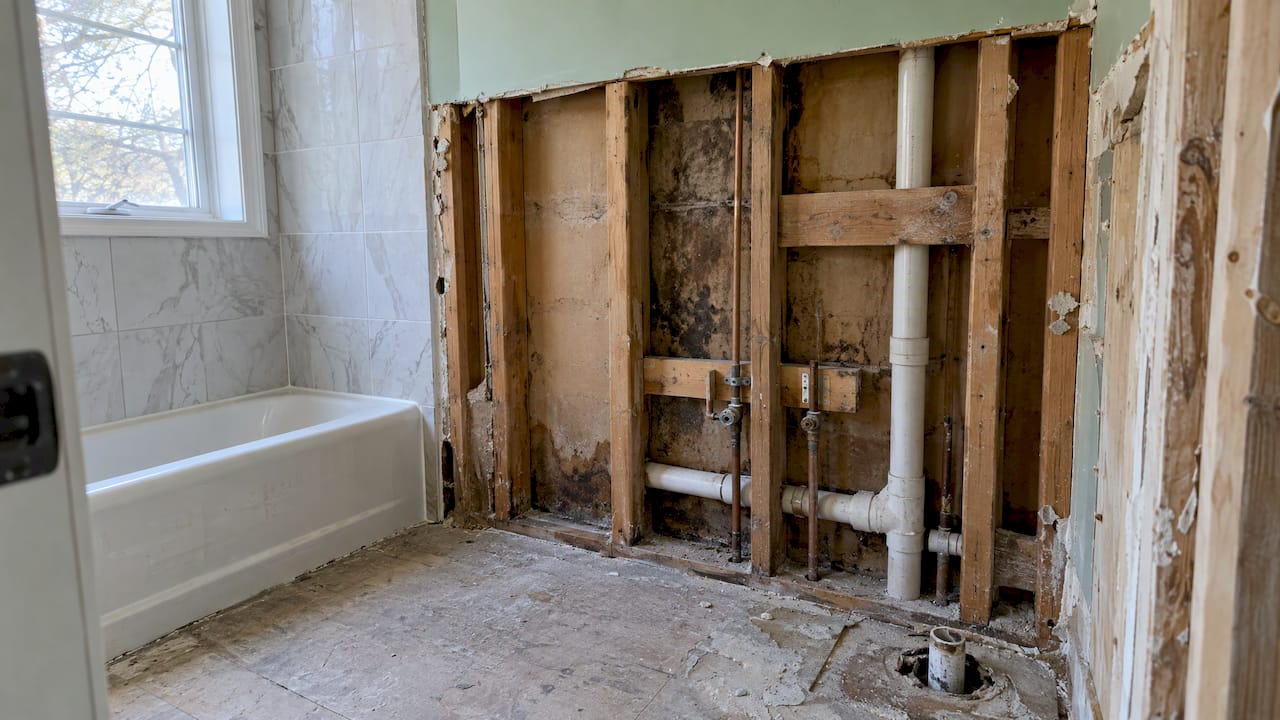
A kitchen or bathroom with chosen layouts, cabinets, fixtures and tile is a natural fit for a fixed price. Everything can be specified, so the price can be firm. The risk is the unseen: old plumbing, uneven floors or water damage behind a wall. The cleanest answer is a fixed price with a written allowance and a clear change order process for what’s found. Our kitchen remodel timeline and bathroom remodel timeline show where those discoveries usually surface.
Decks, siding, windows and roofing
These are measurable. Square footage, materials and fastening details can be written down, which suits a fixed price. Hidden conditions, like rotted framing under an old deck or damaged sheathing under shingles, are the exceptions. A good contract names a unit price or process for handling them before the work starts, instead of leaving it to a conversation in the driveway.
Basements and additions
Most of the project is definable, but some of it depends on what the structure reveals. Many homeowners pair a fixed price for the defined work with a separate, clearly limited arrangement for unknowns.
Older homes and evolving designs
A construction law firm notes that cost-plus works best when scope is uncertain at the start, such as substantial renovations to older homes, and that it depends on rigorous cost documentation and active owner oversight. If you go this way, a GMP is your seat belt.
Repairs and diagnostic work
For emergency repairs, small fixes and “let’s see what’s behind this” work, hourly billing is common and sensible. It is the same reason a plumber bills by the hour. Keep the job small, get a written estimate first and ask for itemized invoices.
What Pennsylvania law requires
Pennsylvania’s Home Improvement Consumer Protection Act sets floor rules, and they affect both models. The text of the state statute provides the following:
- A home improvement contract with a total cash price over $500 must be written, legible and signed by both parties, and it must include the contractor’s registration number.
- If the contract has a time-and-materials provision, the contractor must give you a written initial estimate before work begins. Costs may not exceed that estimate by more than 10% without a written change order signed by both parties.
- For contracts over $5,000, the deposit may not exceed one-third of the contract price, or one-third plus the cost of special-order materials.
- You may rescind the contract within three business days of signing.
The Pennsylvania Housing Finance Agency’s HICPA information sheet adds that the contract should include an itemized description of the work, the materials to be used and specifications that can’t change without a signed written change order. It also says a contractor may include a “not to exceed” contingency that can only be earned by showing invoices or receipts that the work exceeded the original scope.
The statute and its amendments are the authority here, so confirm current wording on the official pages or with an attorney before signing anything complex.
What to check in any contract
The pricing model matters less than the paper behind it. The Better Business Bureau recommends payment terms that state the total amount due, the payment type (check or credit, no cash), how change orders work and when payment can be withheld if work doesn’t match the agreed scope or quality. Use this checklist:
- Itemized scope: rooms, materials, brands or model lines, and what is excluded.
- Allowances: a specific dollar figure for each item you haven’t chosen yet, stated as material only or material plus installation.
- Price structure: the fixed price, or for T&M, the hourly rates, the material markup and any ceiling.
- Records: for hourly work, signed daily timesheets and copies of material receipts.
- Change orders: nothing changes in scope, price or schedule until both sides sign. See how the change order process works.
- Payment schedule: payments tied to completed milestones, not calendar dates. Our guide to milestone payment schedules explains how.
- Timeline: start and completion dates, milestones, and permit and inspection deadlines.
- Cleanup: what the job site and final cleaning will look like. See what your contract should cover for cleaning.
Markup deserves its own question. NetSuite puts typical T&M markup at 15% to 35%. A fixed price hides the same overhead and profit inside one number. Ask any contractor to explain theirs plainly. A confident one will.
A worked example
Imagine a bathroom remodel with a bid of $30,000 fixed, versus an hourly estimate of $26,000. The hourly number looks better. Now suppose the crew finds rotted subfloor and the tile choice moves up a grade. Under T&M, you might land at $33,000 with no ceiling. Under the fixed price, you pay $30,000 plus a signed change order only for what falls outside the written scope, such as an upgrade you requested.
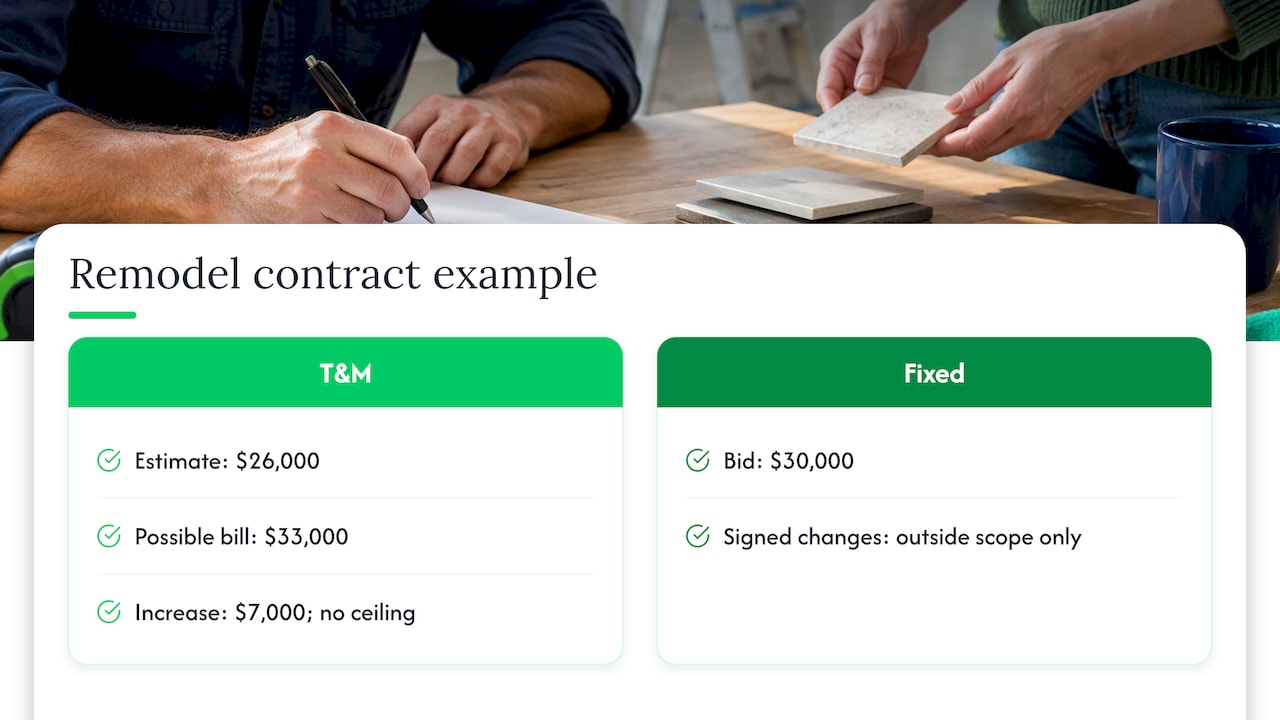
These figures are illustrative, not quotes. The point is that the lower starting number is not automatically the lower final number. Compare what each contract promises about the final bill, not just the opening line.
Our perspective
We have sat at a lot of kitchen tables with homeowners who just want to know what this is going to cost. Most of them don’t want a lesson in contract theory. They want a number they can plan around and a contractor who tells them the truth when something unexpected turns up.
That is why we lean toward a clear, written scope for projects that can be defined. When the plans, materials and selections are on paper, you know what is included, and so do we. Surprises still happen in older homes, and when they do, we believe the right response is to stop, explain what we found, put the cost and options in writing and wait for your approval before moving on.
For small repairs and true unknowns, hourly work can be the honest answer, as long as the estimate is written, the records are open and you are never guessing at the total. Our approach is built on honest recommendations, clear communication and full project management from the first consultation through completion, with a clean, safe job site along the way.
Whatever model you choose with any contractor, ask how changes get handled before you sign. That one answer tells you most of what you need to know.
Jeff
Talk through your project with us
JAG Home Enhancements is a home remodeling service based in Bucks County, PA. We handle kitchens, bathrooms, basements, additions, decks, roofing, siding, windows and doors, and repair work of any size. We manage the project from consultation through completion, and we’ll talk through how your scope, selections and budget should shape the contract.
If you’re planning a kitchen or bathroom, start with our kitchen and bathroom remodeling services. For anything else, visit JAG Home Enhancements to see everything we do, or read our guide on how to choose a remodeling contractor in Bucks County.
Practical steps before you sign
Spend a little time up front and the pricing model will mostly take care of itself.
- Define scope before you collect bids. The more detail every contractor prices from, the easier it is to compare. Bids built from different assumptions can’t be compared fairly.
- Choose finishes early. Unchosen items turn into allowances, and allowances are where budgets drift.
- Hold a contingency of your own. Many homeowners set aside a reserve on top of the contract price for upgrades and discoveries. It keeps a change order from becoming a financial emergency.
- Plan how you’ll pay. If you’re financing, see our overview of home improvement financing and how draws line up with milestones.
- Run through a hiring checklist. Our 8 step hire a contractor checklist covers licensing, insurance, references and the paperwork above.
- Prepare your household. Our piece on living through a remodel helps you plan for the weeks the work is underway.
FAQ
Which is better, fixed price or time and materials?
For most homeowners with a defined project, fixed price is better because the total is known before work begins. T&M is better for small repairs and uncertain scope. The right choice depends on how clearly the work can be described and how much risk you want to hold.
What is the difference between cost-plus and fixed price?
Under fixed price, the contractor commits to a set price and absorbs overruns within the scope. Under cost-plus, you reimburse actual costs plus a fee, so you absorb overrun risk unless a maximum is set. Cost-plus can start before the design is final, while fixed price needs a defined scope.
What are the disadvantages of fixed price contracts?
The contractor builds a contingency cushion into the price, so the number may be higher than a bare-bones estimate. Changes you request mid-project are priced through change orders. The benefit is that you know what you will pay for the written scope.
Can a T&M contract have a cap in Pennsylvania?
Yes, you can negotiate one, and Pennsylvania law already limits overages on T&M provisions. The contractor must provide a written initial estimate, and costs can’t exceed it by more than 10% without a written change order signed by both parties. Confirm the current text on the state’s official site.
Sources
- Act of Oct. 17, 2008, P.L. 1645, No. 132 (Pennsylvania Home Improvement Consumer Protection Act)
- PHFA HICPA Information Sheet
- AIA Contract Documents: Residential Construction Contracts
- NAHB: How Do Builders Charge for Their Services?
- Consumer Reports: Know What Type of Remodeling Contract You’re Signing
- The Seattle Times: Fixed bid, or time and materials?
- American Bar Association: Cost-Plus Contract Agreement and the Disorganized Contractor
- PwC Viewpoint: Types of Contracts
- Hollington Law Firm: Guide for Understanding Construction Contracts
- Procore: Types of Construction Contracts
- NetSuite: Time & Materials Contract vs Cost-Plus Contract
- BBB: What to include in your home improvement contract
- Cost Plus vs Fixed Price Contracts: Pros, Cons, Risks