
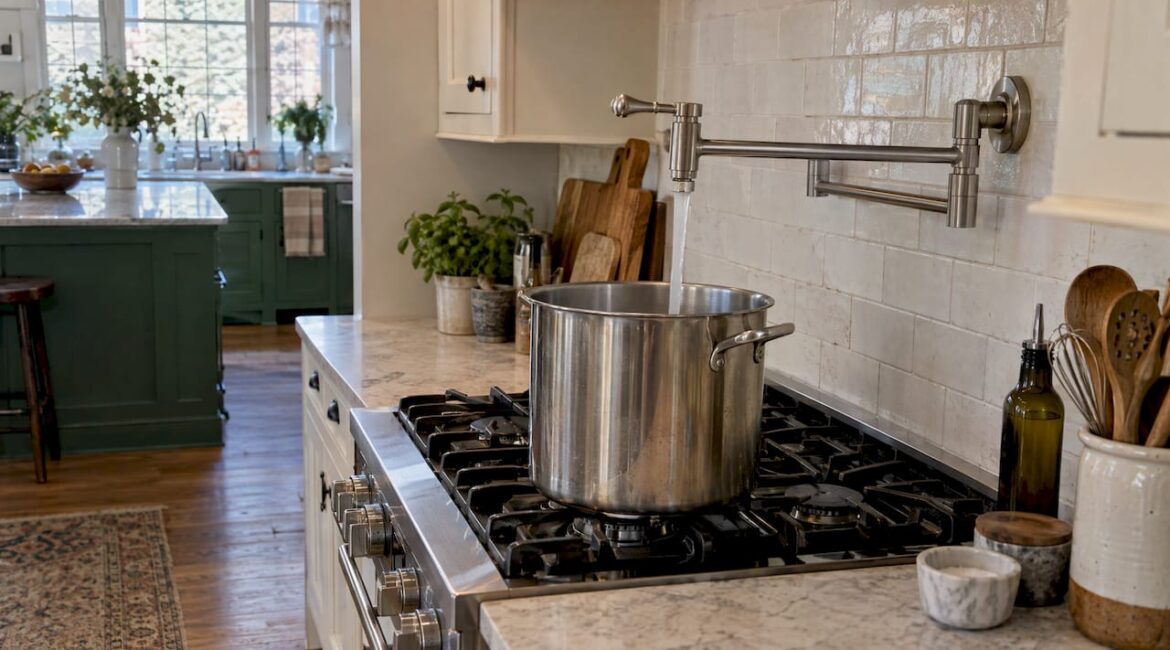
A pot filler is worth it when you regularly cook with big pots of water and you are already opening walls for a kitchen remodel. In that case the plumbing is easy to run, the cost of adding it is small next to the rest of the project, and you stop lugging heavy pots from the sink to the stove. If your walls are finished and your cooktop has no water line nearby, the math changes, because someone has to open the wall to get a supply line there.
This guide is for homeowners planning a kitchen upgrade in Bucks County, Montgomery County and similar older Pennsylvania homes. It covers what a pot filler does, who uses one daily, how high to mount it, what to plan behind the wall, and how to decide during design, before anything is closed up.
TL;DR
- A pot filler is a faucet mounted on the wall over the stove, so you fill pots right on the burner instead of carrying them from the sink.
- It earns its place with pasta, stock, canning and big-batch cooking, and with daily small jobs like filling a kettle.
- A typical mounting height is 12 to 18 inches above the cooking surface, and local code applies.
- The best moment to add one is during a remodel, when the wall is already open and you can plan an access panel.
- Decide before drywall goes up: after that, adding one means opening finished walls.
Table of Contents
- What a pot filler is and what it does
- Who gets the most from a pot filler
- Pot filler pros
- Questions homeowners ask about the carry back
- How high should a pot filler be?
- What happens behind the wall
- What does a pot filler cost?
- Pot filler or not: how to decide
- Planning a pot filler into a kitchen remodel
- Our view: what we would tell a friend
- Planning a kitchen in Bucks County?
- FAQ
- Sources
What a pot filler is and what it does
A pot filler is a small, cold-water faucet fixed to the wall behind your range or cooktop. You may also hear it called a pasta arm or a kettle faucet. According to The Spruce, the arm can be fixed or articulated, and most pot fillers sold today have a swing arm that you can position over different burners.
The idea is simple. Set the empty pot on the burner, swing the arm over it, fill it, and fold the arm back against the wall. The water comes to the pot, so you are not carrying a full stockpot across the kitchen.
The Spruce points out that this avoids the extra trip and the strain of lifting a heavy, full pot out of the sink. It may also cut down on spills along the way. A cooktop with a nearby faucet feels more like a workstation than a stove.
Who gets the most from a pot filler
A pot filler is a luxury rather than a necessity, as The Spruce puts it, and it is most convenient for people who often cook pasta or recipes that call for lots of water or tall stock pots. That is the first test: how often do you boil more than a couple of quarts?
Here are the households that tend to get the most out of one:
- Pasta and soup cooks. If a big pot of water is a weekly or nightly event, you will use it constantly.
- Big-batch and holiday cooks. Stocks, chili, corn on the cob, lobster or crab boils, and canning all start with a heavy pot.
- Families with kids and busy evenings. Fewer trips with a hot, heavy, sloshing pot means fewer spills on a floor where people are walking.
- Anyone who finds lifting difficult. Filling the pot in place takes the heaviest lift out of the first step. It is a good fit with the kind of planning we describe in our guide to aging-in-place bathrooms: put the convenience in now, while you are building.
One homeowner and interior designer, Kristine Krupa, describes using hers about three times a day, mostly for the kettle, flower vases and the dog’s water bowl, and only occasionally for pasta. That is a useful reminder that the value is not only in boiling water. A faucet at the stove is handy for any small job that happens near the cooktop.
A quick way to test your own habits
Before you decide, think through a normal week in your kitchen:
- How many times do you fill a large pot, kettle or stockpot?
- How far is your sink from your cooktop, and is there an island or a walkway between them?
- Does anyone in the house find lifting a full pot awkward?
- Do you cook for crowds, can in season or host holidays?
If you answered yes to two or more, a pot filler will likely feel like one of the best features in the room. If your sink sits right beside the range and you mostly cook quick meals, it is more of a nice-to-have, and your budget may do more good in cabinets, lighting or counters. That is a design call, and it is easier to make with a plan in front of you.
Pot filler pros
- Less lifting. You carry an empty pot to the stove, not a full one.
- Fewer spills and drips. There is no trail of water from the sink to the burner.
- Faster starts. Water goes on to heat the moment the pot is filled.
- Easy small tasks. Kettles, vases, a pet bowl or a rinse at the cooktop become one step.
- A designed look. A well-chosen arm in a finish that matches your sink faucet and hardware reads as a deliberate, finished kitchen.
Questions homeowners ask about the carry back
One common comment is that you still have to empty the pot at the sink. That is true, and it is part of how a kitchen works: draining pasta or pouring off stock happens at the sink either way. What the pot filler removes is the heaviest and most awkward moment, carrying the full pot from the sink to the hot burner and setting it down level. Moving a pot that is hot is something most cooks do with a lid on and a steady grip, and many cooks also ladle or use a strainer insert to lighten the load. Pairing the pot filler with a well-placed sink and clear counter space on both sides makes the full routine smooth.
How high should a pot filler be?
The commonly given range is 12 to 18 inches from the cooking surface, according to Sub-Zero, Wolf and Cove’s placement FAQ, which also tells you to refer to local code. Treat that range as your starting point and confirm the final number with your remodeler and plumber, because the right height depends on the products you choose.
Here is how to think about it:
- Too low and the spout gets in the way of tall pots, pan handles and your hands.
- Too high and you lose some of the convenience, and water falls a long way into the pot.
- Where the arm swings matters as much as the height. If the arm has to reach over several burners, check that its reach covers the ones you use most.
- The tallest pot you own is a good measuring stick. Hold it on the burner and picture the spout above it.
The range or cooktop, the hood and any backsplash tile also affect where the faucet can go. Tile layout lines, outlet locations and the vent hood all compete for the same wall. That is one reason we like to settle the pot filler during design, in the same conversation as the range, hood and lighting. Our kitchen lighting plan guide makes the same point about electrical: decisions that live inside the wall have to be locked before the walls close.
Should it be centered?
Most homeowners place it near the center of the cooktop so the arm can reach every burner you use for large pots. If you have a range with a few favored burners, or a hood that interferes with the middle, your layout may call for a different spot. Mark the position with tape on the wall and walk through a real cooking routine before the plumber sets the rough-in.
What happens behind the wall
This is where a pot filler stops being a faucet and becomes a plumbing project. A pot filler needs a cold-water supply line at the cooktop wall. In many homes there is no water line behind the range, so a line has to be run from elsewhere, through studs, and often through cabinets or from a basement or crawlspace below.
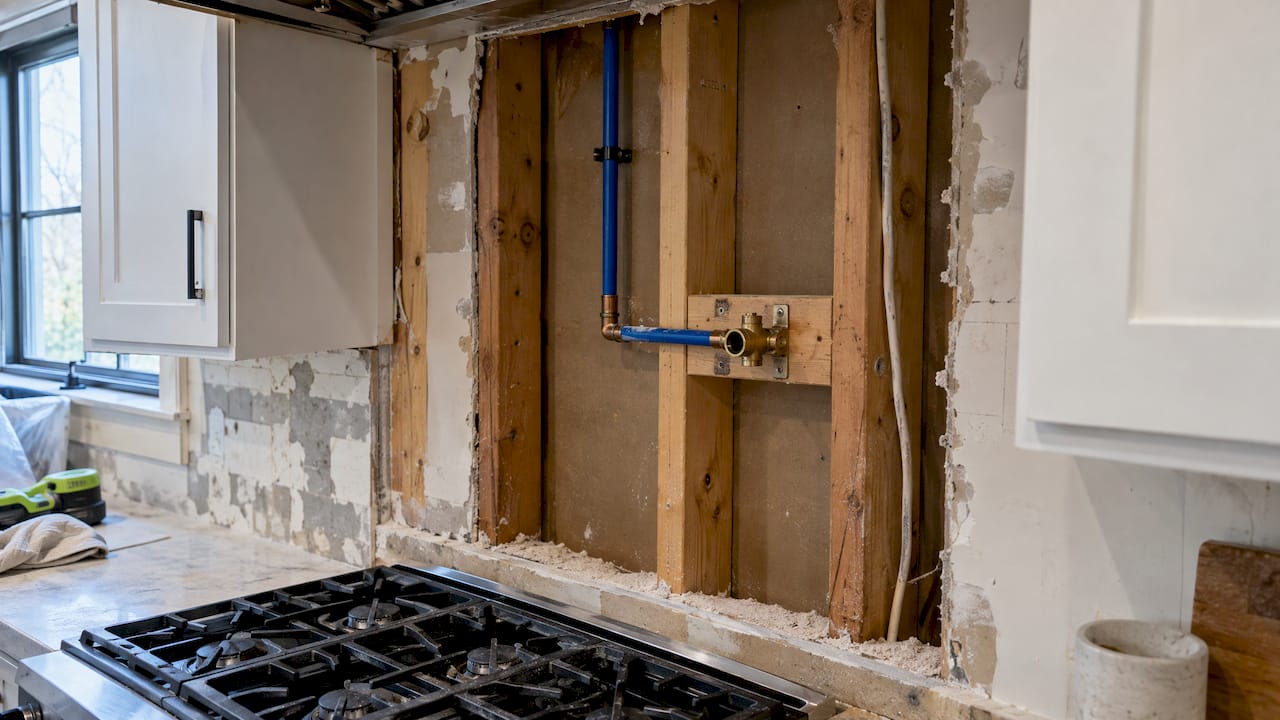
That is why the timing matters. Martha Stewart’s designer roundup advises adding a pot filler when you are already opening the walls for other kitchen renovations. Running one pipe through an open wall is a modest add. Cutting into finished drywall, tile and paint to do it later means patching, refinishing and more disruption.
There are several things to settle while the wall is open:
- Supply route. Where does the line come from, and does it cross anything that makes the run difficult?
- Shutoff valve. Plan where the shutoff will live so that the faucet can be isolated for repairs.
- Blocking. Solid wood backing inside the wall gives the wall-mounted arm something strong to hold when it swings and gets leaned on.
- Access panel. Martha Stewart’s source suggests including an access panel on the opposite side of the wall, when possible, to simplify future maintenance and repairs. If the wall backs onto a pantry or closet, that is easy to plan.
- Code and permits. Plumbing rules are set locally. Your township or borough office and your plumber will know what applies in your municipality.
The same logic about being able to reach pipes later applies throughout a house. A short read on preventive care for pipe systems explains why access and regular checks make repairs smaller and cheaper, which is the thinking behind that access panel.
Leaks and water near the cooktop
Any fixture adds a joint or two inside the wall, and water near a range deserves thoughtful installation. Good practice is simple: use quality fittings, make sure the faucet is supported, install a shutoff you can reach, and keep an eye out for drips or dampness. Water that escapes inside a kitchen can reach cabinets quickly, so it helps to know what to do in the first hours. Our guide to saving kitchen cabinets after water exposure walks through the 24 to 48 hour window by cabinet material.
What does a pot filler cost?
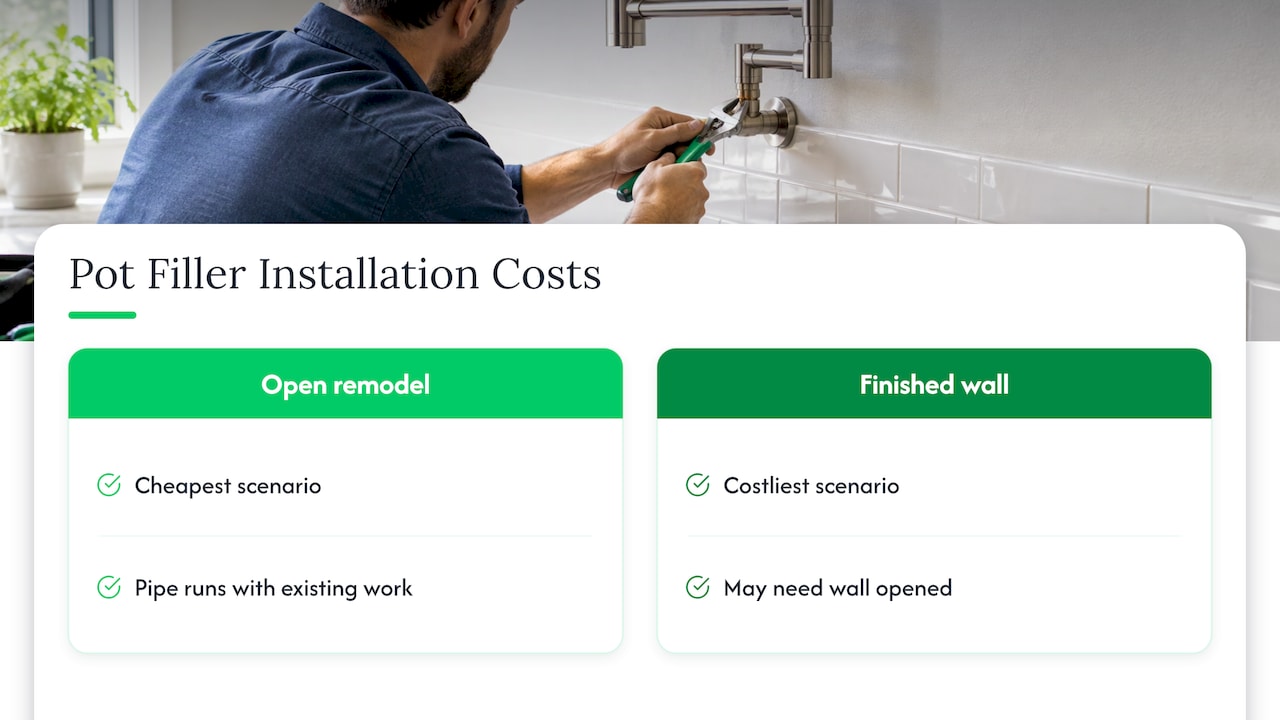
The price has two parts: the faucet, and the plumbing to feed it. The faucet is the easy part to shop for. The plumbing depends entirely on your house: how far the nearest cold line is, what is in the wall, and how much has to be opened. A wall that is already open for a remodel is the cheapest scenario, because the pipe is run alongside work that is already happening. A finished wall is the costliest.
Because those conditions differ from house to house, we do not quote a pot filler as a standalone number. In a remodel we would put it in the full kitchen scope so you can see it next to cabinets, counters, flooring and lighting and decide where your budget does the most for you.
Pot filler or not: how to decide
Here is a plain way to decide.
| Your situation | A pot filler fits well when… |
|---|---|
| Full kitchen remodel, walls open | You cook with big pots, host often, or want the convenience built in |
| Cooktop far from the sink, such as an island range | The walk with a full pot is long |
| Cooking for a large family | Boiling water is a daily task |
| Small kitchen, sink beside the range | You may prefer to put the budget into storage, counters or lighting |
| Finished kitchen, no remodel planned | You are prepared to open the wall for a supply line |
Home Beautiful’s 2026 take is that the usefulness is subjective, and it may be better to spend on something else in a small kitchen, where the sink is already easy to reach, or on a tight budget. That fits what the table shows: the feature rewards the cook who uses it and the kitchen that has the room for it. If your kitchen is compact, our ideas for small kitchen storage show where the same budget can go.
A few other points to weigh:
- Resale appeal. A pot filler reads as a high-end touch. Buyers who cook tend to notice it, though it is the overall quality of the kitchen that carries value.
- Style. Choose a finish that matches the sink faucet and the rest of the hardware.
- Upkeep. Wipe the arm down like any other fixture and check the joints now and then.
- Schedule. Plumbing rough-in happens early in a remodel. Our kitchen remodel timeline shows when the decisions fall, so you can settle this one in time.
Planning a pot filler into a kitchen remodel
If you are leaning yes, this is the order that keeps it simple:
- Choose the range or cooktop and hood first. Their size and position decide how much wall you have.
- Decide the faucet location and height. Start from the 12 to 18 inch range and check it against your tallest pot.
- Map the supply line. Confirm the route before cabinets and drywall.
- Add blocking and an access panel where you can. These cost little during framing and save trouble later.
- Match the finish. Coordinate with sink faucet, hardware and lighting.
- Confirm local code. Your township and plumber set the final requirements.
Our view: what we would tell a friend
We think the best question is not whether a pot filler is worth it in general, but whether it is worth it in your kitchen. Some homeowners use theirs every day and would never give it up. Others cook quick meals beside a sink and would rather spend on cabinets, storage or lighting.
What we care about is that you make the decision with the full picture, before the walls are closed. Our approach is personalized: we start with how you cook, how many people you cook for and what bothers you in your current kitchen, then give honest recommendations that fit your home and your budget.
Because we manage a project from consultation through completion, details like a supply line, blocking and where an access panel could go can be considered alongside everything else in the kitchen, and the job site stays clean and safe while it happens. That is how convenient features end up looking and working as if they were always part of the house.
Jeff
Planning a kitchen in Bucks County?
JAG Home Enhancements is a home remodeling company in Bucks County, PA. Our kitchen remodeling work covers the whole room, from layout and cabinets to flooring, and we guide you from the first consultation through completion. If you are thinking about a pot filler, bring it up early so it can be planned with the range, hood and walls.
See our kitchen and bathroom remodeling services to start the conversation, or read more about kitchen remodeling in Bucks County.
FAQ
What is a pot filler used for?
It supplies cold water right at the stove, so you can fill a pot on the burner instead of carrying it from the sink. Many people also use it for kettles, vases and pet bowls. Most models today have a swing arm that reaches different burners.
How high should a pot filler be above the stove?
A typical height is 12 to 18 inches above the cooking surface, according to Sub-Zero, Wolf and Cove, which also says to follow local code. Check the final position against your tallest pot and your hood before the plumber sets the rough-in.
Are pot fillers worth the money?
They are worth it if you often cook with large pots, such as pasta, stock or canning batches, and best of all when the wall is already open for a remodel. In a compact kitchen where the sink is next to the range, you may get more from other upgrades.
Can I add a pot filler to a finished kitchen?
Yes, but a supply line has to reach the cooktop wall, which usually means opening the wall and repairing it afterward. That is why designers recommend adding one while you are already renovating.
Sources
- What Is a Pot Filler Over a Stove? (The Spruce)
- Pot Filler Placement FAQ (Sub-Zero, Wolf, and Cove)
- What Is a Pot Filler and Do You Need One? (Martha Stewart)
- Are Pot Fillers Worth It? Mine Gets Used Every Day (Kristine Krupa Interiors)
- Pot filler tap: are they worth it? (Home Beautiful)
- Prävention bei Rohrsystemen