

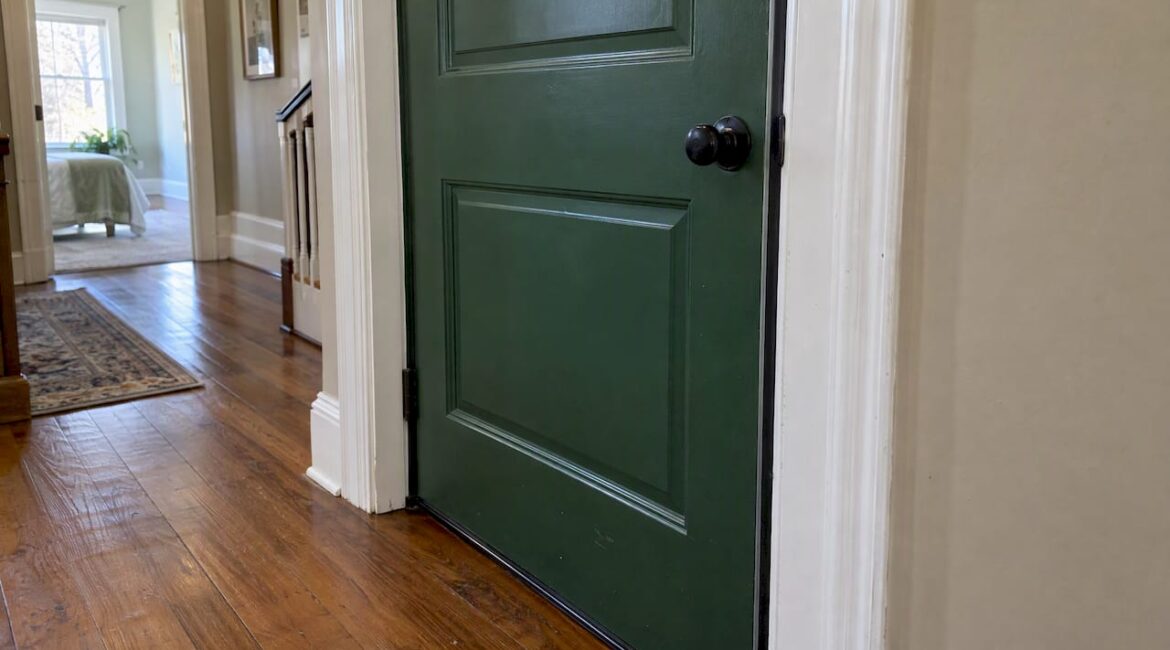
The quickest way to get a quieter interior door is to fix two things: the weight of the door and the gaps around it. A hollow-core door with a gap under it will leak sound no matter what you hang on it. A heavy solid-core door, sealed on all four sides, can make a real difference for a bedroom, home office or nursery.
We remodel homes across Bucks County and Montgomery County, and noisy doors come up often in kitchen, basement and addition projects. This guide explains what to buy, what to seal, what it costs, and where the limits are, so you can spend money in the right order.
TL;DR
- Replace hollow-core doors with solid-core doors. Hollow-core doors give minimal sound insulation, while solid-core doors are much better.
- Seal the gaps. Sound travels through any opening air can pass through, so jamb seals and a bottom seal matter as much as the door slab.
- Foam panels do not help. They tame echo inside a room but do little to stop sound passing through a door.
- A door is only part of the wall. Gaps around the frame, shared ducts and thin walls can limit the result.
- A solid-core door plus seals is usually the best value upgrade. Budget roughly $600 to $1,450 installed, depending on the door and the seal kit.
Table of Contents
- Why interior doors leak so much sound
- Solid-core vs. hollow-core doors for sound
- Door seals: the part that decides the result
- Other tricks that do and do not help
- What the rest of the room can do to your results
- What soundproofing an interior door costs
- Where we come in
- Our perspective on quiet doors
- Frequently asked questions
- Sources
Why interior doors leak so much sound
Most interior doors in American homes are light. A thin veneer or molded skin sits over a honeycomb or cardboard structure, and the door hangs in a frame with a visible gap at the bottom. This Old House describes hollow-core doors as offering minimal sound insulation and being best suited to places like closets, where privacy is not a priority.
Sound reaches the next room in two ways. It passes through the door itself, and it slips through the gaps around it. This Old House points to interior doors as weak points in a room’s sound insulation for exactly that reason.
So the fix has two parts, and one without the other disappoints. Add mass to the door, and seal what is left. Acoustic specialists describe the same two components: mass in the door and sealed gaps around the frame.
One caution about expectations. You are making a door quieter, not silent. Voices and TV dialogue become muffled and harder to follow. Bass, music and shouting are harder to stop, and no ordinary residential door will block them completely.
Solid-core vs. hollow-core doors for sound
This is the biggest single upgrade, and it is also the question many homeowners search for directly.
A solid-core door has a core of compressed sawdust and resins. According to This Old House, that gives it real heft and significantly better sound insulation than a hollow-core door. One acoustic supplier estimates that swapping a hollow-core door for a solid-core model can add up to 10 to 15 STC points. STC, or Sound Transmission Class, is the rating used for how well a building element blocks airborne sound. A higher number means less sound gets through.
| Feature | Hollow-core | Solid-core |
|---|---|---|
| Inside the door | Honeycomb or cardboard structure | Compressed sawdust and resins, or similar dense core |
| Weight | Light | Heavy |
| Sound blocking | Minimal | Significantly better |
| Best for | Closets, rooms where privacy is not a concern | Bedrooms, offices, nurseries, media rooms, bathrooms |
| Feel | Hollow knock, easy to slam | Solid knock, a quiet, substantial close |
What to look for in the door itself
Not every solid-core door is equal. A few details from acoustic guidance are worth checking before you buy:
- Thickness. The Soundproofing Company’s installation manual recommends a 1¾-inch solid-core slab over a 1⅜-inch slab and advises avoiding hollow-core doors. Many interior doors are 1⅜ inches thick, so check the slab size and whether your existing frame can take the thicker door.
- Dense core material. The same manual points to high-mass materials such as MDF, particleboard or mineral-filled cores.
- A smooth face. Recessed panels can create thin, weak spots, so a flat slab usually outperforms a deeply paneled style of the same thickness.
If you love the look of a paneled door, you can still choose one. Just know that a flat slab is the safer pick if quiet is the main goal.
A note on weight and hinges
A solid-core door can weigh several times what a hollow door does. Check that the hinges are screwed into the framing with long screws, not just the thin jamb. A heavy door on weak hinges will sag, rub and open a new gap, which defeats the purpose. This is a small detail that gets missed on quick swaps.
Door seals: the part that decides the result
The door seals question gets far more searches than the door type, and for good reason. Gaps are where a good door gets beaten. One manufacturer’s guide says that a 1% gap around the perimeter can reduce a door’s overall sound-blocking effectiveness by up to 50%. Treat that as a company’s figure rather than a lab rule, but the direction is right. The rule of thumb is simple. If air can pass through a gap, so can noise. This Old House general contractor Tom Silva makes the same point by comparing a door to a refrigerator.
The bottom gap first
The bottom of the door is usually the biggest leak. TM Soundproofing’s guide says the largest leakage path is commonly the bottom gap and recommends an automatic door bottom. This is a seal that lowers when the door closes and retracts as it opens, so it does not drag on the floor.
The Soundproofing Company’s manual adds that an automatic door bottom seals against a hard surface, which matters if you have thick carpet or a rug under the door. A simple sweep is cheaper and works on a level floor, but it can wear and snag.
The sides and the top
Acoustic door stops, which mount on the jamb, seal three sides of the door. A complete seal kit typically combines jamb seals, an automatic door bottom and a threshold to close all four sides.
For a lighter fix, adhesive-backed weatherstripping along the jamb helps. Rubber gaskets are another option. This Old House describes them as compressible frame seals that can block air, water and sound, installed along the bottom, sides and header. Compression is the key idea: the seal must press firmly when the door closes, but not so hard that the latch will not catch.
Do not forget the gap behind the trim
The gap between the door jamb and the rough framing is a second leak path. This Old House says to seal that gap, and describes expanding polyurethane foam behind the trim as one way to do it. It also warns that overfilling can bow the jamb and throw off the door’s alignment. An old EPA guide on home noise likewise says sound can bypass a door through gaps under it, at double-door meeting edges or between the jamb and drywall, and that frame gaps should be filled with acoustical caulk or non-expanding foam.
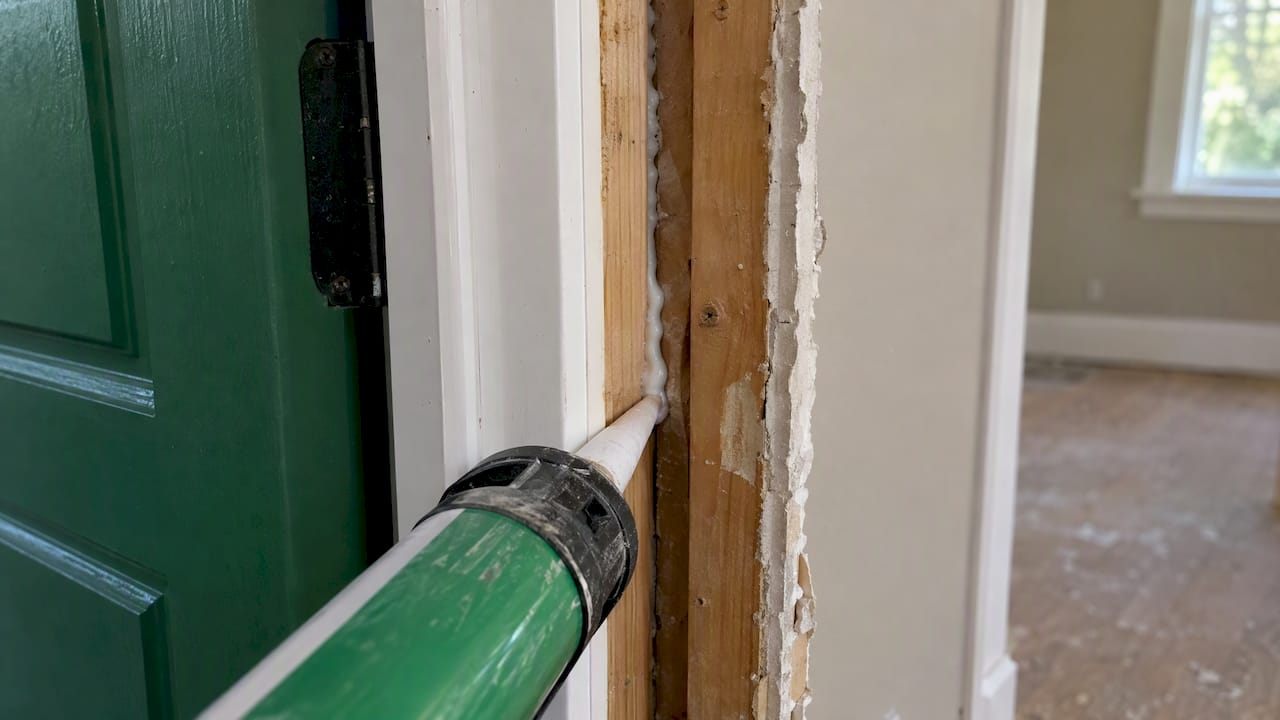
Non-expanding foam or acoustical caulk is the forgiving choice if you are not removing trim every day. This step is easiest when the casing is already off, such as during a bathroom, basement or kitchen remodel.
One trade-off: return air
If the room has a heating or cooling supply but no return, a tightly sealed door can trap air and pressurize the room. The U.S. Department of Energy’s Building America guidance says undercutting doors can form part of the return-air path, but that wall transfer grilles or jump ducts should be installed instead, and that bedroom door undercuts rarely work and should not be relied upon. In plain terms, if you seal a bedroom door tightly, ask your HVAC contractor how air will get back to the system. Do not leave the gap open as the plan.
Other tricks that do and do not help
Adding mass to an existing door. You can screw an extra layer of dense board to a hollow door, but a solid-core replacement is usually cleaner, lighter on the hinges and looks better. Heavy, bonded layers work better than thin ones.
Acoustic foam. Skip it for this job. It absorbs echo inside a room, but does almost nothing to stop sound passing through a door.
Perimeter frames. For a more complete upgrade, you can screw an aluminum frame with a gasket around the door’s perimeter. It works, but it is more visible and is better for a home studio than a hallway.
Heavy curtains or door blankets. They are a stopgap for renters. They are not a substitute for a sealed solid door.
What the rest of the room can do to your results
A door can only do so much. An old rule of thumb says that a door should be within about 10 STC points of the wall around it. If the door is far better than the wall, you have spent money on a door that the wall will undercut. If the wall is a thin partition with hollow cavities, a good door will help, but you will still hear most of what you hear now.
Sound also travels through shared routes, which the EPA guide calls flanking paths: gaps at the frame, ducts, outlets and the like. If a quiet room is the goal, it is worth walking around the room and asking where else air could pass. Check these:
- Supply and return vents shared with the hallway
- Gaps around the door casing
- Recessed lights and outlets on the shared wall
- A hollow wall with no insulation
For basements and media rooms, the ceiling matters as much as the door. Our guide to basement ceiling insulation explains when insulating that ceiling pays off and when it does not.
What soundproofing an interior door costs
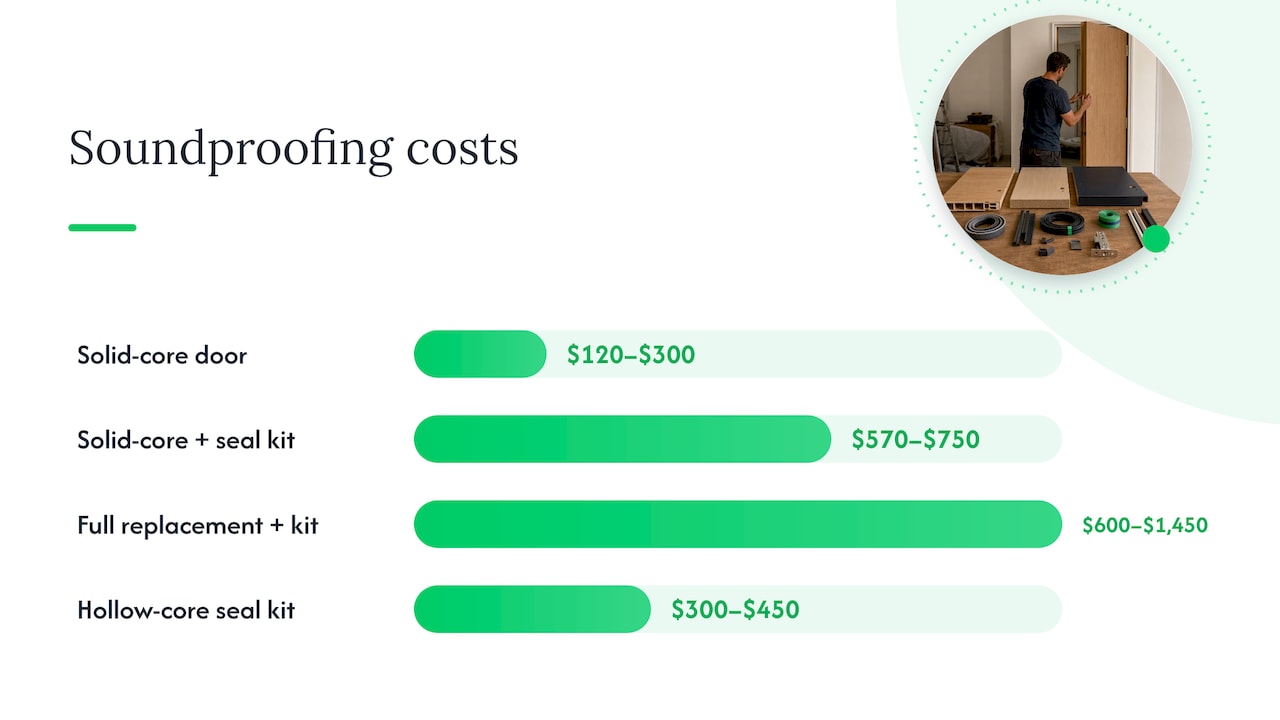
Prices vary with door size, finish and the installer, and we do not publish a fixed price for door work because each opening is different. For a rough sense of scale, a 2024 cost guide from a soundproofing supplier lists a solid-core door at $120 to $300, a solid-core door with a seal kit at $570 to $750, and full replacement with a solid-core door and seal kit at $600 to $1,450. The same guide puts a seal kit for an existing hollow-core door at $300 to $450, depending on the kit.
Those figures are a ballpark, and they come from 2024, so expect today’s prices to differ. Here is how the options compare in practice:
| Option | What you get | Best when |
|---|---|---|
| Seal only (sweep, jamb seals) | Closes air gaps, small improvement | Door is already solid, or the budget is tight |
| Solid-core door only | More mass, gaps remain | You plan to add seals later |
| Solid-core door plus seals | Best balance of cost and results | Bedrooms, offices, nurseries |
| Upgraded door system with frame | Highest performance | Home studios, theaters |
If you are getting several rooms done, doing them in one visit usually costs less than separate trips, and it keeps trim, paint and flooring consistent.
Where we come in
If you want the work done cleanly, we can help as part of a larger project or on its own. We handle window and entry door installation, trim work and custom mill work for homeowners in Bucks County and Montgomery County, and small repair jobs as well as large ones. That includes the fiddly parts of a quiet door: squaring the opening, supporting heavy hinges, sealing around the frame and finishing the trim so it looks right.
Quiet is also a good thing to plan into a bigger job. If you are finishing a basement or adding a bedroom, a basement remodel or home addition is the cheapest moment to get doors, walls and framing right together.
To talk through your doors, start at JAG Home Enhancements and tell us which rooms you want quieter. We will give you an honest recommendation, even if the answer is a sweep and a weekend rather than a new door.
Our perspective on quiet doors
We see the same mistake again and again. A homeowner buys a nice solid door, hangs it, and is disappointed because the gap at the bottom and the loose casing were left alone. The reverse also happens: a person tapes weatherstripping on a hollow door and expects a quiet bedroom.
Our advice is to start with the problem, not the product. Ask what you are trying to block. Conversation in the next room needs mass and seals. A teenager’s bass or a home theater needs more than a door, probably a wall and ceiling plan as well. A home office needs privacy mostly for speech, and a solid-core door with good seals does that well.
We also think in terms of the whole opening. A clean job site and a straightforward conversation matter to us, and so does getting the details right: hinges that hold, a jamb that is plumb, a seal that compresses evenly and a latch that still clicks. These small things decide whether a quiet door stays quiet five years from now.
If the numbers do not justify a new door, we will say so. Sealing an existing solid door is often the smarter spend.
— Jeff
Frequently asked questions
Are solid-core doors really quieter than hollow-core doors?
Yes. A solid-core door has a dense core of compressed sawdust and resins, which gives it more mass and significantly better sound insulation than a hollow door. One supplier estimates a gain of 10 to 15 STC points. You still need seals to get the full benefit.
Do door seals make a big difference?
Usually, yes, especially at the bottom of the door, which is commonly the largest leak. Seals on the sides and top finish the job. Sound follows air, so even a thin gap can undo a heavy door.
Can I make my existing door more soundproof without replacing it?
If the door is already solid-core, yes. Add an automatic door bottom or sweep, seal the jamb with weatherstripping or gaskets, and fill the gap behind the trim. If it is hollow-core, you can seal it, but you will get a smaller improvement than with a new solid door.
Can a room be 100% soundproof?
Not with an ordinary home door. Sound also moves through walls, ceilings, ducts and the frame, so a door only improves one part of the path. The realistic goal is to cut speech and everyday noise a lot, so that you hear muffled sound instead of clear words.
Sources
- A Guide to Soundproofing a Room from Floor to Ceiling, This Old House
- Inside Interior Doors: A Comprehensive Guide, This Old House
- How to Install Solid Core Doors, This Old House
- DIY Ways To Soundproof a Door, This Old House
- How to Weatherstrip an Exterior Door, This Old House
- How to Soundproof a Door: 7 Proven Methods That Work
- Doors and Backer Box Soundproofing Installation Manual, The Soundproofing Company
- How to Soundproof a Door, TM Soundproofing
- BSC Information Sheet 604: Transfer Ducts and Grilles, U.S. Department of Energy
- Quieting in the Home, U.S. EPA
- What is the Cost of Soundproofing a Door, Second Skin Audio