
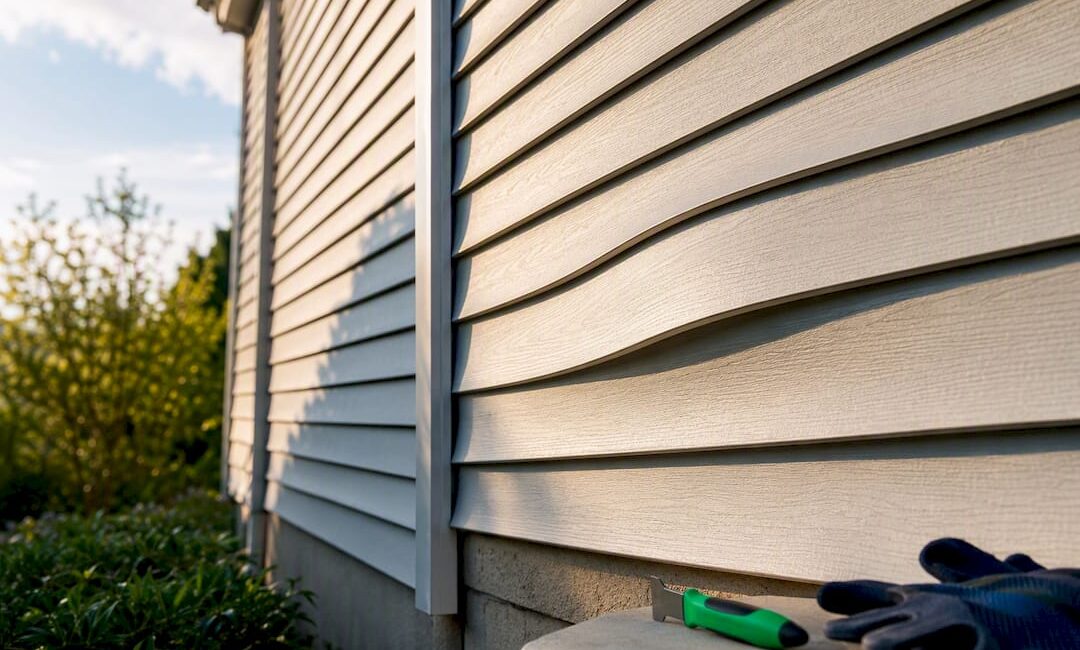
Yes, vinyl siding can warp, and it happens more often than most homeowners expect. Most cases trace to restricted thermal movement, meaning nails driven too tight or panel ends locked with no room to expand, or to concentrated heat bouncing off windows and dark surfaces nearby. Before you assume you need a full replacement, check the nail line and panel ends, then watch whether the distortion changes as the sun moves across that wall.
TL;DR:
- Most warping results from restricted thermal movement caused by tight nails, locked panel ends, or heat reflection from nearby surfaces, not just sun exposure.
- Proper diagnosis involves inspecting nail tightness, panel ends, and observing temperature-related changes, with permanent distortions indicating the need for full panel replacement.
- Repairing buckled panels often involves releasing fasteners, re-nailing with appropriate gaps, and working during cooler times to avoid stretching panels.
- Preventive measures include leaving proper gaps during installation, centering nails, choosing heat-safe colors, and adding shade to reduce reflected heat.
- When damage is severe or recurring despite repairs, replacement is recommended, and professional assessment ensures accurate root cause diagnosis and correct installation practices.
Table of Contents
- What Causes Vinyl Siding Warping?
- How Do You Know If Your Siding Has Warping Damage?
- How Do You Fix Warped Vinyl Siding Yourself?
- How Do You Prevent Vinyl Siding From Warping?
- When Should You Replace Siding Instead of Repairing It?
- What Do Homeowners Get Wrong About Warped Siding Most Often?
- Get a Professional Siding Assessment From JAG Home Enhancements
- Sources
What Causes Vinyl Siding Warping?
Vinyl panels are made to move. As they heat up and cool down, they expand and contract along their length, and every installation detail exists to give them room to do that. When something blocks that movement, the panel has nowhere to go but out of shape.
Heat is the biggest trigger. Cardinal Glass Industries documented visible siding distortion after just one hour of exposure near 165°F, with heat deflection temperatures for common vinyl formulations ranging from 142°F to 192°F and averaging around 166°F. Direct sun rarely reaches that on its own. Reflected heat does. A nearby window, a dark-colored shed roof, or a sunroom addition can bounce enough radiant energy back onto a wall to roughly double the effective solar load hitting that section of siding.
Certain spots on a house act like heat traps:
- Inside corners where two walls meet and reflect sun onto each other
- Alcoves and recessed entryways that hold heat with little airflow
- Walls facing low-E or reflective replacement windows
- Areas near dark asphalt shingles, black shutters, or metal roofing
Installation mistakes cause just as much trouble as the sun does. CertainTeed’s installation guidelines call for centering fasteners in the nailing slot and leaving 1/32 to 1/16 inch of clearance under every nail head. Nail it tight, and you’ve pinned a panel that’s supposed to slide. Locked corners and missing end gaps at J-channel or corner posts create the same problem: the panel expands, hits a hard stop, and buckles.
Moisture plays a smaller but real role, usually by warping the substrate or trim behind the panel rather than the vinyl itself. And repainting siding in a color darker than the original is a self-inflicted cause. Sherwin-Williams warns that darker pigments absorb more heat, and recommends sticking with VinylSafe colors or nothing darker than the factory shade.
How Do You Know If Your Siding Has Warping Damage?
Diagnosing warped siding takes about ten minutes and a good eye for angles. Work through it in this order:
- Sight down the wall. Stand at one end and look along the panel run at a low angle. Waviness that’s invisible head-on often jumps out from the side.
- Repeat the check at a different time of day. If the distortion is worse in the afternoon and eases by evening, heat is almost certainly the driver.
- Inspect the nail line. Look for nail heads sitting flush or pulled tight against the panel instead of resting loosely in the slot.
- Check the panel ends. See whether they’re jammed into the J-channel or corner post with no visible gap.
- Note what’s facing that wall. A nearby window, dark roof, or reflective surface points straight to reflected heat as the cause.
Once you’ve gathered those observations, sort the damage into one of three categories. Mild rippling that shifts with temperature is often just oil-canning, a cosmetic wave that doesn’t compromise the panel. A buckle that holds its shape even after the wall cools is usually repairable. Cracked, split, or permanently bent panels have crossed into structural territory and need replacement.
Pro Tip: Take photos of any warped section in both morning and afternoon light. Field diagnostics from InspectApedia show that documenting the sun’s angle relative to the damage is often the deciding factor in whether a manufacturer or contractor accepts it as an installation defect versus reflected-heat exposure.
How Do You Fix Warped Vinyl Siding Yourself?
Most repairable warping comes from one fixable problem: the panel can’t move because something is holding it too tight. Before you touch a hammer, pick a cool morning or evening. Working on siding above roughly 80°F risks stretching a panel that’s already expanded, and it’ll look wrong once it cools and contracts back.
Tools and materials you’ll need:
- Zip tool (siding unlock tool)
- Flat bar or panel puller
- Hammer and aluminum or galvanized siding nails
- Replacement panel matched to your existing profile and color, if needed
- Utility knife and tape measure
Release-and-rehang steps for a buckled but intact panel:
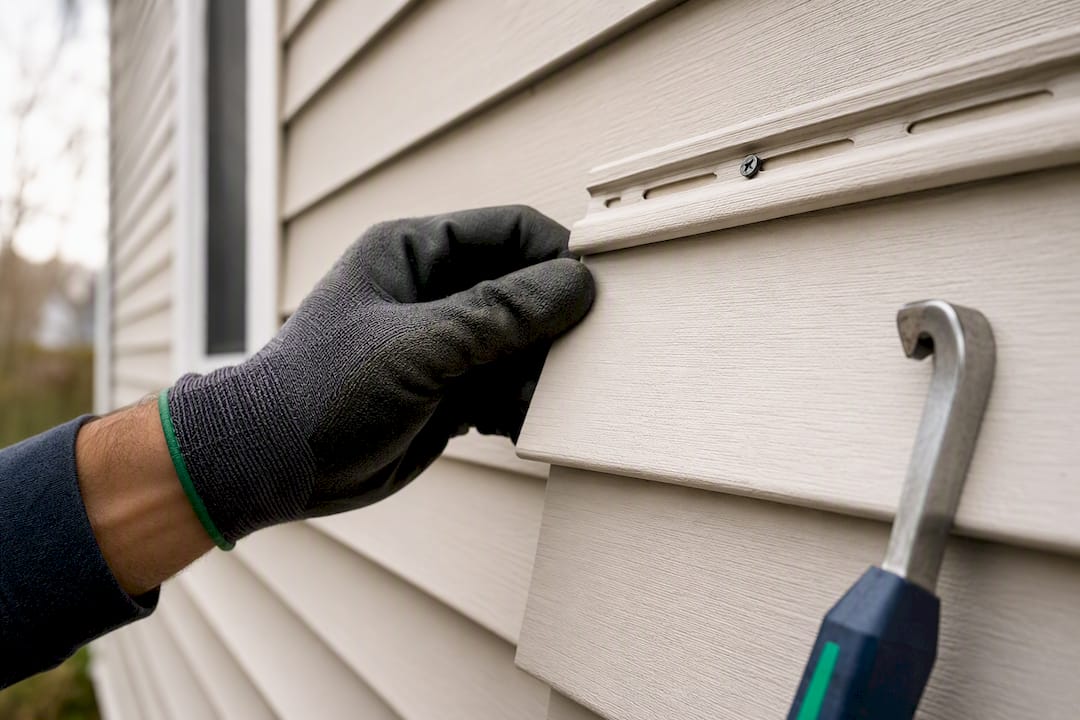
- Slide the zip tool along the bottom lock of the panel above the affected one to unhook it.
- Lift the panel free and pull the nails holding the warped section.
- Re-nail it with fasteners centered in the slot, leaving 1/32 to 1/16 inch of clearance under each head, per Lowe’s installation guidance.
- Confirm the panel ends have a gap at the J-channel: 1/4 inch if it’s above 40°F outside, 3/8 inch if it’s colder.
- Re-hook the panel above it back into place and check for even movement side to side.
For small punctures or minor gouges rather than full buckling, DAP’s repair guidance recommends a vinyl-compatible filler, sanded first with 100-grit and finished with 220-grit for a smooth match. If a panel is cracked, split, or has a permanent bend that doesn’t relax once released, skip the patch and replace the panel outright. Trying to save a structurally compromised section usually just buys you a second repair later.
One thing worth remembering: a large share of buckling that looks like it needs replacement is really just a fastener problem. Releasing the lock and re-nailing correctly often saves the panel entirely.
How Do You Prevent Vinyl Siding From Warping?
Prevention comes down to giving every panel room to breathe, and the numbers matter more than the general idea.
- Leave a small clearance under every nail head to allow for panel movement. Snug, never tight.
- Center each nail in its slot to permit panel expansion and contraction.
- Leave a 1/4 inch gap where panels meet J-channel or corner posts when installing above 40°F, and 3/8 inch below 40°F, following CertainTeed’s and Georgia-Pacific’s published tolerances.
- Overlap panels according to the manufacturer’s spec, and confirm housewrap or a weather-resistant barrier is installed underneath before siding goes up.
- Choose VinylSafe colors or match the original shade if repainting, rather than going darker.
- Where possible, add shade or shift heat sources: trim back reflective landscaping elements, or reconsider dark roofing and window film near vulnerable walls. For expert guidance on matching your siding with the perfect color, check out the best color to paint interior doors.
Pro Tip: If you’re rethinking your siding color choices, run the shade past a VinylSafe chart first. A color that looks perfect on a swatch can push a wall well past its safe heat threshold once it’s installed. A proper house wrap installation underneath also protects against the moisture-related warping that shows up independent of heat.
Walk the exterior once a season, especially after a stretch of intense heat, and you’ll catch small movement problems before they become buckled panels.
When Should You Replace Siding Instead of Repairing It?
Repair makes sense when the panel is intact and the distortion traces to a fixable cause. Replacement becomes the better call once a panel is cracked, permanently bent, or when the same section keeps warping no matter how many times you re-nail it. If you’re replacing panels, order a few extras. Vinyl color runs vary by manufacturing batch, and matching a decade-old panel to new stock is nearly impossible otherwise.
Check your warranty before assuming it covers the damage. Many manufacturer warranties exclude damage from reflected heat, treating it as an environmental condition rather than a product defect. Photograph the affected wall at different times of day, showing the sun or reflection pattern, before filing any claim.
If you’re bringing in help, a qualified contractor should do more than swap panels. Expect them to:
- Diagnose the actual cause, not just replace what’s visibly damaged
- Install to manufacturer nailing and gap tolerances, not “tight for a clean look”
- Give you a clear written scope, timeline, and material list before starting
Ask directly: “What’s causing this, and how will your installation prevent it from happening again?” A vague answer, or one focused only on cosmetics, is a red flag.
What Do Homeowners Get Wrong About Warped Siding Most Often?
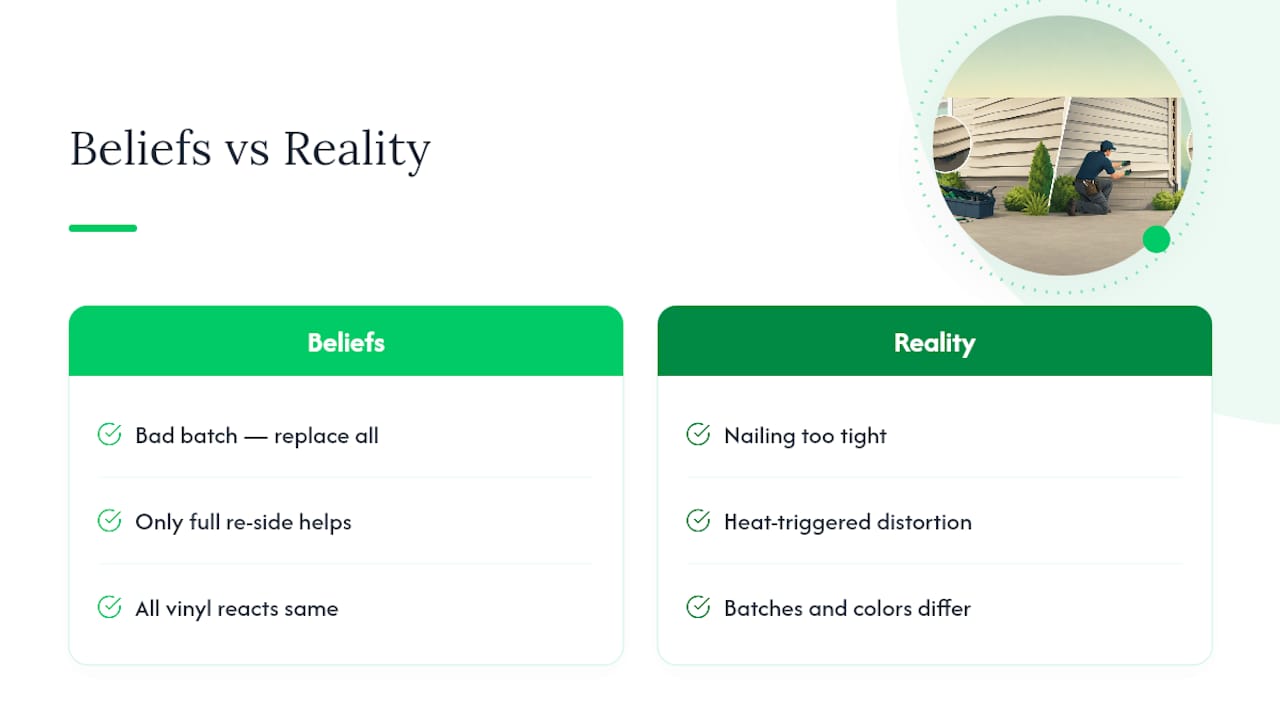
Homeowners jump to two wrong conclusions. Either they blame a “bad batch” of siding and want everything replaced, or they assume nothing can be done short of a full re-side. In practice, most of what we see on job sites in Bucks County is a nailing problem hiding behind a heat problem. Someone installed the siding a little too tight to get rid of a visible wave, and it looked fine until the first real heat wave hit.
The other misconception is that all vinyl performs the same in the sun. It doesn’t. Manufacturing batches and color formulations carry different “frozen-in” molecular strains from the extrusion process, so two siding runs exposed to identical heat can react differently. That’s not an excuse to skip a diagnosis. It’s a reason to get one.
— Jeff
Get a Professional Siding Assessment From JAG Home Enhancements
If you’ve checked the nail line, watched the wall through an afternoon, and you’re still staring at a warped panel with no clear cause, that’s exactly where a professional assessment earns its cost back. Jaghomesnow’s exterior renovations team diagnoses the actual root cause, whether it’s reflected heat, an installation error, or a substrate issue, before recommending repair or replacement.
An estimate can include a walk-through of the affected wall, a clear explanation of what’s driving the distortion, and manufacturer-aligned installation practices on any repair or replacement work, including correct nail clearance, end gaps, and color guidance if you’re considering a change. Timelines depend on scope, but you’ll get a written plan before any work starts, not a verbal guess. If you want a second opinion on a wall that keeps buckling no matter what you try, request a siding assessment to get a clear answer on whether repair or replacement is the better option.
Sources
- Cardinal Glass Industries — IG14 bulletin on vinyl siding distortion
- CertainTeed — how to install vinyl siding
- DAP — how to repair vinyl siding without replacing panels