
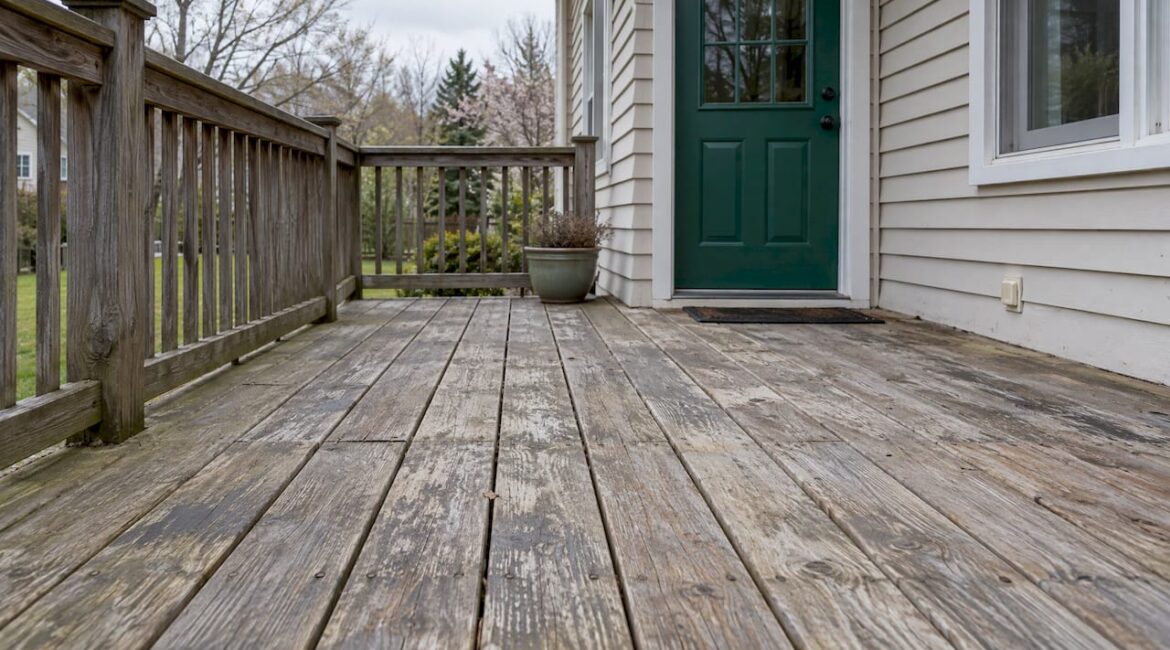
To resurface an old deck, first confirm the frame underneath is sound. Then pick the surface that fits the deck’s condition: clean and refinish it, roll on a thick coating, replace the boards, or switch to composite. A solid frame can carry almost any of these. A weak frame needs repair before any of them is worth the money.
We build, repair and rebuild decks in Bucks County, so this is the order we follow when a homeowner asks us what to do with a gray, splintery deck. The sections below walk through that order, with the steps for each option.
TL;DR
- Inspect the posts, beams, joists, ledger and fasteners first. Soft wood, sagging joists or a ledger pulling from the house means repair or replacement, not a new surface.
- Sound wood in decent shape usually needs only cleaning, light sanding and a fresh stain or sealer. Plan to repeat it every few years.
- A thick resurfacing coating can hide cracks and splinters up to 1/4 inch on a solid deck, but it will not fix rot or loose boards.
- New wood boards or composite decking give the longest-lasting surface, as long as the joists are level and properly spaced.
- Decks built before 2004 may contain CCA-treated lumber. Handle old finish removal on those with extra care.
Table of Contents
- Check the frame before you choose a surface
- Your resurfacing options and when each one fits
- Repairs to make before any new surface
- How to refinish a sound wood deck, step by step
- Keeping a refinished deck looking good
- Safety: cleaning, sanding and old lumber
- Perspective: what we tell homeowners
- Permits and code when you change more than the finish
- When to bring in a deck builder
- FAQ
- Sources
Check the frame before you choose a surface
A new finish only changes what you see and walk on. It does nothing for the structure holding you up, so the inspection comes first.
Walk the deck and look underneath. You are checking the posts, beams, joists and the ledger, which is the board that connects the deck to your house. Poke any suspicious spot with a screwdriver. Wood that lets the tool sink in easily is rotted. Sagging joists or wobbly posts mean the frame needs work. Lumber Plus describes the same signs, along with rusted or loose fasteners.
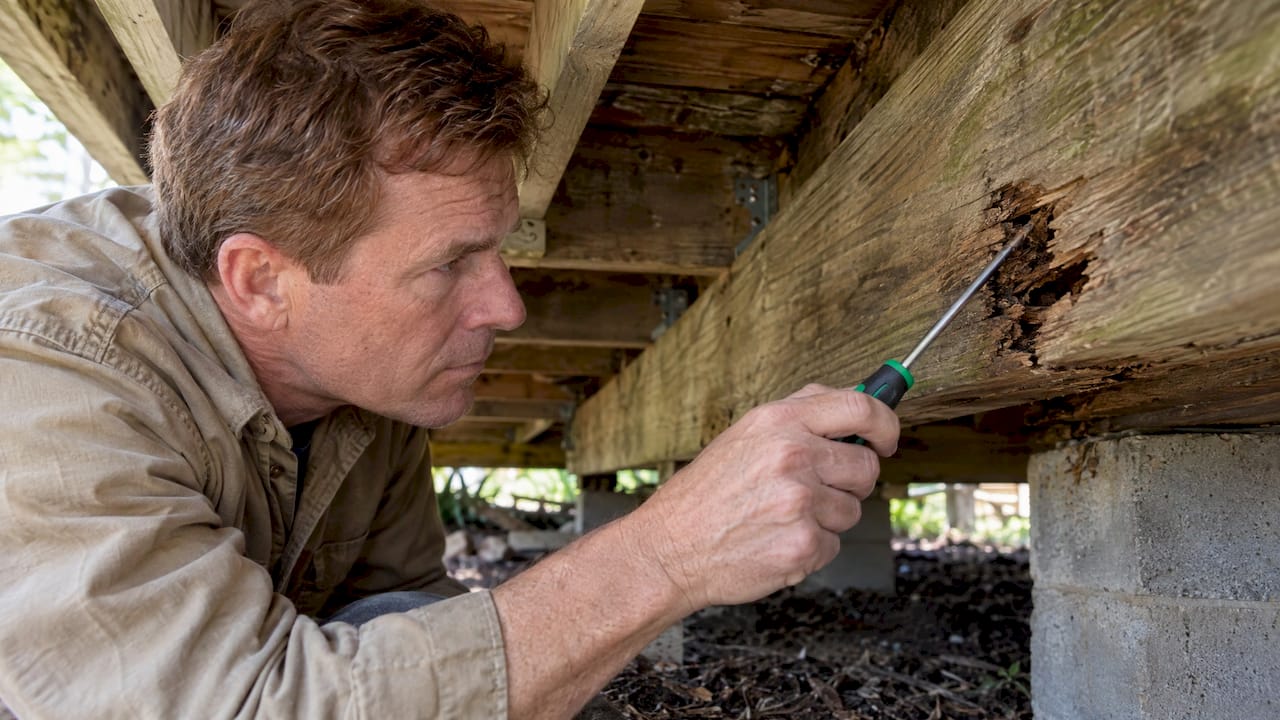
Pay special attention to the house connection. The deck should be fastened to the house with stainless or galvanized lag screws and through bolts, not nails that can pop out. A ledger board pulling away from the house is a reason for full replacement, according to TimberTech’s guidance on when a deck needs replacing. The same page lists pervasive rot in the substructure and many rusted or loose screws as other signs.
If only the surface boards are damaged by moisture, with rot, warping or splitting limited to the top, replacing those boards while keeping the original substructure is a sensible path. Bob Vila’s editors make the same point about coatings: there is no fix for an unsafe or compromised deck, so rot or severe warping means replacing the surface rather than coating it.
Two of our own guides cover the most common frame problems:
- How to stop a sagging deck from returning, including a probe test and slow jacking.
- Our 25% rule for rotted deck post repair, which helps you decide between repairing and replacing a post.
A quick read on your deck
| What you find | What it usually means |
|---|---|
| Gray, rough boards, solid when probed | Clean, sand and refinish |
| Cracks and splinters, frame solid | Refinish, or a thick coating for light damage |
| A few soft or split boards, joists sound | Replace those boards, then refinish or recoat |
| Many soft boards, tired surface everywhere | New decking over the existing frame |
| Sagging, wobbly posts, ledger pulling away | Structural repair or rebuild first |
Your resurfacing options and when each one fits
Most old decks fall into one of four routes. Home Depot’s refinishing guide breaks the first two apart: refinish with stain or sealant after cleaning and prep, or use a thick coating to conceal surface damage that sanding cannot remove.
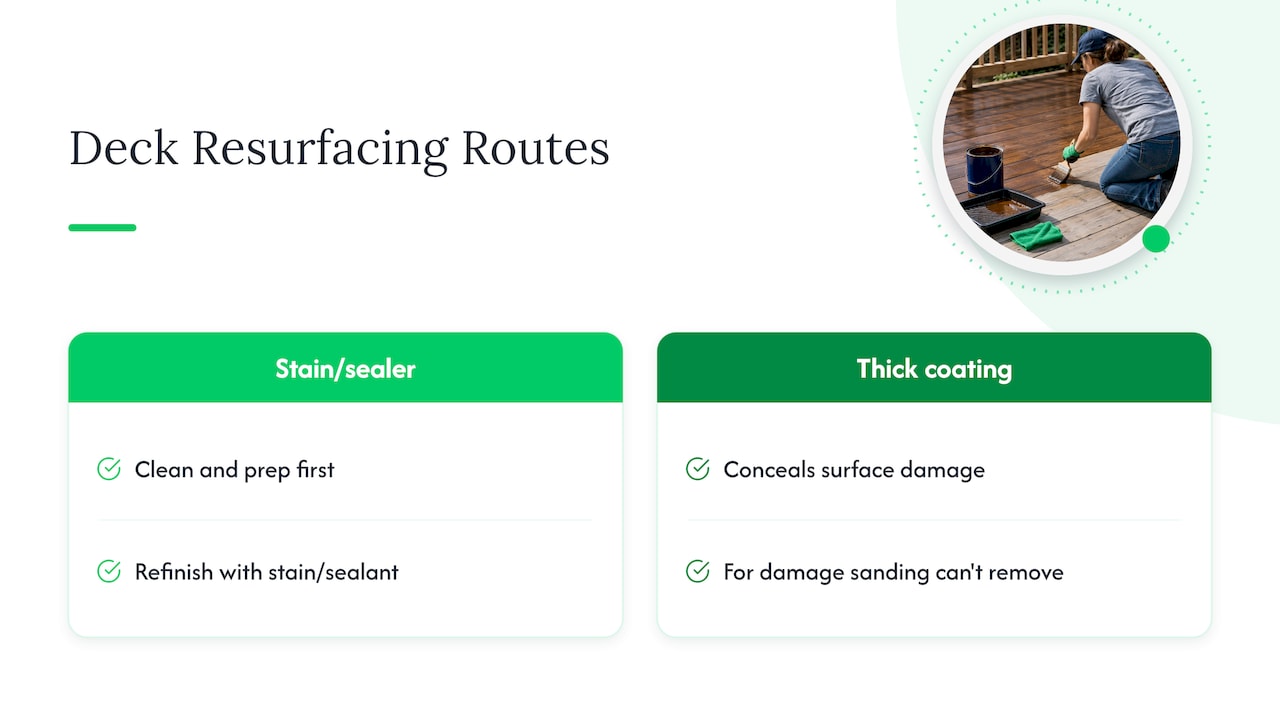
Option 1: Clean and refinish with stain or sealer
This is the right call when the boards are solid and the problem is weathering. A simple water test helps. If water beads on the surface, the wood is still sealed and may only need cleaning. If it soaks in, the wood is dry and will benefit from sealing.
The trade-off is upkeep. Film-forming finishes and stains need renewing as the deck weathers, so a refinished deck rewards a regular schedule. Our seasonal deck maintenance checklist helps you plan it.
Option 2: A thick resurfacing coating
These products are rolled or brushed on like a heavy paint. They suit a structurally solid deck with cracks, splinters and a worn surface that sanding will not fix. One manufacturer’s data sheet says its product covers properly prepared wood, composite and concrete, and conceals cracks and splinters up to 1/4 inch. It is not for drivable surfaces such as driveways.
Coatings are best seen as a way to extend a sound deck’s life for some years, not as a permanent fix. Deeper damage needs repair first, covered below.
Option 3: Replace the deck boards
When many boards are soft, cupped or splitting but the joists are healthy, new boards on the existing frame make a real difference. Pressure-treated lumber is the budget choice. Cedar and other premium woods cost more and give a richer look. All of them need sealing and periodic care.
Option 4: Composite or PVC decking over a sound frame
Composite offers the lowest upkeep, with no sanding or staining cycle. It has one firm requirement. Composite overlay works only if the joists are level and spaced correctly for the new material. That is why we measure the frame before recommending it. Our comparison, composite decking vs. wood decking for Bucks County homes, goes through the differences in look, upkeep and lifespan.
What about cost?
Price depends on deck size, the material, access and how much repair the frame needs. Because every deck is different, we price by walking the deck and measuring it. Square-foot figures online run wide and often assume ideal conditions, so we would rather give you a number based on your actual deck.
Repairs to make before any new surface
Every option above starts with the same repair list. Skipping it is the most common reason a new finish fails early.
- Replace rotted or severely damaged boards. Behr’s application guide lists replacing rotting or unstable boards as the first step before coating.
- Fix the fasteners. Rusted screws, nails and fasteners should be replaced, loose ones tightened and protruding nails hammered in. Deck screws are the better choice over nails for re-securing boards.
- Deal with standing water. Re-secure sagging boards or widen board gaps so water can drain.
- Fill larger cracks. A coating manufacturer’s data sheet says to fill cracks wider than 1/4 inch with an acrylic, non-silicone filler and to remove loose splinters.
- Sand sharp edges and rough grain so the finish bonds and bare feet stay safe.
When replacing a single board, use stainless or hot-dipped galvanized screws, leave a gap between boards for drainage, and check the joist beneath for rot before fastening the new piece. One repair guide suggests two 3-inch screws per joist crossing and pre-drilling near the ends to prevent splitting.
How to refinish a sound wood deck, step by step
Lowe’s walks through the standard sequence, and the steps below follow it.
- Clear and protect. Remove furniture and planters. Cover nearby plants, siding and fixtures.
- Clean. Apply deck cleaner to a few boards at a time, scrub stubborn spots, and keep it from drying on the wood. Rinse thoroughly. If an old finish is flaking, a stripper is the right product. One data sheet says to keep it wet for 10 to 15 minutes, then scrub or pressure wash and rinse.
- Let it dry. Allow 24 to 48 hours before sealing, according to Lowe’s.
- Sand. After the wood dries, sand along the grain, starting with 60 to 80 grit on rough areas and moving to 120 to 150 grit if you want it smoother. Remove the dust.
- Apply stain or sealer. Work in two- to three-board sections with thin, even coats. Brush between boards and on board ends and corners. Allow 24 to 48 hours to dry.
Timing matters. The stripper’s data sheet recommends starting above 50°F with 24 hours of dry weather expected. In Bucks County, that points to late spring or early fall.
Pressure washing needs a light hand. It can remove weakly adhered finishes but can also damage wood if misused.
Applying a coating
Follow the product’s label closely. For one popular coating, at 77°F and 50% relative humidity it is touch-dry in 4 hours, recoatable in 4 to 6 hours, ready for light foot traffic in 24 to 48 hours and fully cured in 72 hours. Cooler, damper weather slows all of that.
Keeping a refinished deck looking good
A restored deck is not a one-time job. Home Depot’s staining and sealing guide says to apply cleaner or brightener every one to three years, followed by sealer. If cleaning is put off for more than three years, it suggests power washing as the first step. Use the water test to decide when to reseal.
Sun, shade, tree cover and Pennsylvania’s freeze-thaw winters all change how long a finish lasts. A shaded, damp deck needs attention sooner than one in full sun. Seasonal checks catch loose fasteners and soft spots before they spread.
Safety: cleaning, sanding and old lumber
The work is simple, but a few precautions matter.
- Gear. Wear goggles, long sleeves, long pants and closed-toe shoes with deck cleaner, and a respirator and eye protection when sanding.
- Slippery surfaces. Bare and freshly coated wood can be slippery when wet. Never mix a stripper with other products.
- Ladders, stairs and electrical. Take care on stairs and ladders, and avoid spraying electrical components.
- Decks built before 2004. There is a good chance the lumber is treated with chromated copper arsenate (CCA). Consumer Reports says regular refinishing helps seal it in, but if the finish is flaking or worn in spots, hire a professional equipped to remove the old finish and dust safely. The Consumer Product Safety Commission advises that with CCA wood you avoid harsh cleaners such as bleach and oxalic acid, and avoid sanding or power washing.
Perspective: what we tell homeowners
We see the same pattern on many Bucks County decks. A homeowner calls about a worn surface, and the real issue turns out to be a ledger, a post or a joist. Resurfacing a deck without looking at those parts is how you end up paying twice.
So we start at the frame, and we tell you what we find in plain terms. If the structure is sound, we help you choose the surface that fits how you live: refinishing for a wood deck you love, new boards when the surface has run its course, or composite when you want weekends free of sanding and staining.
We manage the project from consultation through completion, keep the job site clean, and stay reachable while the work is underway. Decks in this area also have to meet local rules for footings and railings, so we plan with those in mind from the start.
Jeff
Permits and code when you change more than the finish
A fresh coat of stain rarely needs a permit. Replacing the structure, rebuilding stairs or altering the footprint is different, and rules vary by municipality. Before changing anything structural, check with your township. Two of our guides help you prepare: the footing and permit checklist for Pennsylvania decks and the railing height and spacing rules inspectors look for. A new surface is often the right moment to bring an older railing up to current standards.
When to bring in a deck builder
Call a professional when the inspection turns up any of these:
- Soft wood in posts, beams or joists.
- A ledger that is loose, rusted or pulling from the house.
- Sagging or uneven framing that would stop composite from sitting flat.
- A pre-2004 deck with flaking finish.
- A project that adds a railing, built-in seating, or an outdoor living feature.
We handle new deck construction, deck resurfacing and refinishing, composite decking installation, custom railings and built-in seating, and more, for homeowners in Bucks and Montgomery counties. See our custom decks and outdoor living spaces page for the details, or start from the JAG Home Enhancements home page to describe your project.

We will look at the frame first, explain what we find, and recommend the surface that fits your deck and your budget.
FAQ
Can I resurface a deck that has some rot?
Yes, if the rot is limited to a few surface boards and the joists are sound. Replace the affected boards, then refinish or recoat. Rot in posts, beams or the ledger calls for structural repair first. A coating will not stop it.
How long should I wait to seal after cleaning?
For most wood decks, let the surface dry 24 to 48 hours after cleaning before applying stain or sealer. Climate and sun exposure change drying time, so use the water test: if water soaks in rather than beads, the wood is ready for sealer.
Is a thick deck coating the same as paint?
Not quite. Thick resurfacers are formulated to fill and conceal small cracks and splinters, up to 1/4 inch on one manufacturer’s product. Larger cracks need filler first. Loose boards and rot have to be repaired before any coating goes on.
Can I put composite over my old deck?
Often yes, when the frame is sound, level and spaced correctly for the new boards. We check the joists before recommending it, because uneven framing shows through the finished surface.
Should I refinish a deck built before 2004 myself?
With an older deck, there is a good chance it is CCA-treated. If the finish is flaking or worn, Consumer Reports recommends a professional with the right equipment. Avoid sanding and power washing it, and wash your skin after handling the wood.
Sources
- Decks.com: How to Restore & Refinish a Deck
- Lumber Plus: Deck Resurfacing Frame Inspection and Reuse Guide
- This Old House: How to Inspect Your Deck
- TimberTech: Deck Replacement
- Bob Vila: The Best Deck Resurfacers
- Home Depot: How to Refinish a Deck
- Advanced DeckOver Smooth Coating data sheet
- Journeyman HQ: Common Deck Resurfacing Options
- Behr: How to Apply Advanced DeckOver Coating
- Rust-Oleum RockSolid 10X Deck Resurfacer data sheet
- Fix Up First: How to Repair a Deck
- Lowe’s: How to Stain a Deck
- Wolman Deck Strip data sheet
- Home Depot: Staining and Sealing guide
- J. Racenstein: Staying Safe While Cleaning and Restoring Wood Decks
- Consumer Reports: Ultimate Decking Buying Guide
- CPSC: What You Should Know About CCA-Pressure Treated Wood