
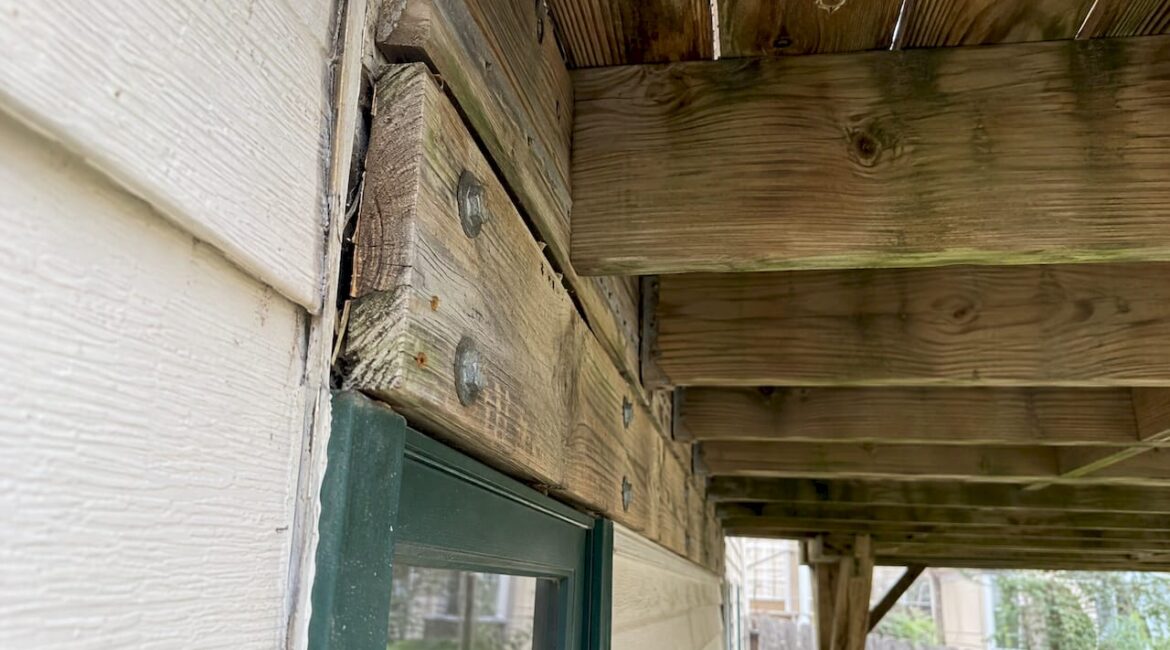
The ledger is the board that bolts your deck to the house, and when its connection fails, the deck can pull away and fall. The National Association of Deck Residential Associations (NADRA) estimates that about 90 percent of deck collapses result from ledger connection failures. Most of those failures come from two things: rot that develops where water gets behind the ledger, and fasteners that were never adequate. Both can be found before anyone steps on a failing deck, and both are fixed by rebuilding the connection correctly. At JAG Home Enhancements, we build and repair decks for homeowners in Bucks County and Montgomery County, and a ledger check is the first thing we want to see done on any older deck.
TL;DR
- The ledger attaches the deck to the house. Roughly 90 percent of deck collapses trace back to a failed ledger connection.
- The two big causes are nails instead of bolts, and water getting behind the ledger because flashing is missing or wrong.
- Warning signs: a gap between ledger and house, rusted or loose fasteners, soft or split wood, a deck that moves or bounces.
- If only nail heads are visible on the ledger, treat the deck as unsafe and keep people off it until a qualified professional repairs it.
- A proper repair replaces damaged wood, restores the flashing and re-fastens the ledger to code, and it often means opening the siding.
Table of Contents
- What the ledger does and why its failure is so sudden
- What causes a deck ledger to fail
- Warning signs you can check from the ground and the yard
- What current codes require at the ledger
- What a proper ledger repair involves
- How often to inspect
- Our approach to ledgers
- Have your ledger looked at in Bucks County
- FAQ
- Sources
What the ledger does and why its failure is so sudden
A deck that is attached to the house has posts and footings on the outer edge and a ledger on the house side. The ledger is a horizontal board fastened to the house’s band joist (the framing member that runs around the outside of the floor structure). The deck joists hang from it. Every person, planter and grill on the deck pulls down on that board and also pulls it outward.
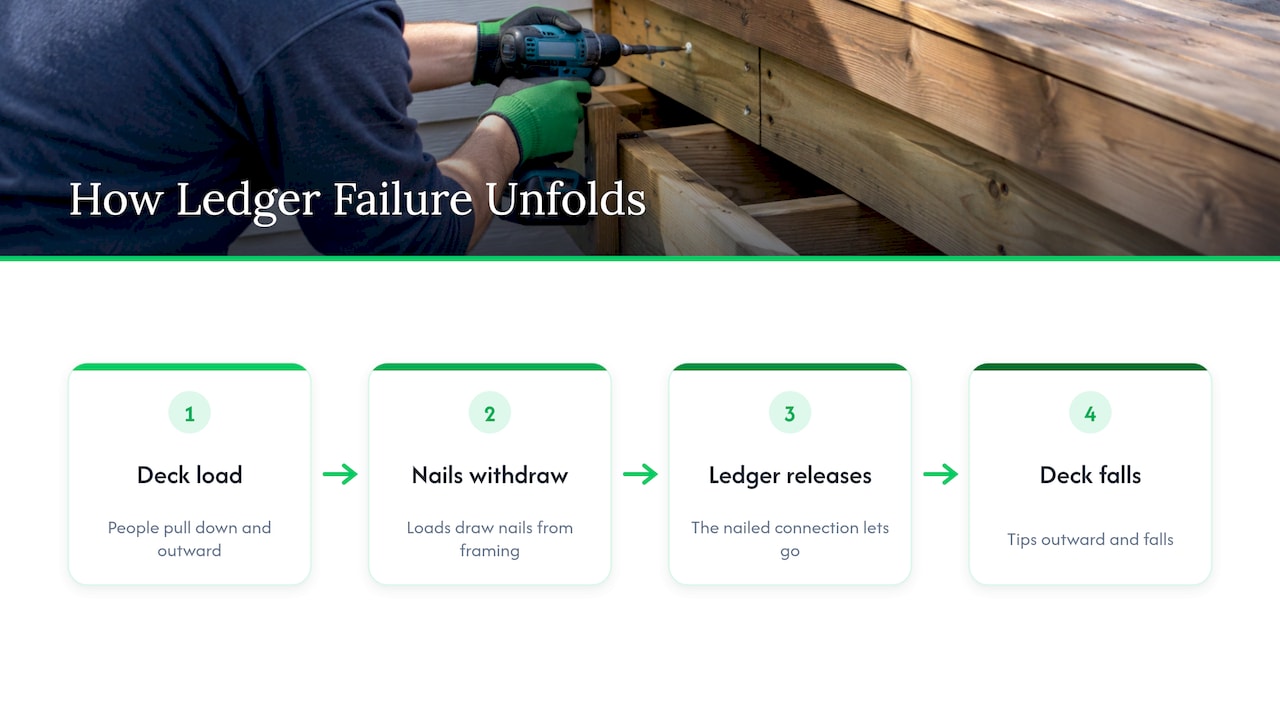
Engineers at the American Wood Council describe the problem plainly. Data on deck failures collected since 2001 shows that collapses most often involve ledgers fastened with nails instead of properly installed bolts or lag screws. Nails resist sideways shearing well but hold poorly when they are pulled straight out. Loads from the people on the deck bend or draw the nails out of the sheathing and band joist, and decks have collapsed with only one or two people on them.
That is why failure feels like it comes without warning. A deck-building specialist writing in The Seattle Times explained that when a nailed ledger lets go, the deck tips outward and falls. Temperature and humidity cycles work nails loose over the years, much like nail pops in drywall. A deck can look fine and carry a quiet summer for a decade, then fail under a full party.
Some nailed decks still stand only because they have never been loaded to the 40 pounds per square foot the residential code assumes for occupants, which is about one person for every 2-by-2-foot area, according to the International Code Council.
What causes a deck ledger to fail
NADRA’s guidance groups the causes into three families:
- Improper fastening. Nails only, unapproved screws or bolts, spacing that is too wide, or too few fasteners.
- Missing flashing. Without it, water runs behind the ledger and soaks both the ledger and the house framing.
- Wrong flashing material. Paper felt where metal belongs, for example.
Rot, wind pressure and the weight of the deck add to the stress.
Fasteners that look right but are not
Even bolts and lag screws can be wrong. The Seattle Times specialist noted that a lag screw that is too short, reaching only the siding and sheathing and not the band joist, can still pull off. So can screws that are all in a single line rather than staggered up and down, which can split the wood.
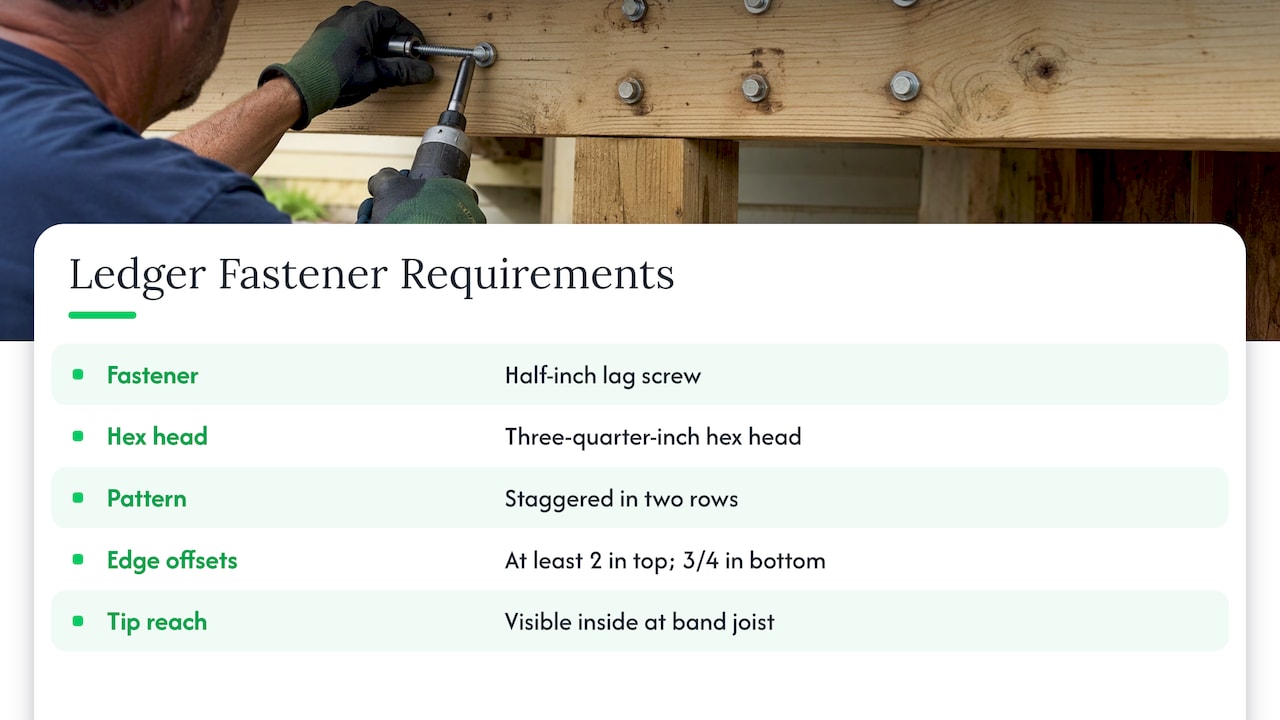
The American Wood Council’s installation details are specific. A half-inch lag screw has a three-quarter-inch hex head. The screws should be staggered in two rows, at least 2 inches from the top edge and three-quarters of an inch from the bottom edge, and the tip should be visible inside the house at the band joist. If it is not, the authors recommend a qualified professional investigation.
Water is the slow killer
Rot begins where water gets between the ledger and the house. Flashing is the metal or membrane that sheds water out and over the ledger, so it never sits in that joint. InterNACHI’s inspection guide warns that aluminum flashing should not touch pressure-treated lumber or galvanized fasteners, because the contact causes rapid corrosion. If the wood and the fasteners rot or corrode out of sight, the connection weakens long before the deck shows it.
Wood-destroying insects can add to the damage in some framing. If you see mud tubes or hollow-sounding wood near the joint, the causes of termite damage are worth reading about, and the framing should be assessed along with the ledger.
Water problems do not stay at the deck. The same moisture can reach the house’s band joist and wall framing, and the same thinking applies on the roof, where we explain where each flashing type goes and what it does.
Warning signs you can check from the ground and the yard
You do not need tools for a first look. Walk around the deck and, if you can, look at the underside where it meets the house. NADRA advises looking and feeling for rot or cracking, a spongy feel from moisture, and rusted or loose fasteners. The City of Philadelphia’s Department of Licenses and Inspections gives similar advice: check the underside for rot, water penetration behind the ledger, nail-only attachment and loose or corroded hardware.
Here is a practical list:
- A gap between the ledger and the house. A widening gap can mean bolts need tightening or that there is a deeper structural problem, according to This Old House. Do not cover a gap with trim or caulk before you know why it opened.
- Fasteners. Look for nail heads only, rust streaks, loose heads or missing hardware. Where the ledger should be through-bolted or lag-screwed, nails alone are a red flag.
- Wood condition. Cracked, split or soft ledger lumber, dark staining, or crumbling fibers.
- Flashing. Metal that has pulled away or cracked, or brittle, missing caulk at the joint.
- Movement. A deck that bounces, sways, slopes or has joists separating from the ledger, plus loose stairs or railings.
- House damage. Cracked siding or visible damage to framing next to the deck.
One simple test from InterNACHI’s guide is the hammer test: tap a bolt head, and a loose one rings hollow while a tight one rings solid. It tells you something, but it does not tell you what is happening behind the siding.
When to stop using the deck
The American Wood Council is direct about one finding. If only nail heads are visible on the ledger, the deck should be identified as unsafe, its use forbidden, and it should be repaired or replaced right away by a qualified designer or construction professional. The same authors strongly recommend a professional evaluation of elevated decks even when bolts or lag screws are present.
If you see a gap, soft wood or a deck that moves, apply the same caution: keep people and heavy furniture off it until it has been evaluated. For a Bucks County home, we are the people to call for that evaluation and the repair that follows.
What current codes require at the ledger
Codes give a clear benchmark for how a ledger should be built. In Pennsylvania, the statewide Uniform Construction Code builds on the International Residential Code, and your township’s building office issues permits and inspects. Here is what the code language says, in plain terms.
| Item | What the code approach calls for |
|---|---|
| Connection | Decks must be positively anchored to the house for vertical and lateral loads, not by nails that rely on withdrawal resistance. |
| Fasteners | Half-inch lag screws or bolts, hot-dipped galvanized or stainless steel, with washers, in a staggered pattern. |
| Spacing | Set by joist span. For example, a tip sheet based on IRC Table R507.9.1.3 gives 16 inches on center at an 8-foot span, 11 inches at 12 feet and 8 inches at 16 feet. |
| Ledger lumber | A minimum 2×8 in the prescriptive method. |
| Veneers | No ledger attached through brick, masonry, stone, EIFS or stucco. |
| Flashing | Per IRC R703.4, extending under the siding and over the ledger, and ending in a drip edge. |
The sources behind those rows: the anchoring and veneer rules come from a 2025 connection guide that summarizes IRC Section R507. The spacing examples come from a municipal deck tip sheet that also requires the lag screw tip to extend past the inside face of the band joist. The fastener, lumber and flashing details come from a 2026 residential deck guidelines document, which also describes flashing reaching at least 6 inches up behind the siding and housewrap.
The code editions the sources cite share the same core rule. Since the 2009 edition, every IRC edition requires the ledger to be connected to the band joist with half-inch bolts or lag screws. Local amendments and the edition your township enforces can differ, so the municipal permit office has the final word on your address.
The ledger is not the only connection that matters. Footings, posts and guards are all inspected on a permitted deck. For Pennsylvania specifics, see our guides on footing requirements for PA decks and deck railing height and spacing rules.
What a proper ledger repair involves
A ledger repair is not a matter of adding a few more screws. The goal is a connection that meets the code approach above, on sound wood, behind sound flashing. In practice, that usually follows this order:
- Limit loads and assess. The deck is taken out of service, and the ledger, the band joist behind it and the joist ends are checked for rot and corrosion.
- Open the joint. Because flashing tucks behind the siding, siding near the ledger is often removed so the old flashing and the wall behind it can be seen.
- Replace what is damaged. Rotted ledger lumber, damaged sheathing or a compromised band joist are replaced before anything new is fastened to them.
- Re-flash. New metal flashing is lapped under the siding and housewrap and over the ledger, with a drip edge, using materials that do not react with treated lumber.
- Re-fasten. The ledger goes back with approved half-inch bolts or lag screws, washers, correct spacing and staggering, and tips that reach the inside of the band joist.
- Check the rest of the deck. Posts, footings, joist hangers, stairs and railings are looked at while the deck is open, since a deck with one weak connection often has others.
In some cases, a deck with a bad ledger and soft framing is better rebuilt than patched. A rebuild can also be the moment to move to composite decking or a new layout. Our work covers new deck construction, composite decking installation, deck resurfacing and refinishing, and small or large repair work.
Posts rot for related reasons, from water sitting where wood meets the ground or hardware. If you are weighing a repair against a rebuild, our rotted deck post repair guide shows how we think about it, and our sagging deck guide covers a related warning sign.
How often to inspect
NADRA’s position is that an annual inspection by a licensed professional of the whole deck structure is the best way to prevent a collapse, whatever the deck’s age, with homeowners doing preliminary checks in between (NADRA). The City of Cincinnati’s deck safety program adds a few simple seasonal tasks: tighten loose fasteners, replace rusted ones, and make sure flashing is sound where the deck meets the house. Spring, after the freeze and thaw, and fall, before leaves pile up, are natural times. Our seasonal deck maintenance schedule lays out the routine.
Our approach to ledgers
We have one rule for ledgers: the connection comes first, the finish comes second. A beautiful composite surface on a nailed ledger is a risk with a nice coat of paint on it.
When we look at a deck, we look where the deck meets the house before we look at the boards. Is the flashing continuous? Is the wood solid? Are bolts through the band joist? If the answers are no, we say so honestly and explain what the fix involves, because a homeowner should never find out about a ledger problem from the deck itself.
We manage a project from the first consultation through completion, and we keep the job site clean and safe. That matters on a ledger repair, where siding comes off and the house is open for a while. You deserve to know what is happening on your home each day and to reach us when you have a question.
If your deck is more than a few years old, ask for a ledger review. It is the cheapest insurance on the property.
Jeff
Have your ledger looked at in Bucks County
JAG Home Enhancements is a home remodeling company based in Bucks County, PA, building custom decks and handling repair work for homeowners in Bucks County, Montgomery County and nearby areas. We offer deck design and layout, new deck construction, composite decking installation, deck resurfacing and refinishing, custom railings and built-in seating, and small or large repair work. Our focus is personalized service, clear communication and honest recommendations from consultation through completion.

If you have seen a gap, rust, soft wood or nail heads at your ledger, or your deck simply has not been checked in years, contact JAG Home Enhancements to arrange a look at your deck. For a larger outdoor project, see our custom decks and outdoor living spaces page.
FAQ
Can I keep using my deck if the ledger is attached only with nails?
No. The American Wood Council says a ledger showing only nail heads should be treated as unsafe, with use forbidden until it is repaired or replaced by a qualified professional. Nails hold poorly when pulled out, and decks have collapsed under as few as one or two people.
Is a gap between the deck and the house always a ledger failure?
Not always, but it should never be ignored. A widening gap can mean loose bolts or a deeper structural problem, and covering it hides the evidence. Have the ledger and the framing behind it evaluated before you trim or caulk it.
Does every ledger need flashing?
Yes, in the code approach described in the sources above. Flashing in the IRC’s R703.4 style sits under the siding and over the ledger, runs up behind the siding and housewrap, and ends in a drip edge, so water cannot reach the ledger joint. Your township’s building office confirms the rules for your address.
Can a ledger be bolted to a brick or stone house?
The code language we reviewed prohibits attaching a ledger to or through brick, masonry, stone, EIFS or stucco veneers. A deck on that kind of wall needs a different structural design, such as a freestanding deck with its own posts. Have it designed and permitted through your municipality.
How often should a deck be inspected?
NADRA recommends a professional inspection every year, with your own quick checks in spring and fall. Check sooner after a storm, or if you notice movement, rust or softness.
Sources
- How Ledger Boards Impact Deck Safety (NADRA)
- Is Your Deck Safely Connected to Your House? (American Wood Council)
- Ledger failure is cause of most deck collapses (The Seattle Times)
- Is your deck safely connected to your house? (ICC Building Safety Journal)
- How to Inspect Your Deck and Make Sure It’s Safe (This Old House)
- Study Guide: How to Perform Deck Inspections (InterNACHI)
- L&I: Take Steps Now to Protect Against Outdoor Deck Collapses (City of Philadelphia)
- Check Your Deck (City of Cincinnati)
- Deck Connection and Fastening Guide (2025)
- Guidelines for Residential Decks (2026)
- Single Family Residential Uncovered Decks and Porches tip sheet