
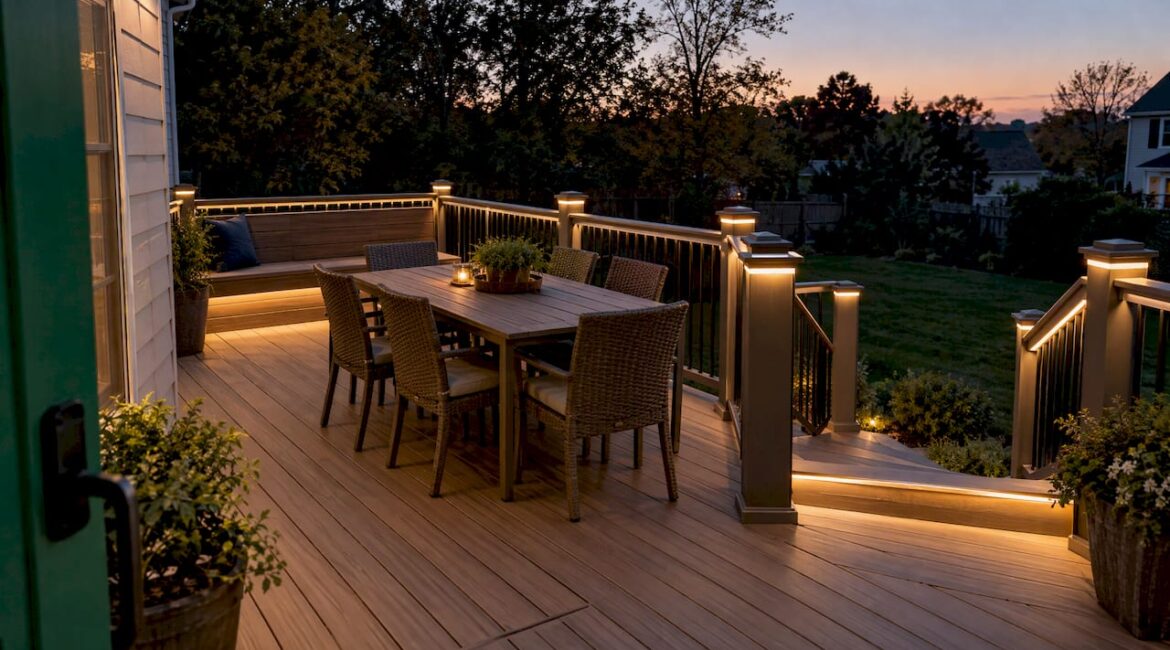
The best deck lighting is layered, low voltage and warm. Light the stairs first for safety. Then add a soft glow under the rail, and finish with a few accents over the seating and dining areas. Plan it in zones instead of trying to light every square foot, and place fixtures so nobody looks straight into a bulb.
Below, we walk through the ideas that work, where each one goes, how far apart to space them, and what to check before anything is drilled or plugged in. We build decks across Bucks County, so we also point out what matters when a deck gets a permit and an inspection.
TL;DR
- Start with safety: stair risers, door landings and any change in level get light before anything decorative.
- Layer three zones: the perimeter (rails), the floor (stairs and walkways) and overhead or accent areas (pergola, seating).
- Low voltage LED systems use a transformer that steps household power down to 12 volts, and the transformer belongs on a GFCI-protected outlet.
- Keep fixtures out of seated eye level, use warm white light and put each zone on a dimmer.
- Run wiring before the boards and rails go on. Adding recessed lights later means drilling into finished decking.
Table of Contents
- Start with zones, not fixtures
- Deck stair lighting ideas
- Under-rail lighting for a soft perimeter glow
- Post cap lights and uplights
- Recessed deck lighting
- Lighting for seating, dining and cooking
- Low voltage deck lighting: how it works
- Safety and code checks before you install
- Common mistakes that spoil a deck at night
- Our perspective
- Plan your deck lighting with JAG Home Enhancements
- FAQ
- Sources
Start with zones, not fixtures
Most lighting mistakes come from buying fixtures first and deciding where they go later. A better approach is to walk the deck at dusk and mark the places people actually use: the steps, the path to the door, the grill, the dining table and the lounge area.
This Old House recommends planning by zones, such as stairs, seating, cooking, dining and paths, rather than lighting every square foot. It suggests spacing fixtures 10 to 15 feet apart so they create gentle pools of light without overwhelming the deck.
Fine Homebuilding offers a useful way to sort the zones by job. Its 2016 deck lighting guide separates essential lighting for code-required doors and stairs, targeted lighting for grilling or eating, and lower-intensity ambient light that fills the dark gaps. That order is also the order we suggest for your budget: essential first, task second, ambience last.
A simple three-layer model works for almost any deck:
- Perimeter: under-rail strips or post-cap lights that define the edges.
- Floor: stair lights and recessed lights that guide footing.
- Overhead and accent: string lights, pendants or lanterns that give the space its mood.
Deck stair lighting ideas
Stairs are where lighting does its most important work. A step you cannot see clearly is a fall waiting to happen, and a deck is usually where guests are carrying plates and drinks.
Riser-mounted lights are the most common answer. Fine Homebuilding recommends recessed, shaded or louvered stair lights mounted on risers so the light is directed downward. That cuts down on trip hazards, glare and distracting views of the bulb itself.
A few practical points for stairs:
- Light every step, or at least every other step on longer runs, so there is no dark tread between two bright ones.
- Aim light across the tread, not up into the eyes of someone climbing.
- Light-colored or contrasting stair materials generally need less illumination than dark ones, according to the same Fine Homebuilding guide, so a dark composite tread may need a little more help.
- Light the top and bottom landings as well, since that is where people hesitate.
Good stair light is also about comfort for the eyes. If you want a broader look at keeping glare low indoors and out, this piece on better lighting for healthier eyes covers the principles.
Stair layout, rise and run, and code all interact with lighting. We cover that in our guide to deck stair design, including layout, code and lighting.
Under-rail lighting for a soft perimeter glow
If you only add one decorative layer, make it a slim LED strip tucked under the top rail cap. The light falls down onto the deck surface, the fixture stays hidden and the whole edge of the deck reads as a gentle outline after dark.
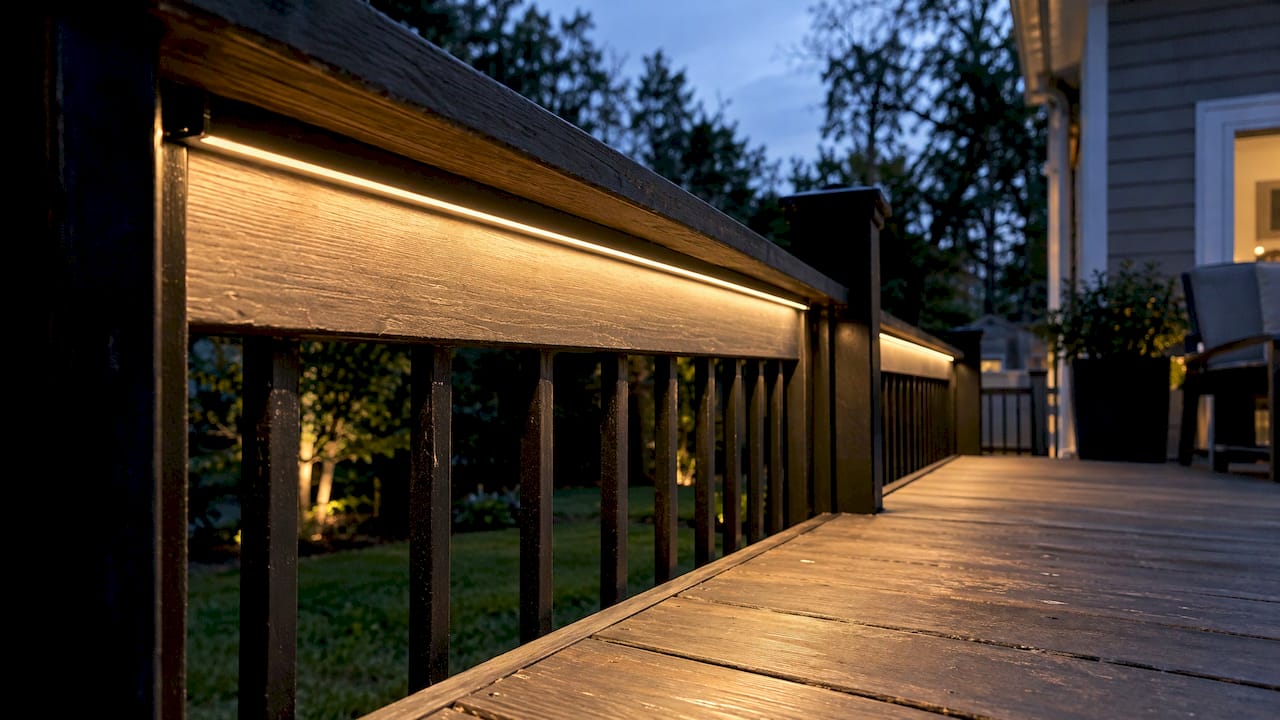
This Old House also points to subtle strip or rope lights along railings, benches and stair risers as a way to add atmosphere without overlighting. HGTV highlights LED rope lighting beneath railings, steps or furniture, and notes that many versions are waterproof.
Why under-rail works so well:
- The light source sits above eye level, so it rarely shines in anyone’s face.
- It lights the floor evenly, which helps people judge where the deck ends.
- It disappears in daylight, so it does not clutter the railing design.
The same logic applies to sun as well as lamps. When afternoon light is the glare problem, outdoor shades for glare and comfort are one more way to tame brightness on a deck or porch, while downward-facing rail lights do the same job after sunset.
If you are planning custom railings or built-in benches, tell your builder about lighting early. Channels and wire paths are far easier to hide when the railing is built, not after. Our custom deck and outdoor living work includes railings and built-in seating designed with this in mind.
Post cap lights and uplights
Post caps are the classic choice for a deck with defined corners. A lit cap marks each post, which helps guests see the edge, and it adds a finished look that matches the rest of the railing.
This Old House lists post-cap lights and uplights as options for post designs. Keep these points in mind:
- Post caps are decorative and not strong task lighting. Pair them with stair and floor lights.
- Do not light every post if the deck is long. Alternate or skip posts so the spacing looks intentional.
- Pick a color temperature that matches your other fixtures. Mixing cool white caps with warm strips looks patchy.
Recessed deck lighting
Recessed lights sit flush in deck boards, post faces or riser boards. They are subtle and durable, and they work well to mark walkways, perimeters and stair risers. The tradeoff is planning: they involve drilling into the decking, so the layout needs to be decided before boards go down.
For the installation, one manufacturer’s instructions say to run wiring and splitters before the decking and railing go in, and to check local codes before drilling.
Spacing matters more than most people expect. Place recessed floor lights too close together and you get glare and a runway effect. Place them too far apart and you get dark spots. A workable approach:
- Mark the planned positions with painter’s tape.
- Wait until dark and test with temporary fixtures or a flashlight.
- Adjust before you drill a single hole.
JLC makes the same point, recommending that you test fixture placement after dark to check spacing and light levels.
If you want recessed lighting on an existing deck, it is still possible, but it usually means pulling a few boards or working from underneath. That is one of the places a contractor saves time.
Lighting for seating, dining and cooking
This is where ambience happens, and where glare causes the most complaints. The rule is simple: keep light sources out of the sightline of seated people.
Ideas that work:
- String lights in warm white over a pergola or overhang. This Old House suggests warm-white LED string lights over a pergola or overhang, paired with dimmers to keep a festive feel without overlighting.
- Pendants or LED candles over the table or lounge area.
- Sconces on the house wall near dining areas, plus lanterns or candles on the tabletop.
- Task lighting at the grill, aimed at the cooking surface and not at the people around it.
JLC suggests separate controls and dimming because grills, dining areas, stairs, transitions and spas each need useful light without excess brightness. In practice, that means at least three switches or dimmers: one for stairs and paths, one for ambient perimeter light and one for the seating area.
If you are thinking about a pergola, shade structure or outdoor kitchen, the lighting plan should be drawn up with it. Overhead structures give you somewhere to hide fixtures and wiring cleanly. See our outdoor living spaces in Bucks County for how we approach that kind of project.
Low voltage deck lighting: how it works
Low voltage is the default for residential decks, and it is what most readers searching for deck lighting end up choosing. A transformer plugs into a standard outlet and steps household power from 110 volts down to 12 volts. This Old House advises keeping the transformer within 2 feet of a GFCI-protected outlet, hiding the wiring and sizing the transformer for the total light load.
Fine Homebuilding calls low-voltage lights a safer alternative to line-voltage lights. It says they pose almost no shock threat and have simpler connections that do not require an electrical license or permit to install. That is general guidance from a 2007 article, so confirm what your township requires before you start.
A simple planning checklist:
- Count your fixtures and add up their wattage.
- Choose a transformer with some headroom beyond that total.
- Pick wet-location-approved LED fixtures. JLC recommends wet-location-approved LED fixtures on separately controlled, dimmable circuits.
- Plan wire runs along joists or inside rail posts so cables are protected and out of sight.
- Add a timer or photocell so lights come on without anyone thinking about it.
What about solar?
Solar lights need no wiring, which is why they are popular for quick upgrades. They depend on sun, though. Fine Homebuilding notes solar fixtures typically need about six hours of sunlight a day, and their output is limited by the size of the panel. They suit a shaded-free, sunny deck and accent use more than primary stair lighting.
Safety and code checks before you install
Water and electricity meet on every deck, so a few checks are not optional.
- GFCI protection. The U.S. Consumer Product Safety Commission advises GFCIs on outdoor outlets to reduce the risk of electrocution, and notes that many local codes require them for outdoor circuits. It also recommends testing them once a month following the manufacturer’s instructions.
- Outdoor-rated equipment. The Electrical Safety Foundation International says extension cords and electrical decorations used outside should be marked for outdoor use.
- Why GFCIs matter. ESFI describes a GFCI as a lifesaver in outdoor environments, because it cuts off current when it detects a leak to ground.
If your plan includes new line-voltage wiring, such as a new outlet, sconces or ceiling fixtures on a pergola, that is a job for a licensed electrician, and your township may require a permit and inspection. Low voltage is simpler, but if you are also building or rebuilding the deck, the permit conversation is the same one. In Pennsylvania, getting a deck permit before you hit the 30 inch trigger matters, and if you are in Warwick Township our notes on the local deck permit process explain what reviewers look for.
Common mistakes that spoil a deck at night
We see the same handful of problems on decks other people have lit.
- One bright floodlight on the house. It flattens everything and creates glare. Layered low-voltage light feels better and gives safer footing, a point lighting expert Scott Caron makes in This Old House coverage.
- Lighting everything evenly. A deck lit like a parking lot has no mood. Leave some areas darker on purpose.
- Cool white bulbs. They feel clinical outdoors. Stay warm.
- No dimmers. Dinner and cleanup need different levels.
- Wiring as an afterthought. Exposed cables and splices are both ugly and a hazard.
- Fixtures at eye level. Seated guests should never see the bulb.
Our perspective
We have been building decks in Bucks County long enough to know that lighting is the most commonly skipped line item, and the one homeowners most often wish they had included. By the time boards are down and railings are up, running wire the clean way gets expensive and awkward.
Our advice is to treat lighting as part of the deck design from the first consultation. Decide where the stairs, seating and grill go, then decide how each one will be lit. We would rather spend an extra twenty minutes at the planning stage than leave you with visible cables and a dark staircase.
We favor low voltage LED, warm color temperatures and separate dimmers for each zone. It keeps the deck safe, keeps it comfortable and keeps the look consistent with the railings, posts and materials we build with. We also keep job sites clean and communication clear, so you know when wiring is going in and what it will look like when we finish.
Jeff
Plan your deck lighting with JAG Home Enhancements
If you are building a new deck or upgrading an existing one, we can design the lighting along with the structure, railings and seating so the wiring is hidden and the layout makes sense after dark. We handle custom deck design and layout, new construction, composite decking, custom railings and built-in seating, outdoor kitchens and pergolas for homeowners in Bucks County, Montgomery County and nearby areas.

To talk through your project, see our custom deck building services or reach us through jaghomesnow.com.
FAQ
What are the best lighting options for decks?
For most decks, the best mix is riser lights on the stairs, under-rail strip lights for the perimeter and warm string lights or pendants over seating. Low voltage LED is the usual choice because it is safer and easier to install. Add dimmers so you can change the mood.
How far apart should deck lights be?
There is no single number. This Old House suggests about 10 to 15 feet between fixtures for gentle pools of light, while smaller recessed and stair fixtures usually go closer together. Too close causes glare and too far leaves dark patches, so test the layout after dark before drilling.
Do I need a permit to add deck lights?
Low voltage lighting is generally simpler and may not require an electrician or permit, according to Fine Homebuilding. New line-voltage wiring usually does, and rules vary by township. Call your local building department before you begin.
Can I add recessed lights to an existing deck?
Yes, but it is more work than doing it during construction. Recessed fixtures must sit flush in boards, posts or risers, and wiring must be routed underneath. Surface-mounted stair lights or under-rail strips are easier retrofits.
Sources
- Adding the Perfect Mood Lighting to Your Deck, This Old House
- Exterior Lighting Right Where You Need It, This Old House
- Accent Lighting for Your Deck, Fine Homebuilding
- Bright Ideas for a Well-Lit Deck, Fine Homebuilding
- Lighting Up Outdoor Living Spaces, JLC
- Stylish Outdoor Lighting Ideas, HGTV
- Deck Lighting Installation Instructions, recessed
- Home Electrical Safety Checklist, CPSC
- Outdoor Decoration Safety Tips, ESFI
- Outdoor Electrical Safety Check Booklet, ESFI