
Most Pennsylvania homeowners can combine the federal Energy Efficient Home Improvement Credit with a state loan or a utility rebate to bring down the cost of new windows. Your first move is simple: confirm the windows you’re considering carry an ENERGY STAR label and check whether your utility runs an Act 129 rebate program. From there, low-income households should also ask about the Weatherization Assistance Program.
TL;DR:
- Most Pennsylvania homeowners can maximize savings by combining federal, state, and utility incentives, including the federal tax credit, loans, and rebates.
- The federal tax credit covers new, ENERGY STAR-certified windows with specific caps, and documentation is crucial for claiming it during tax filing.
- State programs like the KEEP loan and utility rebates require pre-approval and specific paperwork, so applying early can prevent delays and disqualifications.
- Proper installation is essential; homeowners should ensure contractors provide warranties, detailed air sealing, and insulation documentation for eligibility and efficiency.
- Upgrading windows is most cost-effective when paired with other home improvements like attic insulation, especially if windows are currently failing or causing drafts.
Table of Contents
- Federal, state, and utility incentives to check first
- What the federal window tax credit actually covers
- Pennsylvania loan and utility rebate programs explained
- What Pennsylvania homeowners can realistically expect to save
- A checklist for applying to loans, rebates, and the tax credit
- Choosing a contractor who protects your investment
- Budgeting and financing your window project
- Windows versus other energy upgrades: what to fix first
- How JAG Home Enhancements supports your window project
- Sources
- FAQ
Federal, state, and utility incentives to check first
Before you call a contractor or sign a purchase order, it helps to know which programs actually apply to your household. Some are open to any homeowner, others depend on income or which utility serves your address. Here’s the short list worth checking in order:
- Federal Energy Efficient Home Improvement Credit: a tax credit claimed when you file, not a discount at purchase.
- KEEP Home Energy Loan (Keystone Energy Efficiency Program): a fixed-rate loan for energy upgrades, including windows, through the Pennsylvania Department of Environmental Protection.
- PHFA HEELP loan: a smaller, fixed-rate loan aimed at homeowners who need help paying for energy-related repairs.
- Act 129 utility rebates: programs run by major Pennsylvania electric utilities, with rebate types and amounts that vary by provider.
- Weatherization Assistance Program (WAP): targeted at income-eligible households, where window work is one possible piece of a broader home energy fix.
Knowing which of these applies to your situation before you shop saves you from picking a window that looks efficient but doesn’t meet a program’s fine print.
What the federal window tax credit actually covers
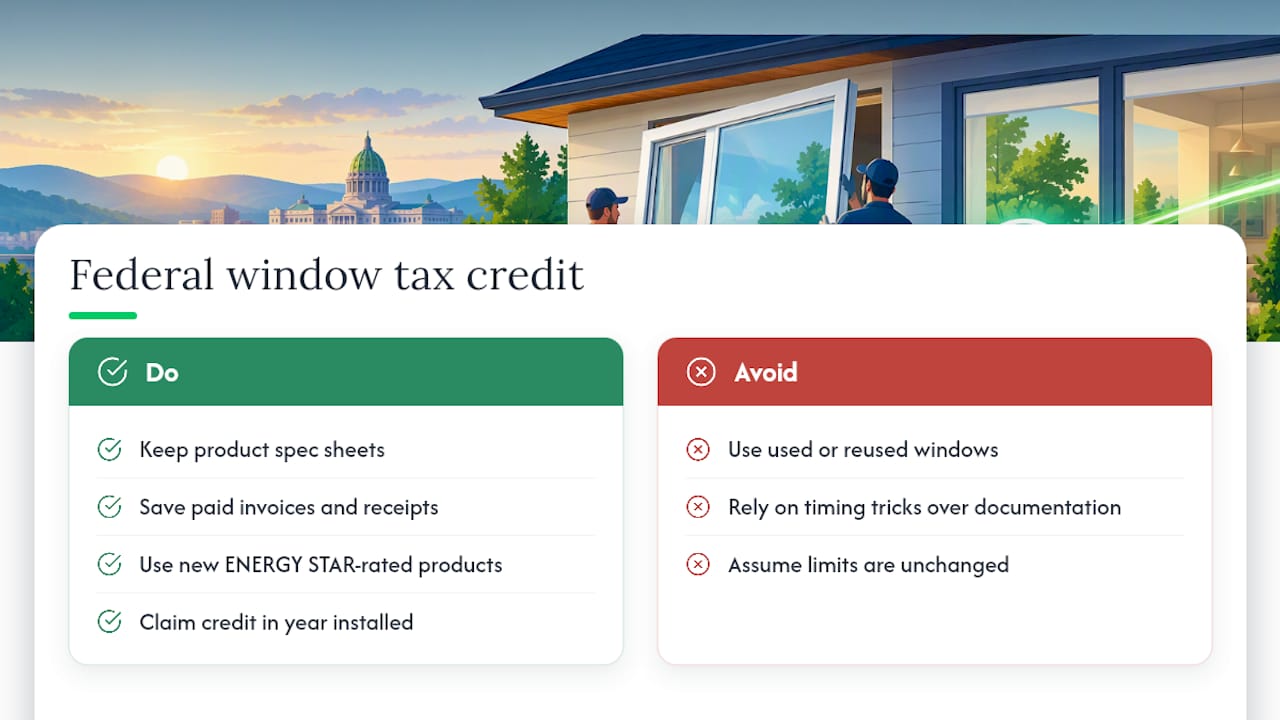
The IRS Energy Efficient Home Improvement Credit lets you claim a credit for qualifying windows and skylight purchases, but it comes with caps. Exterior windows and skylights have their own dollar limit within the credit, and there’s a separate overall cap for the full set of eligible home improvements claimed in a year. To qualify, the product generally needs to meet ENERGY STAR’s most current performance requirements and must be new, not used or reused from another project.
Keep your product spec sheets and paid invoices. The credit is claimed on your federal tax return for the year the windows were installed, so documentation matters more than timing tricks. If you’re weighing whether to move a project into this tax year or push it into the next one, our breakdown of the federal window tax credit walks through the paperwork in more detail. Rules and caps can shift with new IRS guidance, so confirm the current limits before you file.
Pennsylvania loan and utility rebate programs explained
Once you know the federal credit’s limits, layer in state and utility help to shrink the amount you’re financing out of pocket.
The KEEP Home Energy Loan offers fixed-rate financing for energy upgrades, with loan amounts from $2,500 to $25,000 and repayment terms between 36 and 120 months for owner-occupied single-family homes and small multi-unit properties. It’s a below-market-rate loan, so approval still involves a credit check.
PHFA’s HEELP loan works on a similar principle but is scaled for smaller repair needs. If KEEP feels too large for your project, HEELP is worth a look through the Pennsylvania Housing Finance Agency.
Act 129 is the law behind most utility rebate programs in the state, and it requires large electric distribution companies to run efficiency programs for residential customers:
- PPL Electric Utilities
- PECO
- Duquesne Light
- FirstEnergy companies (Met-Ed, Penelec, Penn Power, West Penn Power)
Offerings vary by utility, so search your provider’s name plus “energy efficiency rebate,” or use the ENERGY STAR rebate finder by zip code to see what’s currently live in your area.
What Pennsylvania homeowners can realistically expect to save
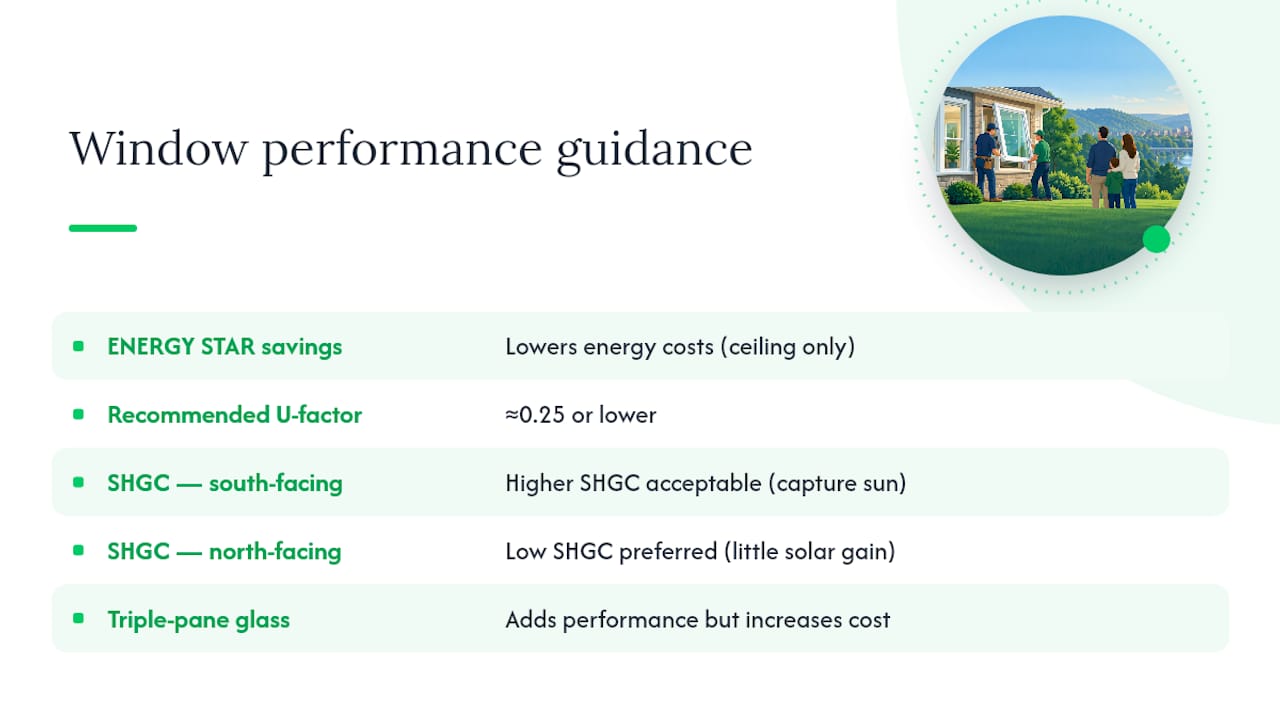
Replacing old single-pane windows with ENERGY STAR-certified models can lower household energy costs by a significant percentage on average, according to ENERGY STAR. Actual savings swing based on your home’s design, your local climate, and which direction your windows face, so treat that figure as a ceiling, not a promise.
For Pennsylvania’s climate, DOE and FEMP guidance points toward a low U-factor, generally around 0.25 or lower, to limit heat loss during our cold months. Solar heat gain coefficient, or SHGC, matters too: south-facing windows can handle a higher SHGC to capture free winter sun, while north-facing windows see little solar gain and benefit most from a low U-factor. Triple-pane glass adds performance but also adds cost, and the DOE/FEMP analysis notes that even a modest price premium over standard double-pane can still pencil out over the product’s life, though the return shrinks the higher you climb the price ladder.
A checklist for applying to loans, rebates, and the tax credit
Getting the paperwork right the first time saves weeks of back-and-forth. Work through these steps in order:
- Confirm the window’s ENERGY STAR certification and NFRC label match your climate zone before you buy.
- Request written spec sheets from your contractor or supplier, showing U-factor and SHGC values.
- Apply for KEEP or HEELP financing, or check your utility’s Act 129 portal, before your final payment is due.
- Keep every invoice, contract, and product certificate in one folder for tax season.
- Ask your tax preparer which IRS form applies to the Energy Efficient Home Improvement Credit for your filing year.
Pro Tip: Apply for rebate pre-approval before your contractor orders the windows, since some utility programs require sign-off before installation, not after.
Choosing a contractor who protects your investment
A high-performance window still leaks energy if it’s installed poorly. Air sealing around the rough opening, correct flashing, and proper insulation determine whether you actually see the savings printed on the label. This is where a lot of homeowners lose money without realizing it, because the window itself gets the blame when the installation was the real problem.
When you’re vetting a contractor in Bucks County or anywhere nearby, ask for:
- A written warranty covering both the product and the labor.
- A clear project schedule with start and completion dates.
- A cleanup standard for the job site each day.
- Proof of experience installing windows in the local Pennsylvania climate.
- NFRC and ENERGY STAR product sheets for the specific windows they’re proposing.
- A written list of the air-sealing and insulation steps they’ll perform at each opening.
Every window project should be built around this kind of documentation, since rebate and tax-credit paperwork often requires it. For homeowners in Richboro and Newtown weighing their options, our local window replacement guide covers more of what to ask before signing.
Budgeting and financing your window project
Window costs shift based on frame material, glass package, and whether you need custom sizes for an older home. Vinyl frames typically cost less than fiber cement or wood-clad options, and larger or oddly shaped openings push the price up regardless of frame choice.
If the full cost upfront is a stretch, KEEP and HEELP loans spread the expense over three to ten years, which can be easier to absorb than a lump sum, especially compared to standard contractor financing at a higher rate. Just remember that the sequence matters: get your rebate pre-approval or utility sign-off locked in before final payment, since the tax credit itself isn’t applied at checkout. You claim it later, when you file. Get several written estimates that spell out the full scope, including air sealing and trim work, so you’re comparing apples to apples rather than just the window price tag.
Windows versus other energy upgrades: what to fix first
If your attic insulation is thin or your home still feels drafty after checking for air leaks, fix that first. Windows are worth prioritizing when frames are failing, rotting, or fogged between panes, or when comfort and resale value are the goal. Pairing any window project with a home energy audit helps confirm where your money will do the most good.
— Jeff
How JAG Home Enhancements supports your window project
Replacing windows in an older Bucks County home involves more than picking a style. It means confirming the right ENERGY STAR climate-zone rating, documenting everything correctly for rebates and tax credits, and making sure the installation seals as well as the glass performs.
Some contractors handle that full picture for homeowners in Bucks County, Montgomery County, and the surrounding area:
- Help selecting windows that meet current ENERGY STAR and NFRC standards for the local climate.
- Providing spec sheets and installation documentation useful for rebate applications and tax filing.
- Managing air sealing, flashing, and insulation at every opening, not just the window swap itself.
- Maintaining a clean, safe job site and clear communication from consultation through final walkthrough.
If you’re ready to see what a properly documented, properly installed window project looks like, request a free estimate through our replacement windows page and we’ll walk you through your options.
Sources
Use these pages to verify current rules before you commit to a program or purchase:
- Pa
- IRS — Energy Efficient Home Improvement Credit
- DCED — Weatherization Assistance Program (WAP) FAQ
- DOE / FEMP — Purchasing energy-efficient residential windows, doors, and skylights
FAQ
What is the Pennsylvania window replacement program?
Pennsylvania doesn’t run a single dedicated window replacement program. Instead, homeowners typically combine the KEEP Home Energy Loan, PHFA’s HEELP loan, Act 129 utility rebates, and, for income-eligible households, the Weatherization Assistance Program.
How does the tax credit for energy-efficient windows work?
The IRS Energy Efficient Home Improvement Credit lets you claim a credit on your tax return for qualifying new windows that meet ENERGY STAR performance standards, subject to a window-specific dollar cap and an overall credit cap. You claim it when you file, using documentation like invoices and product certificates, not as a discount at the time of purchase.
What type of window is most energy-efficient?
There’s no single “most efficient” window model. According to DOE and FEMP guidance, the right choice is an ENERGY STAR-certified window matched to your climate zone, with a low U-factor and an SHGC suited to which direction the window faces.
Is there a tax credit for energy-efficient windows in 2026?
The federal Energy Efficient Home Improvement Credit remains active, though caps and eligibility rules can be updated through IRS guidance. Check the IRS credit page directly before filing to confirm the current limits for your tax year.