

Plan on at least 50 CFM for a bathroom you run intermittently, or 20 CFM if the fan runs continuously. For most bathrooms under 100 square feet, simply match 1 CFM per square foot, then round up to the next standard fan size. Those numbers line up with ASHRAE, HVI and ENERGY STAR guidance, and we’ll show you how duct losses can shrink them.
TL;DR:
- For bathrooms over 100 square feet, add 50 CFM for each shower, toilet, or bathtub, and 100 CFM for a jetted tub.
- For tall ceilings, multiply room length, width, and height in feet by 0.13, then round up to the next standard fan size.
- A fan rated at 50 CFM at 0.1 inches of water gauge may deliver only 23 to 31 CFM at 0.25, so choose above target.
- ENERGY STAR limits intermittent fans to 3 sones and continuous models to 1; set a delay timer to run 10 to 20 minutes after showers.
- Keep the duct the same diameter as the fan outlet, short and straight, with few elbows; seal joints and support flexible duct to prevent sags.
Table of Contents
- What are the quick sizing rules for a bathroom fan?
- How do you calculate the CFM your bathroom needs?
- Why does a fan deliver less air than its label says?
- How do noise, efficiency and controls affect the fan you pick?
- What does a good installation look like?
- Why do so many homeowners call a contractor for this?
- How can we help you size and install the right fan?
- FAQ
- Sources
What are the quick sizing rules for a bathroom fan?
You can pick a starting target without any math. Three rules cover nearly every home, and they come from ENERGY STAR and from HVI, the trade group for ventilation manufacturers.
- Minimum for any bathroom: 50 CFM for an intermittent fan, or 20 CFM for a continuous one.
- Bathrooms under 100 square feet: 1 CFM per square foot, according to Building America ventilation guidance.
- Bathrooms over 100 square feet: skip the floor-area shortcut and add up fixtures instead. HVI recommends 50 CFM for each shower, toilet or bathtub, and 100 CFM for a jetted tub.
A quick size-to-CFM guide for fan shopping:
- Smaller bathrooms: the 50 CFM intermittent minimum still applies.
- Bathrooms under 100 square feet: use the floor-area rule as a starting point.
- Larger bathrooms: add up the fixtures instead. For a separate shower and tub, include the CFM requirement for each fixture.
If you’re working in a tight room, our small bathroom layout ideas show how fan placement and duct runs fit into compact plans.
How do you calculate the CFM your bathroom needs?
The volume method gives you a more tailored number than the floor-area rule, especially when you have tall ceilings. It aims for roughly 8 air changes per hour, which is why the multiplier is 0.13.
- Measure the room. Get length, width and ceiling height in feet.
- Find the volume. Multiply length × width × height to get cubic feet.
- Apply the multiplier. Multiply the volume by 0.13 to get your target CFM.
- Round up. Move to the next standard fan size, usually the next ten.
- Check it against the minimum. If your result falls below 50 CFM, buy a 50 CFM fan.
Here’s a worked example. Say your bathroom is 10 feet by 8 feet with an 8-foot ceiling. That’s 640 cubic feet, and 640 × 0.13 comes to 83.2 CFM. A fan in the 90 to 100 CFM range gives you a comfortable cushion.
The 1 CFM per square foot rule is the simpler route for standard rooms. Compare that estimate with the volume method, especially if the room has a tall ceiling. When your bathroom tops 100 square feet, switch to the fixture-based additions from the previous section. HVI’s own example is an 8’ × 12’ × 8’ room, which holds 768 cubic feet and needs about 102 CFM to hit 8 air changes per hour.
Why does a fan deliver less air than its label says?
Manufacturers rate fans at a very low resistance, about 0.1 inches of water gauge (in. w.g.). Real ductwork pushes back harder, and Building America advises sizing fans using flow at 0.25 in. w.g., which is closer to what a typical installation sees. In practice, a fan rated at 50 CFM at 0.1 in. w.g. may deliver only about 23 to 31 CFM at 0.25.
That gap is why we tell homeowners to buy above the calculated number. A few things drag airflow down:
- Long duct runs from the fan to the exterior wall or roof
- Extra elbows, since each one adds backpressure
- Sagging flex duct that forms low spots and kinks
- Reducers or a duct smaller than the fan’s collar
- Dampers or wall caps that restrict flow
To compensate, choose a fan rated well above your target, or look at DC or variable-speed models that hold their airflow better under pressure.
Pro Tip: When in doubt, have a pro measure the installed airflow, or pick a fan rated well above your calculated need.
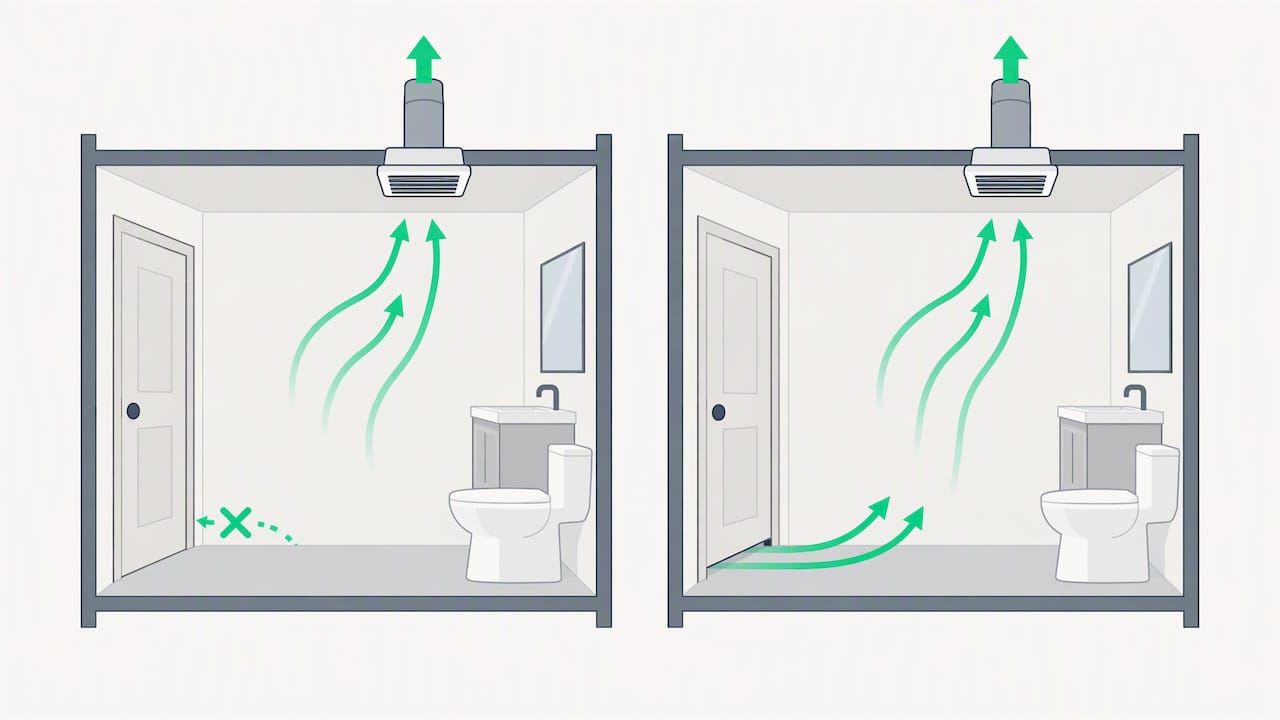
Door choice matters too. A tight-fitting bathroom door with no undercut can starve the fan of makeup air, a point covered in this guide to bathroom doors.
How do noise, efficiency and controls affect the fan you pick?
Once you know your CFM, narrow the field by sound level and efficiency. Fans are rated in sones, a measure of loudness. ENERGY STAR sets limits of 3 sones or less for intermittent fans and 1 sone or less for continuous ones. A fan at 1 sone is barely audible, which is why people are more willing to leave a quiet one running.
Efficiency matters because bathroom fans can run for hours. ENERGY STAR requires certified fans in the 10 to 89 CFM range to deliver at least 2.8 CFM per watt, according to its fan criteria. A higher CFM per watt rating means more air moved for each unit of electricity, which adds up over the years.
Controls change how well the fan does its job:
- Delay-off timer: keeps the fan running after you leave. HVI guidance points to 10 to 20 minutes as the common setting, since residual humidity lingers after a shower.
- Humidity sensor: turns the fan on when moisture rises and off when it clears.
- Continuous low speed: works as part of a whole-house ventilation plan, which is where the 20 CFM continuous minimum comes in.
If you’re comparing models, a buying guide can help you weigh noise, CFM and mounting style side by side.
What does a good installation look like?
A well-sized fan still fails if the ductwork is poor. Use this checklist yourself or hand it to your contractor, based on DOE installation guidance:
- Match the duct diameter to the fan’s outlet collar, and avoid reducers.
- Keep the run as short and straight as possible, with as few elbows as you can manage.
- Stretch flex duct tight and support it so it can’t sag.
- Seal every joint with UL 181B mastic or tape.
- Insulate the duct where it passes through unconditioned space, to R-8 where required.
- Terminate outdoors with a properly flashed, screened cap, and make the penetration hole closely match the termination collar.
- Site the termination away from intakes and operable openings so moist air doesn’t drift back inside.
- Verify airflow with a flow hood if you have code requirements or persistent moisture problems.
Local requirements vary, so our write-up on bathroom exhaust fan code in Bucks County is a good starting point for jurisdiction-specific notes.
Why do so many homeowners call a contractor for this?
In our experience, recurring mold spots and peeling paint usually trace back to an undersized fan or a bad duct run, not a defective product. Getting it right means sizing for real static pressure, routing the duct cleanly and sealing the penetration. A fan swap is also easiest during a bathroom remodel, when walls and ceilings are already open and one crew manages the whole project. That’s often the point where professional help pays for itself.
— Jeff
How can we help you size and install the right fan?
If you’d rather not guess at static pressure and duct routing, we can help with bathroom ventilation as part of a remodel or as a standalone job. You get personalized service, a clean job site and one team managing the project from consultation to completion. Tell us about your bathroom, and we’ll discuss options for ventilation. Request a consultation or quote through our bathroom remodeling page.

FAQ
How do you calculate the CFM of a bathroom fan?
Multiply the room’s length, width and height in feet, then multiply that volume by 0.13 and round up. For bathrooms under 100 square feet, you can also use 1 CFM per square foot as a shortcut, per HVI guidance.
What is the minimum bathroom fan size?
The accepted minimum is 50 CFM for an intermittent fan or 20 CFM for a continuous one, according to ENERGY STAR. Larger or fixture-heavy bathrooms need more than the minimum.
Should I buy a fan rated higher than my calculated CFM?
Yes, in most cases. Ducts, elbows and wall caps reduce the airflow a fan actually delivers, so a fan rated well above your target helps you end up with the airflow you calculated.
How long should a bathroom fan run after a shower?
Plan on 10 to 20 minutes. A delay-off timer handles this automatically and clears the humidity that lingers after you leave, as HVI notes.