Impact resistant shingles are asphalt shingles built to take hail and flying debris better than standard shingles. They are rated Class 1 through Class 4 in a lab test, and Class 4 is the top rating. For many homeowners the practical questions are simple: what does the rating mean, what does it add to a roof bid, and will your insurer reward it? This guide answers all three, with a Bucks County and Montgomery County lens.
TL;DR
- Class 4 shingles passed a lab test using a 2-inch steel ball dropped from 20 feet. Class 3 passed with a 1.75-inch ball from 17 feet.
- In one industry cost survey, higher-performing impact resistant shingles averaged about 9% more per roofing square than standard shingles. Your total bid depends far more on roof size, pitch and labor.
- A Class 4 rating is not hail-proof. Ridge caps, underlayment and installation also matter.
- Some insurers discount premiums for impact resistant roofs, but the rules vary, so ask your insurer before you sign a contract.
- Hail risk in our part of Pennsylvania is real but moderate, so the decision is about your budget, insurance and how long you plan to stay.
Table of Contents
- What impact resistant shingles are
- How the ratings work
- Class 3 vs Class 4 shingles
- Impact resistant vs architectural shingles
- What impact resistant shingles cost
- Are Class 4 shingles worth it in Pennsylvania?
- Can impact resistant shingles lower your insurance premium?
- How long do Class 4 shingles last?
- How to choose an impact resistant roof
- Plan your roof with JAG Home Enhancements
- FAQ
- Sources
What impact resistant shingles are
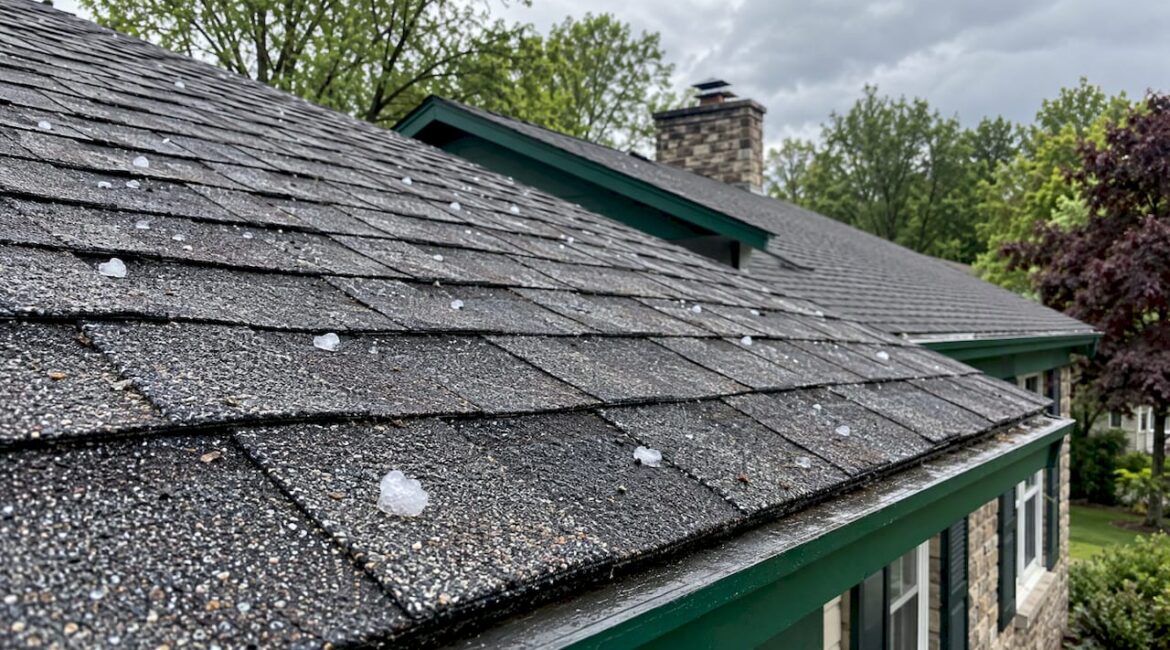
Impact resistant asphalt shingles are modified to take more punishment from hail. Manufacturers typically do this with tougher reinforcement and polymer-modified asphalt that flexes instead of cracking. A professional roofing-science article from IIBEC explains that hail damage to asphalt shingles is usually a rupture, fracture, tear or bruise in the reinforcement, and that even a slight bruise can let water seep in and weaken the shingle’s ability to shed it.
That is why hail damage is often invisible from the ground. A roof can look fine in the yard and still have bruised shingles that fail early. If you suspect a storm hit your roof, our guide on documenting hail-damaged shingles in 72 hours walks you through what to photograph and when.
How the ratings work
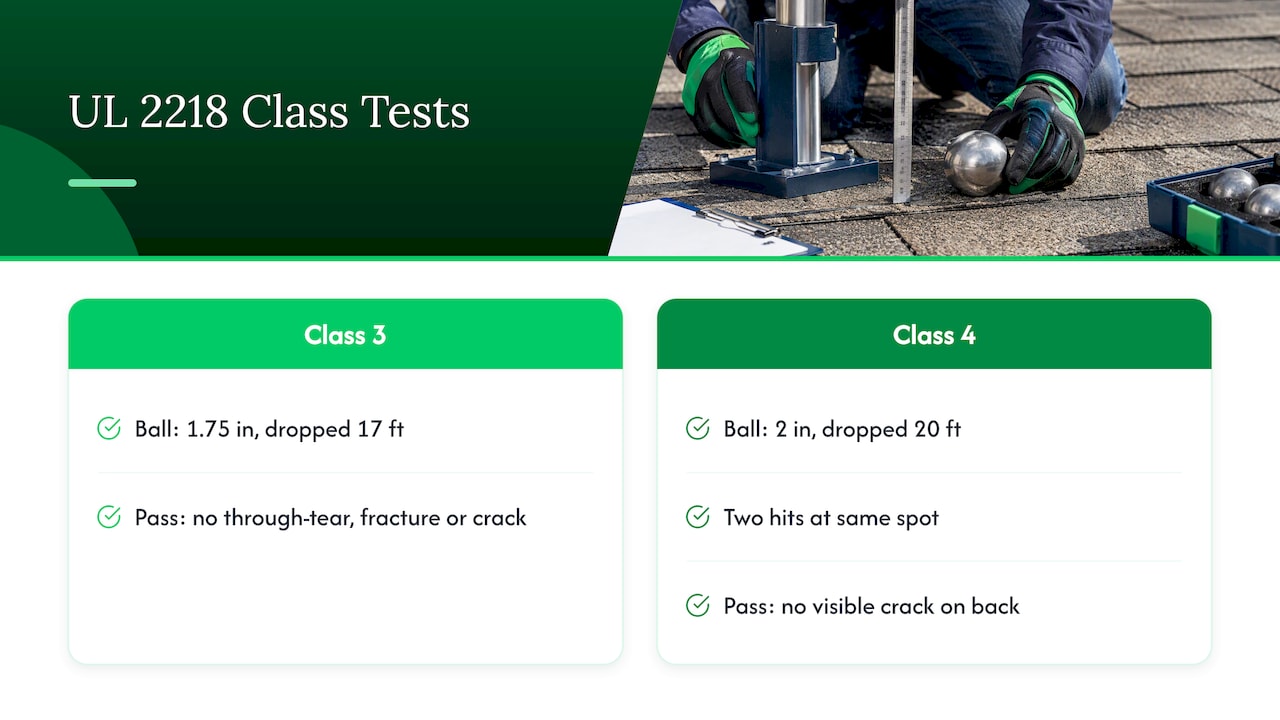
The rating most people see on a bundle wrapper comes from UL 2218, a standard UL developed in the 1990s with industry and insurance companies. The test drops steel balls onto the shingle. According to IIBEC, Class 3 uses a 1.75-inch ball from 17 feet and Class 4 uses a 2-inch ball from 20 feet. A product passes if there is no tear, fracture or crack extending through it.
The Insurance Institute for Business & Home Safety (IBHS) adds a detail worth knowing: in the Class 4 test, the same spot takes two hits, and the shingle passes if no crack is visible on its back.
Steel balls are not hailstones, though. IBHS developed its own protocol using laboratory-made hailstones designed to mimic natural hail. It grades dents, granule loss and tears rather than a simple pass or fail, which lets it tell strong products from merely adequate ones.
Class 3 vs Class 4 shingles
The short version: Class 4 is the higher rating, and it is tied to the larger, heavier test ball.
| Class 3 | Class 4 | |
|---|---|---|
| Steel ball size | 1.75 inches | 2 inches |
| Drop height | 17 feet | 20 feet |
| Passing standard | No visible backside tear, crack or fracture | No visible backside tear, crack or fracture |
| Typical fit | Lower hail exposure, tighter budgets | Higher hail exposure, insurance discounts, longer ownership |
The test figures come from GAF’s guide to Class 3 vs Class 4, which matches the IIBEC description. That guide also frames the choice sensibly: Class 3 can suit lower-hail-risk areas, while Class 4 makes more sense where hail exposure, budget, insurance treatment and local requirements support the higher specification.
Class 4 is not the same as hail-proof
The Midwest Roofing Contractors Association notes that Class 4 shingles resist tested hail up to about 2 inches, and that hail near tennis-ball size (about 2.5 inches) and larger can still damage a roof. The same article makes a point we agree with strongly: a Class 4 shingle does not automatically give you a Class 4 roof system. Required ridge caps, underlayment and installation procedures all have to be followed.
In plain terms, the label on the bundle is only part of the result. The crew that installs it matters just as much.
Do they really perform better?
IBHS tested dozens of products. Its hail impact summary found that impact resistant products generally scored about 16% better against 1.5-inch hail. Against 2-inch impacts, products rated Good or Excellent averaged 14% higher scores than non-impact-resistant shingles, and some individual comparisons reached 34%. The same summary shows that not every impact resistant product performed equally well, so ask which specific shingle you are being quoted rather than relying on the class alone.
Earlier IBHS work compared architectural shingles directly. Impact resistant architectural shingles passed about 40% of Class 4 impact locations versus about 30% for basic architectural shingles, and across the four classes they performed roughly 25% to 80% better.
Impact resistant vs architectural shingles
These are two different questions, and people often mix them up. Architectural (also called laminated or dimensional) shingles describe the construction and look: multiple layers that give depth. Impact resistance describes how the shingle handles a hit. Many Class 4 products are architectural shingles, but not every architectural shingle is impact rated.
Consumer Reports says architectural shingles, with their several layers, can withstand stronger winds and weather than three-tab shingles, with some multilayered types rated for winds up to 110 mph. If you are choosing between a three-tab roof and an impact resistant architectural roof, you are upgrading in two ways at once: appearance and durability.
One more detail: IKO notes that higher-end laminated shingles often carry a Class 4 rating so homeowners can qualify for an insurance discount where one is offered. The rating itself is not a warranty or guarantee of hail performance. Treat it as a useful spec, not a promise.
What impact resistant shingles cost
We do not publish fixed prices for roofing, because every roof is different. Instead, here is how the numbers work so you can read any bid.
IBHS surveyed prices in seven U.S. markets. Shingles rated Good or Excellent averaged about 9% more per roofing square than non-impact-resistant shingles, with notable regional variation. A roofing square is 100 square feet of roof.
For context on the base price, Consumer Reports puts basic three-tab shingles at roughly $75 to $105 per square and multilayered architectural shingles at up to $350 per square, noting that labor and other materials also shape bids.
Here is a worked example using only the percentages above. Say the shingle material for your roof costs $4,000 in a standard line. A 9% premium adds about $360 in material. That is an illustration of the arithmetic, not a quote. Your real difference depends on the product line, the number of squares, and whether the manufacturer’s Class 4 line also bundles in matching accessories.
What moves your total bid most:
- Roof size and pitch, since steeper roofs need more safety equipment and time
- Tear-off of existing layers and any decking repair
- Underlayment, flashing, ventilation and ridge caps
- Chimneys, skylights and valleys
- Access to the property and disposal
Consumer Reports also cautions that the full installed bid and warranty terms matter more than the shingle label, and that manufacturer “lifetime” warranties may provide full replacement only for an initial period and commonly exclude hail. Our explainer on roofing warranties shows how to read those terms before you commit.
Are Class 4 shingles worth it in Pennsylvania?
Here is the honest, local picture. The Pennsylvania Insurance Fraud Prevention Authority says damaging hailstorms of at least three-quarters of an inch are most likely from April through September. Its 1986 to 2016 data identified western counties such as Allegheny, Butler, Washington and Westmoreland as the more frequent severe-hail targets, and Bucks County was not on that list.
That does not mean your roof is safe from hail. It means the case for Class 4 here rests on a few other things:
- Insurance. If your carrier offers a discount, the savings can offset part of the upgrade every year.
- Storm mix. Our area gets wind-driven rain, falling branches and the occasional severe thunderstorm, and tougher shingles handle all of it better than a thin, brittle one.
- How long you will stay. If this is your long-term home, a stronger roof pays back over more years.
- Peace of mind. Fewer worries after a storm is a real benefit, even if it is hard to price.
If you are likely to sell within a few years, a roof in good condition still helps. Condition and age affect how buyers and lenders see a house, as this look at roof damage and selling a house shows. A new impact resistant roof gives you something concrete to point to.
Can impact resistant shingles lower your insurance premium?
Sometimes. CertainTeed’s guide says some insurers offer impact-resistant roof discounts and cites reported annual savings of 5% to 35%, while telling homeowners to verify eligibility with their own insurer. GAF says discounts depend on location and insurer, may require a contractor report or certified inspection, and may be larger for Class 4 than for Class 3.
State Farm, for one, says that if you use certain impact resistant products, you may be eligible for a discount and should check with your agent before installing a new roof. Its eligibility process uses a certification form, and only certain shingles qualify.
Before you sign anything:
- Call your insurer or agent and ask whether they discount impact resistant roofs in Pennsylvania.
- Ask which product classes and which specific shingles qualify.
- Ask exactly what paperwork they need, and give that list to your contractor.
- Keep invoices, product labels and photos of the finished installation.
While you are on the phone, review the rest of your policy too. The Pennsylvania Insurance Department advises homeowners to check replacement cost versus actual cash value coverage and wind/hail deductibles, which can be set separately. It also recommends photographing storm damage, contacting your insurer promptly and making temporary repairs only after documenting the condition. For a step-by-step view, see our guides to the roof insurance claim process and Pennsylvania roof claims.
How long do Class 4 shingles last?
The honest answer is that manufacturers generally do not publish a separate service life for Class 4 lines compared with their standard lines. What changes the real-world lifespan is more familiar: climate, attic ventilation and installation quality. A well-ventilated attic keeps shingles from cooking from below, and good flashing keeps water out of the edges where leaks usually start.
That is also why we pair any shingle choice with a look at the whole roof system. If your current roof is aging and you are weighing options, read how to decide between roof repair and replacement, and our local checklist on when it is time for a roof replacement in Yardley or Doylestown.
How to choose an impact resistant roof
Use this short checklist when you compare bids:
- Ask for the exact product name and class in writing, not just “impact resistant.”
- Confirm the full system. Ask what underlayment, ridge caps and starter strips are included, since the Class 4 rating depends on following the manufacturer’s requirements.
- Check local code. Pennsylvania has roofing code requirements that affect inspections; our guide to PA roofing code covers them.
- Get insurer approval first if you want a discount, and ask what documentation to collect.
- Read the warranty for what it covers and what it excludes, including hail.
- Compare total installed price, not the price of shingles alone.
Our perspective
We have seen what a bad storm does to a roof that looked fine the day before, and we have seen how much calmer homeowners are when the roof was specified well. That is why we do not treat impact resistant shingles as a sales upsell. We treat them as one option in a conversation about your house, your budget and your insurance.
Our approach is simple. We start with your roof and your goals, recommend what we honestly think fits, and manage the project from consultation through completion, with a clean job site and clear communication along the way. For homeowners who plan to stay, want better storm protection, or have an insurer that rewards it, Class 4 shingles installed as a complete system are a smart, durable choice, and we are glad to price them next to a standard option so you can compare.
The best shingle on the market only performs if it is installed correctly, so we put as much care into flashing, underlayment and ventilation as into the shingle itself.
Jeff
Plan your roof with JAG Home Enhancements
If you are replacing a roof in Bucks County, Montgomery County or nearby, we can walk your roof, explain your shingle options and give you a clear, written proposal. Our roofing work covers replacement, repairs and storm damage, and we manage the job from first visit to final cleanup.
Ready to compare a standard roof with an impact resistant one? Contact JAG Home Enhancements to schedule a consultation. Roof leaks can’t wait for a decision, either, so if water is already getting in, see our guide on what to do within 48 hours of a roof leak.
FAQ
Are impact resistant shingles worth it?
They can be, especially if your insurer offers a discount, you plan to stay in the home for years, or your area sees frequent storms. Test data from IBHS shows impact resistant products generally outperform standard shingles, though individual products vary. Compare the added cost on your actual bid with any premium savings your insurer confirms.
How much do impact resistant shingles cost?
In IBHS’s seven-market survey, higher-performing impact resistant shingles averaged about 9% more per roofing square than standard ones. Your installed total depends on roof size, pitch, tear-off and accessories. A written, itemized estimate is the only reliable way to see your number.
What is the difference between Class 3 and Class 4 shingles?
Both are rated under UL 2218. Class 3 passes with a 1.75-inch steel ball dropped from 17 feet, and Class 4 passes with a 2-inch ball dropped from 20 feet. Class 4 is the higher rating, but neither one is hail-proof.
Do impact resistant shingles lower homeowners insurance?
Some insurers offer a discount, but it depends on your insurer, your location and the specific shingle. You may need contractor documentation or an inspection. Call your insurer before you buy so you know what proof to collect.
Are impact resistant shingles the same as architectural shingles?
No. Architectural describes a layered construction and look, while impact resistant describes performance in a hit test. Many Class 4 shingles are architectural, but you should confirm the class for the exact product you are quoted.
Sources
- Testing of Impact-Resistant Asphalt Shingles, IIBEC
- UL Solutions and IBHS on residential roofing shingles
- Roof 101, Insurance Institute for Business & Home Safety
- Class 3 vs Class 4 Shingles, GAF
- Midwest Roofing Contractors Association article on Class 4 shingles
- Hail Impact Performance of Asphalt Shingles, IBHS
- Relative Impact Resistance of Asphalt Shingles, IBHS
- Best Roofing Shingles, Consumer Reports
- Roofing Buying Guide, Consumer Reports
- What are Architectural Roofing Shingles, IKO
- Home Repair Scams, Pennsylvania Insurance Fraud Prevention Authority
- Pros and Cons of Impact-Resistant Shingles, CertainTeed
- Homeowners insurance discounts, State Farm
- Pennsylvania Insurance Department storm guidance
- Roof damage and selling a house