
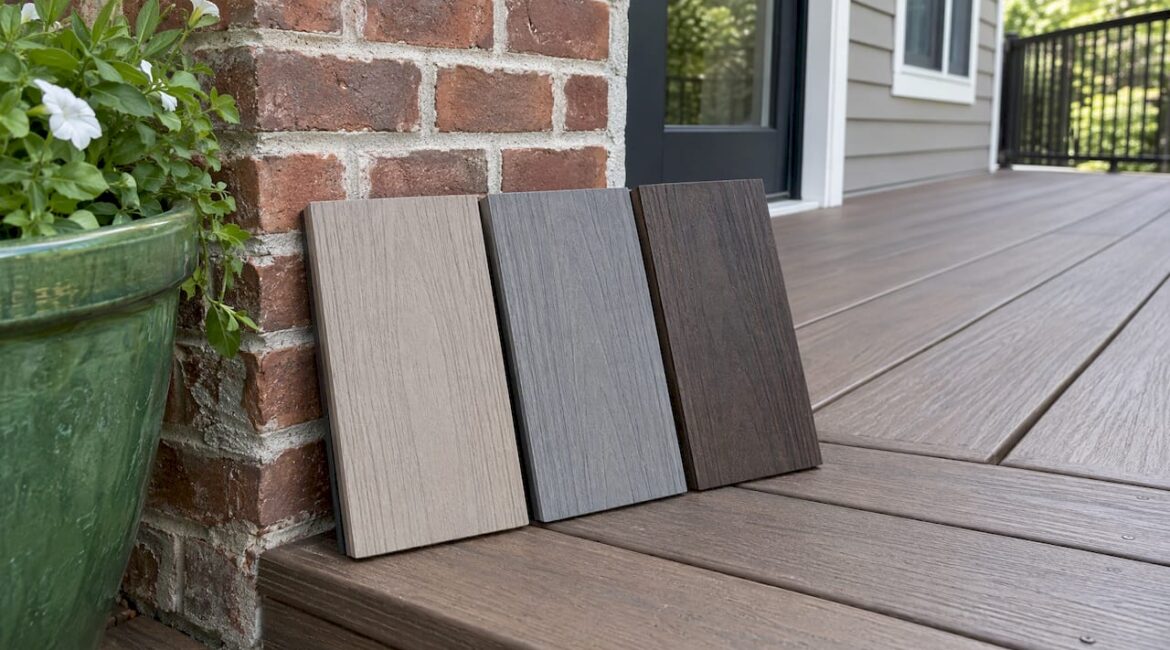
The best composite deck color is a tone that complements your home’s siding and trim, suits how much sun the deck gets, and still looks right after you test a real sample outdoors. Most homeowners land on a brown, tan or gray, and the real decision is which undertone and how light or dark.
We build decks across Bucks County, and color is the choice homeowners second-guess most. This guide walks through the main color families, how to match your house, what sun does to a dark board, and how to use borders so the finished deck looks designed rather than ordered from a catalog.
TL;DR
- Composite colors fall into a few families: grays, golden or tan browns, classic browns and, less often, reds and bold shades.
- Aim for a complementary tone to your house, not an exact match, and keep warm undertones with warm and cool with cool.
- Light boards hold less heat in all-day sun. Dark boards feel cozier and show a stronger edge.
- Always view full-size samples outside, at several times of day, next to your siding, brick and railing.
- A contrasting border board is an inexpensive way to make a deck look custom.
Table of Contents
- The main composite deck color families
- How to match your deck color to your house
- Sun, heat and the light-versus-dark decision
- Combining colors: borders, inlays and accents
- How to test a sample the right way
- Fading, maintenance and keeping the color you chose
- A few mistakes we see again and again
- Our perspective
- Plan your deck with JAG Home Enhancements
- FAQ
- Sources
The main composite deck color families
Composite boards are made to echo natural wood, so the most popular shades are warm, natural browns. Manufacturers group their lines in slightly different ways, but the pattern is consistent. One manufacturer’s color guide sorts its boards into grays, running from greige to graphite, golden browns, from warm tan to sun-kissed brown, and classic browns, from a traditional mid-tone to rich chocolate. Another retailer’s guide adds a reddish-brown category and counts 32 options for one brand family.
Here is how we describe the families to homeowners.
| Color family | Look and feel | Works well with |
|---|---|---|
| Light gray, greige | Open, modern, airy | White, blue or gray siding; small decks |
| Medium gray, taupe | Balanced, transitional | Almost any exterior; wooded or stone settings |
| Charcoal, graphite | Strong, contemporary edge | Light siding, black trim, large decks |
| Tan, golden brown | Warm, sunny, traditional | Beige, yellow, brick and stone homes |
| Classic brown, walnut | Rich, familiar, wood-like | Nearly everything; the safe choice |
| Reddish brown, teak, mahogany | Warm, tropical, high-end | Cream, tan or natural wood exteriors |
| Bold blues, greens, deep reds | Statement color | Accents and borders more than whole decks |
Trend reports point the same way. A decking retailer’s review of what’s hot lists earthy browns, grays and tans, tropical teak and walnut shades, grayscale palettes and a smaller group of vibrant colors, and notes that contrasting border colors are a growing technique.
Single-tone versus multi-tonal boards
Some boards are one even color. Others are multi-tonal, with streaks and variation that imitate real grain. Multi-tonal boards hide small marks and look more natural up close. Solid colors read cleaner and more contemporary from across the yard. Neither is better. Choose based on whether you want your deck to look like wood or to look like a designed surface.
How to match your deck color to your house
You do not need an exact match. In fact, a deck that is too close to the siding can look flat. A manufacturer guide recommends a complementary tone with some contrast from the home. Its rules of thumb are simple:
- Yellow, beige, tan or brown homes: almost any tan or brown board works.
- Red, gray or blue homes: those colors or a gray board.
- White homes: any color can work.
The same guide explains undertones. Yellow, orange or red undertones read warm, and blue, green or violet read cool. Sticking to warm with warm and cool with cool, for both the deck and the house, keeps things harmonious.
A lumber retailer’s color guide says much the same: warm earth-tone homes pair with browns, tans or warm-leaning grays, while cooler palettes of white, blue or gray siding pair with cool grays or even a rich dark brown for contrast. Another selection guide adds a useful point for strongly colored siding: choose a quieter deck color so the deck supports the house instead of competing with it.
Look at everything that stays
Your deck sits beside things you are not replacing: brick, stone, a front walkway, a patio, window frames, a roofline. Pull samples next to all of them. If you are also planning new siding, settle that first. Our look at siding color trends can help you choose a palette before you pick boards, since the deck should follow the house and not the other way around.
Do not forget the railing, fascia and stairs
Board color is only part of the picture. Railings, fascia, stair risers, landscaping and lighting all change how the finished deck looks. A common pairing is a medium or dark board with white or black railings. Stairs deserve their own thought, both for style and for safety, and our guide to deck stair design covers layout, code and lighting. If you plan evening use, deck lighting ideas show how light changes a board’s color after dark.
Sun, heat and the light-versus-dark decision
Color affects comfort as well as looks. A manufacturer’s color ideas page notes that light colors give a deck an open, airy feel, dark hues feel cozier, and decks in full sun benefit from lighter colors that hold less heat.
The physics is familiar. One decking guide compares it to wearing a black shirt or a white shirt on a summer day: darker boards heat up the most in all-day sun. It suggests a lighter board if the deck gets full sun every day, and says darker colors matter less in cooler climates or with limited sun. A retailer guide adds that lighter shades or lines with cooler-underfoot technology are worth considering for full-sun decks.
In Bucks County, summers are warm enough that this is worth a thought. Ask yourself:
- Does the deck face south or west with no shade?
- Will kids or pets cross it barefoot or in paws?
- Is a pergola, umbrella or tree canopy going to break up the afternoon sun?
If the answers are yes, yes and no, lean toward a medium or light tone. If the deck is shaded by mature trees, as many are around Doylestown and Buckingham, a darker board is much more forgiving. Shade structures can also change the equation, and we build pergolas, shade structures and privacy screens that let you keep a dark color and still stay comfortable.
What light and dark boards show
Light boards make a compact deck feel more open, but one selection guide’s comparison notes that dust, leaf stains and marks can be more visible on them. Medium gray, taupe and medium brown give a balanced transition between house and landscape. Dark gray, charcoal and dark brown create a stronger edge, but they can run warmer in direct sun and may show pale dust or pollen more clearly.
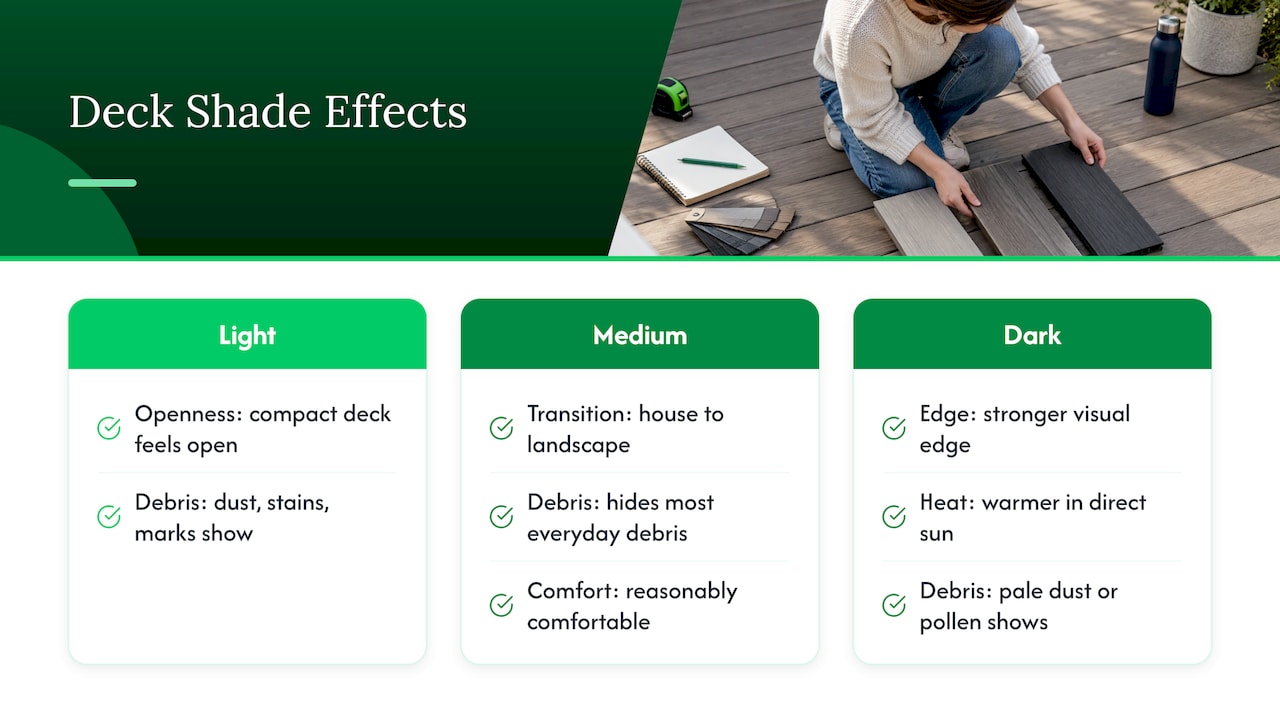
That is why medium tones are so popular. They hide most of the everyday debris and stay reasonably comfortable. If you cannot decide, a medium brown or taupe is rarely a regret.
Combining colors: borders, inlays and accents
One color across the whole deck is classic. Two colors, used with care, look custom. The easiest technique is picture framing, which lays at least one board, and up to three, around the perimeter, running perpendicular to the deck surface. A picture frame guide explains that frame boards also cover the deck’s end cuts, giving a crisp, polished look that can be as subtle or bold as you like.
There are three approaches:
- Same color: a subtle, sophisticated finish.
- Contrasting color: a bold look, for example a dark border around a mid-tone field.
- Complementary color: a harmonious effect, with a border one or two shades from the main boards.
Another decking guide points out a practical detail: if you use grooved-edge boards with hidden fasteners across the main sections, framing the perimeter with square-edge boards creates a more polished finish.
Some good pairings to start from:
- Medium gray field with a charcoal border for a modern look.
- Warm tan field with a deep brown border for a traditional house.
- Weathered brown field with a slightly darker stair tread to make steps easier to see.
Keep it to two colors, three at most. More than that rarely ages well. For more layout inspiration, see our deck design ideas for Churchville, Jamison and Warrington, which show what tends to add value in nearby neighborhoods.
Finishing the edges
The space under a raised deck is part of the view. Skirting in a matching or complementary color closes it off and makes the deck look finished from the yard. Our guide to deck skirting ideas covers materials and styles, and it helps to choose skirting at the same time as boards.
How to test a sample the right way
Screens and brochures lie. Photos are shot in professional lighting and your monitor has its own calibration. A color selection guide calls evaluating physical samples in the intended location the most critical step, and recommends looking at them in the morning, at noon and in the evening. Another guide warns that a sample that looks right indoors can look lighter, darker, warmer or cooler outside.
Here is the process we suggest:
- Get full-length sample boards, not just small chips, if you can.
- Lean them next to your siding, brick, stone or pavers.
- View them in direct sun, shade, morning light and late afternoon light.
- Look from the back door, the yard and the spot where you will sit.
- Hold them beside the planned railing, fascia, stair trim and border board.
- Check the texture and sheen when dry and after water, such as a rinse with a hose.
- Leave them out for several days, so you see them in normal conditions.
Then decide with your household, not in the showroom. If two colors tie, choose the one that looked better on a cloudy day. That is the color you will see most often.
Fading, maintenance and keeping the color you chose
Most homeowners pick a color and expect it to stay that way. Capped composite boards are designed for that. A manufacturer guide to capped decking states that the polymer cap protects against mold, mildew, fading and surface wear, and that occasional cleaning with soap and water keeps the deck looking its best. It also notes that some capped boards are capped on all four sides for additional protection against moisture and UV.
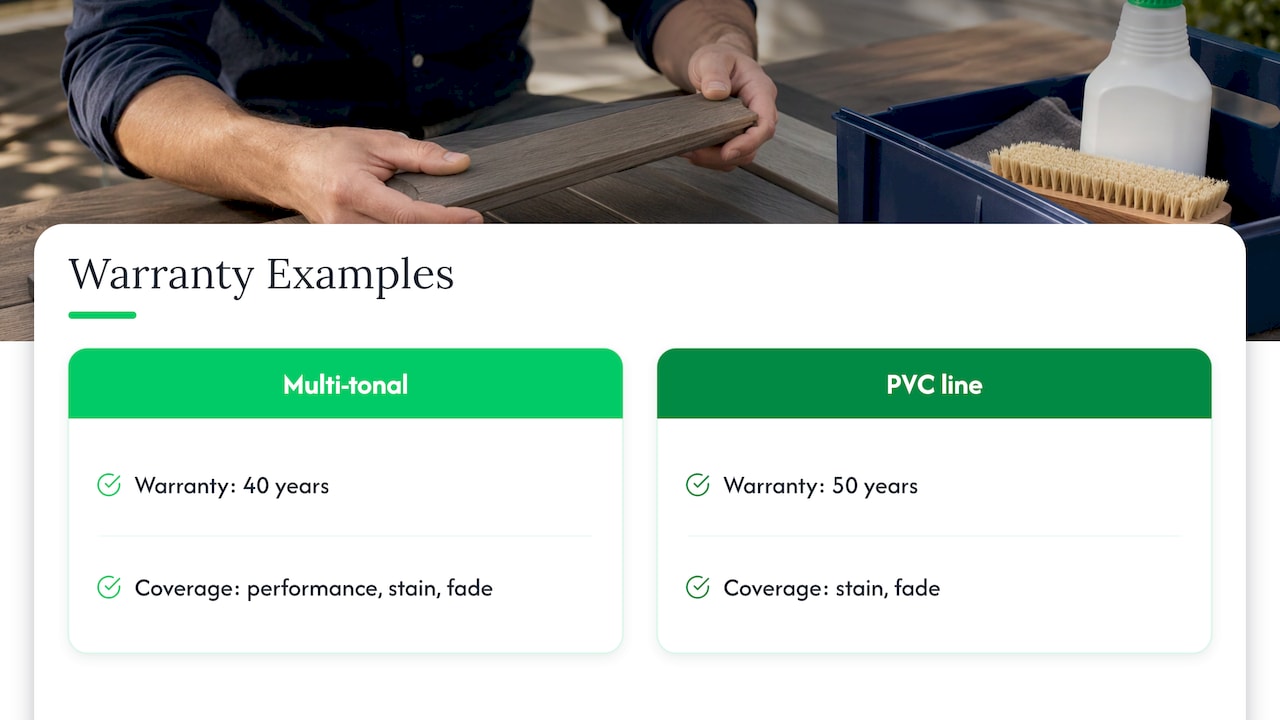
Warranty terms differ by product line, so read the stain and fade coverage on the exact board you choose. For example, one manufacturer states a 40-year performance, stain and fade warranty on one multi-tonal line, and a 50-year stain and fade warranty on a PVC line. Details and exclusions vary, so ask us for the warranty document for your specific product.
To keep the finish looking its best, follow a seasonal routine. Our deck maintenance schedule lays out what to do each season. If you are still weighing materials, our comparison of composite decking versus wood decking explains how they differ in upkeep and lifespan.
Furnishing the deck once the color is set
Color does not end with the boards. Cushions, planters and rugs are the easiest way to add the bold shades you decided not to put on the boards. If you add an outdoor rug, read up on using an outdoor rug safely so moisture does not get trapped underneath. Neutral boards, whether warm brown, gray or tan, give you a flexible background for whatever palette you pick.
A few mistakes we see again and again
- Choosing from a small chip indoors. The color shifts outside. Always test full boards on site.
- Ignoring the undertone. A warm-brown deck against a cool gray house can look off even if both colors are nice on their own.
- Going dark on a sunny, unshaded deck. It looks great in the showroom and may be uncomfortable in July.
- Matching exactly. Too much similarity flattens the design. Look for contrast.
- Forgetting the railings and stairs. Choose them in the same sitting as the boards.
- Using too many colors. Two or three is plenty.
Our perspective
When homeowners ask us which color is best, we start with questions about their home, not the color wheel. How much sun does the deck get? What does the siding look like in the afternoon? Where will you sit?
We lean toward medium tones in warm browns, taupes and grays because they hide everyday dust, hold up in sun and sit comfortably next to most Bucks County exteriors, from stone farmhouses to newer vinyl-sided homes. But the right answer is the one that still makes you smile in three years.
We also like a border board. It costs little compared with the project, and it gives the deck a finished, custom look. We bring samples to your property, set them against your actual house and help you see the design before anything is built, because choosing a color is much easier when you can see it on your own home.
Jeff
Plan your deck with JAG Home Enhancements
We design and build custom decks in Bucks County and nearby areas, including new construction, resurfacing and refinishing, and composite decking installation. Our work also covers custom railings and built-in seating, outdoor kitchens and bar areas, and pergolas and privacy screens. You get personalized service, clear communication and a clean job site from consultation through completion.

If you are ready to turn a color idea into a plan, explore our custom deck and outdoor living services or reach out through JAG Home Enhancements to schedule a consultation. If you are planning a spring build, see why spring is a smart time to build a deck in Bucks County.
FAQ
What is the most popular composite deck color?
Browns and grays lead the market. Because composite is meant to mimic wood, warm natural browns and tans are the traditional favorites, with gray growing steadily as a modern alternative. A medium brown or taupe is the safest choice if you want a color that suits most homes.
Should my deck match my house?
Not exactly. A complementary tone with some contrast usually looks better than a perfect match. Keep warm undertones with warm house colors and cool with cool, and pair the deck with fixed features such as brick, stone and trim.
Are dark composite decks too hot to walk on?
Dark boards absorb more heat, so they can be warmer underfoot in all-day sun. If your deck gets full, unshaded sun, a lighter or medium board is more comfortable. If the deck is shaded by trees or a pergola, dark colors are less of a concern.
Will my composite deck color fade?
Capped composite boards are designed with a protective polymer shell that resists fading, mold and surface wear. Warranty terms and fade coverage vary by product line, so review the documents for the exact board you pick. Regular cleaning with soap and water helps the deck keep its look.
How do I choose between two similar colors?
Put full-size samples outside, next to your siding and railing, and look at them in morning, midday and evening light. Keep them for several days. The one you prefer on both sunny and overcast days is usually the right one.
Sources
- How to find your ideal composite deck board color (manufacturer guide)
- Composite decking color options and how to choose (retailer guide)
- Composite decking colors: what’s hot (August 2024)
- Composite decking color selection guide
- Composite decking colors: selection guide (October 2026)
- Deck color ideas (manufacturer guide)
- Picture frame composite deck ideas
- Capped composite decking: what it is
- Multi-tonal decking product page and warranty
- PVC decking product page and warranty
- Using an outdoor rug on a deck safely