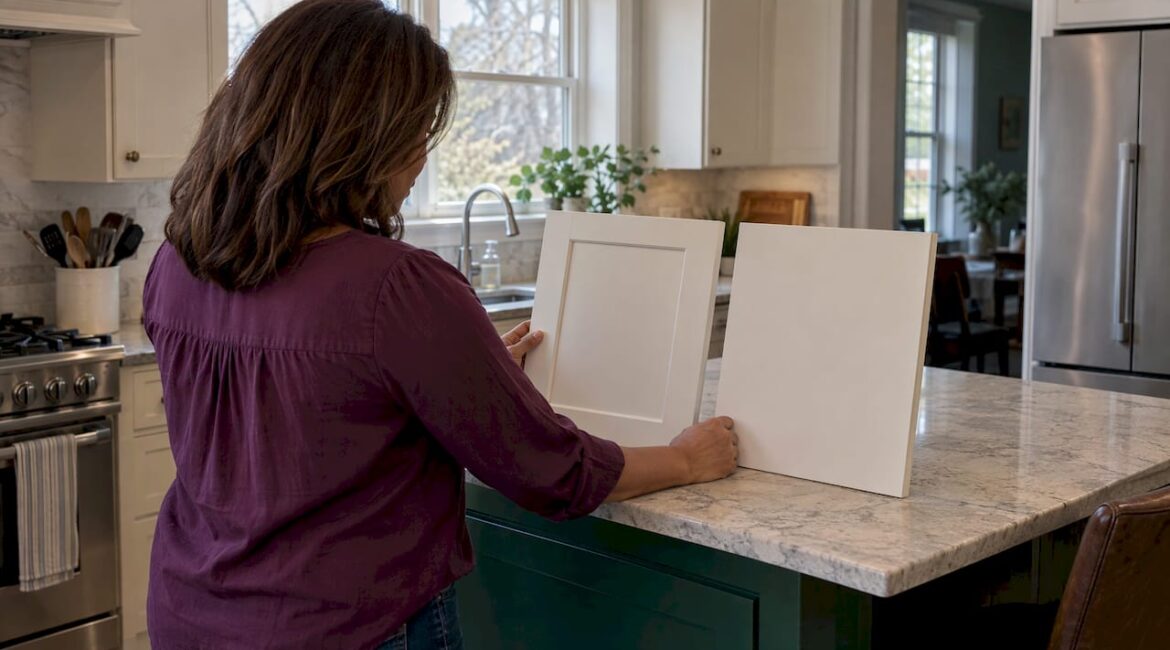
The right kitchen cabinet style is the one that fits your home’s architecture, your cleaning habits and your budget, and for most homeowners that points to a Shaker or a flat-panel door in a durable material. Cabinets take up more visual space than anything else in a kitchen, so the door style sets the tone for the whole room. It also affects how much time you spend wiping grease off the fronts, how well the kitchen suits an older house, and how it will look to a buyer years from now.
This guide explains each style in plain terms, compares the two doors people ask about most (raised panel and flat panel), and walks through materials and construction so you can judge a door by more than its looks. If you are planning a kitchen in Bucks County or Montgomery County, our kitchen remodeling team can help you narrow the choice once you have read this.
TL;DR
- Cabinet styles fall into three families: traditional, contemporary and transitional. Most homes suit a Shaker door or a flat-panel door.
- Raised-panel doors look classic but their detailing collects dirt. Flat-panel and slab doors are the easiest to keep clean.
- The door style is only half the decision. Materials and construction decide how long the cabinets last.
- Choose a style that complements the rest of the house, then check the build quality behind the door.
- Water is the biggest threat to most cabinet materials, so plan for the sink and dishwasher areas.
Table of Contents
- The three families of kitchen cabinet styles
- Kitchen cabinet door styles, one by one
- Raised panel vs. flat panel
- Style is not the same as construction
- Materials and finishes that decide durability
- Protect cabinets from water
- How to choose a style for your home
- Budget and timing
- Our perspective
- Plan your cabinets with JAG Home Enhancements
- FAQ
- Sources
The three families of kitchen cabinet styles
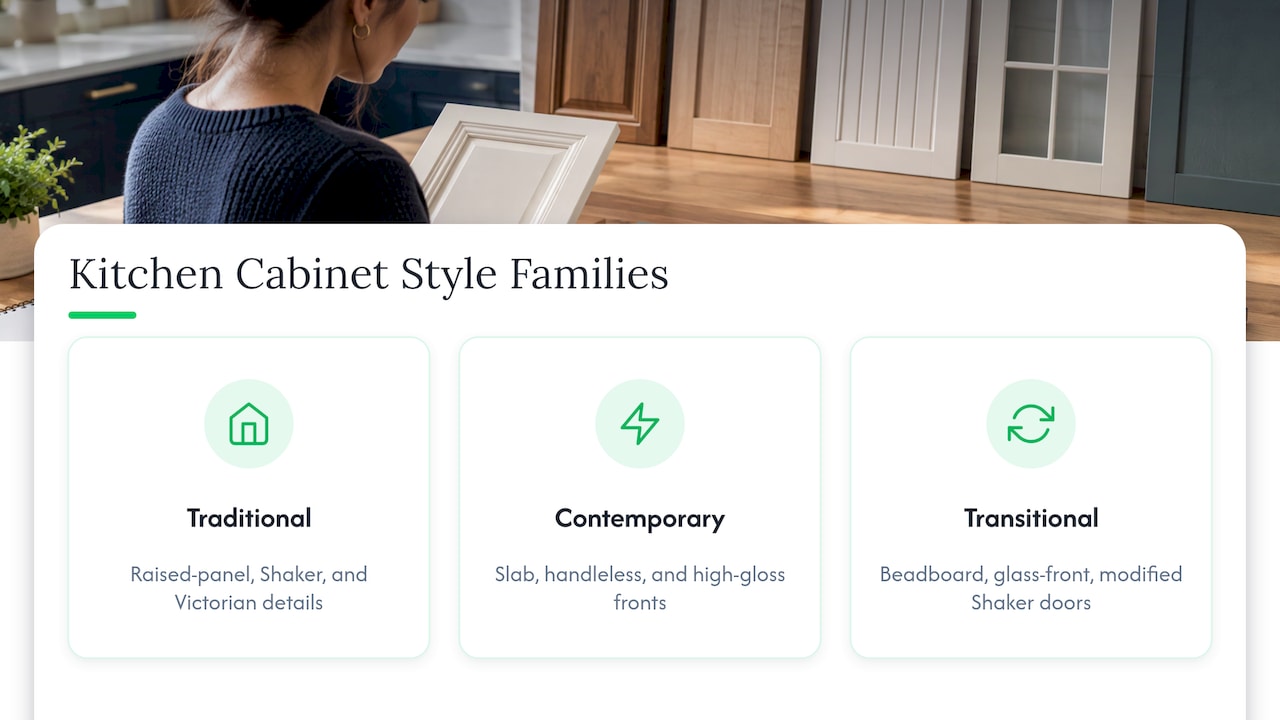
It helps to sort the dozens of names you will hear into three groups. This Old House divides cabinet styles into traditional, contemporary and transitional.
Traditional kitchens lean on detail. That includes Colonial-style raised-panel doors in warm wood tones, Shaker doors with a five-piece frame and a recessed center panel, and Victorian styling with carvings, glass fronts and ornate hardware.
Contemporary kitchens favor clean lines. Think flat-panel or slab fronts, handleless doors that open with a push, and high-gloss lacquered finishes.
Transitional kitchens sit in between. Beadboard, glass-front doors and a modified Shaker with narrower stiles and rails (the vertical and horizontal frame pieces) are typical.
If you cannot decide between old and new, transitional is usually the safest direction. It reads as current without tying the kitchen to a single decade.
Kitchen cabinet door styles, one by one
The door is the part you see and touch every day. Here are the styles homeowners ask about most, with what each looks like and where it works.
Shaker
A Shaker door has a frame of four pieces around a flat, recessed center panel. Bob Vila’s style roundup notes that flat-panel is less popular than the standard Shaker, which tells you how dominant Shaker has become. It looks right in farmhouse, traditional and modern kitchens, and it takes paint well. One thing to know: a painted Shaker can show hairline cracks at the joints over time, and the bottom rail has a small ledge where dust settles. Both are normal traits of the design, and good finishing keeps them minor.
Flat panel
A flat-panel door has a recessed center panel inside a raised frame, with little or no profile. This Old House says it works in both traditional and modern kitchens. Bob Vila reports that it is a good choice for a sleek, modern look and the easiest profile to keep clean.
Raised panel
The center panel rises toward the edges, giving a three-dimensional look. It is associated with traditional design and suits formal or older homes. The same detailing that gives it character also catches dirt, and Bob Vila reports it takes more time to clean than a flat front.
Slab
A slab door is a single flat piece with no frame. It is ideal for modern kitchens and gives the cleanest look. Because there is nothing to break up the surface, the material and finish matter a lot. On a long run of cabinets, matching the grain from door to door is what makes slab fronts look intentional.
Beadboard
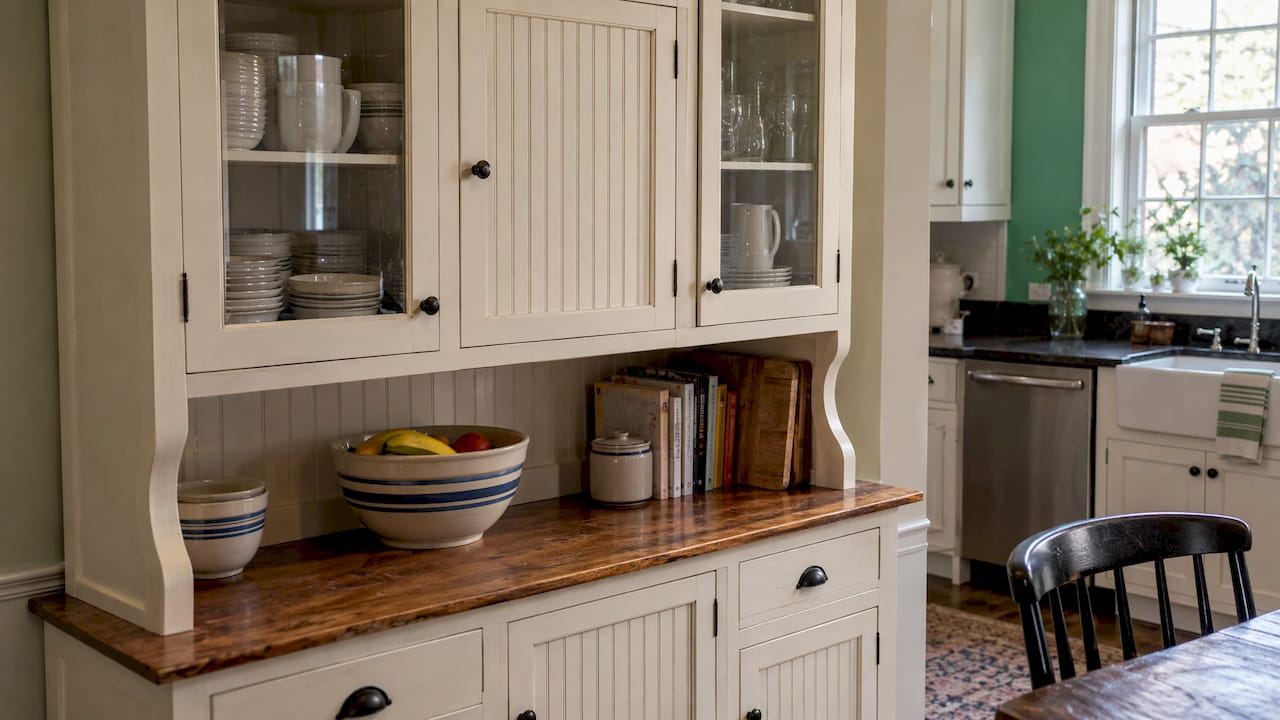
Beadboard has vertical grooves in the center panel. It brings a cottage or country feel and works well in a casual kitchen, or on an island or a hutch where you want a touch of texture.
Glass-front
A glass panel lets you display dishes and makes the kitchen feel more open. Most homeowners use glass on a few upper cabinets as an accent rather than across the whole kitchen, because everything inside is visible.
Inset
Inset doors sit flush inside the cabinet frame rather than on top of it. They have a refined, furniture-like look. They are built to precise tolerances, so they are usually a made-to-order choice.
Raised panel vs. flat panel
This is the comparison people search for most, and it comes down to detail versus ease.
| Raised panel | Flat panel | |
|---|---|---|
| Look | Traditional, formal, three-dimensional | Clean, simple, works traditional or modern |
| Cleaning | Detailing collects dirt and takes longer to wipe | The easiest profile to keep clean |
| Best for | Formal or older homes | Updated, family kitchens |
| Watch for | Shrinkage lines in the panel, heavier look | Fewer decorative options |
The cleaning difference comes from Bob Vila’s cabinet style guide, where a kitchen designer calls flat-panel the easiest profile to keep clean. The same guide describes raised-panel doors as a traditional mainstay whose detailing is dirt-catching. In a kitchen where someone fries food several nights a week, that gap adds up.
Raised panel has one practical strength in older houses. Its trim styles can be customized, which makes it easier to adapt to low ceilings and out-of-level walls, a common situation in older Pennsylvania homes. If your Bucks County house has settled over a century or two, a door style that tolerates uneven lines is worth considering.
Style is not the same as construction
Cabinet style describes how the door looks. Construction describes how the whole cabinet is made and sold. The two are separate decisions, and mixing them up is a common source of regret.
Consumer Reports explains three construction levels in its buying guide, published in 2016, so treat its dollar figures as a ratio rather than today’s price:
- Stock cabinets are off-the-shelf units, limited in colors and styles, and often thinly veneered particleboard. Its guide put them at about $70 per foot.
- Semi-custom cabinets are made to order in sizes, materials, finishes and trim, and the guide calls them the best-value choice for most kitchens, starting around $150 per foot.
- Custom cabinets are built to exact specifications with many added features and cost the most.
The same guide describes what well-built cabinets have: solid wood drawers with dovetail joints, full-extension drawer guides, and doors with a solid wood frame around a solid wood or plywood panel instead of veneered particleboard or MDF. Those are good things to look at when you open a drawer in a showroom.
Materials and finishes that decide durability
Two Shaker doors can look identical and age very differently. This Old House summarizes the common materials this way:
- MDF (medium-density fiberboard) is stable and takes paint well.
- Particleboard is economical and common in stock cabinets.
- Plywood is strong and resists warping.
- Solid wood is durable for door and drawer fronts.
- Thermofoil is durable and easy to clean.
On the wood-versus-MDF question, Homes and Gardens quotes interior designer Kimberly Oxford, who says solid wood cabinets are hardwearing, can be refinished several times and develop a patina. She says MDF cannot be refinished the same way and is more susceptible to damage from prolonged moisture, so she pairs painted MDF doors with plywood cabinet boxes for a balance of beauty and longevity.
A practical rule of thumb follows from that. Painted styles such as Shaker look crisp on MDF doors. Stained styles that show grain look best in solid wood. Plywood boxes behind either one give you strength where you do not see it.
One finish worth understanding is rigid thermofoil, often called RTF. A guide to RTF cabinets reports that they can last around 10 to 15 years with proper care and resist scratches and UV light, but heat is their weak point. Steam can blister the vinyl, so appliances that give off high heat need heat shields. If your range sits next to the cabinet run, that detail matters.
Protect cabinets from water
Whatever style you choose, the sink base, the dishwasher side panels and the area around the refrigerator water line are where cabinets fail first. Most materials swell or degrade when they stay wet. If you ever have a leak, the first two days matter. We wrote a 24 to 48 hour rule for saving kitchen cabinets by material that explains what to do for each type.
How to choose a style for your home
Family Handyman lists six common styles (Shaker, Craftsman or Mission, flat-front or slab, beadboard, handle-free and raised-panel traditional), and a lead designer it quotes advises homeowners to choose a style that complements the rest of the home. Here is a simple way to apply that.
- Look at the house first. Walk through the rooms next to the kitchen. Trim profiles, flooring and window style tell you which family of cabinets will feel natural. A colonial with heavy crown molding invites raised panel or Shaker. A renovated open plan with clean lines suits flat panel or slab.
- Be honest about cleaning. If you cook a lot, choose fewer grooves and ledges. Flat panel and slab are easiest to wipe.
- Set the finish before the color. Painted or stained decides the material. Paint suits MDF doors. Stain suits solid wood.
- Decide the construction level. Semi-custom often gives the best balance of choice and cost, according to Consumer Reports. Custom makes sense when your room has odd dimensions.
- Check the layout. A door style looks different in a galley than in an open plan. Our guide to kitchen layout types shows what fits which space.
- Think about resale. Timeless choices such as Shaker in a neutral color tend to appeal to the widest range of buyers. Our look at kitchen remodel ROI in Bucks County covers what homeowners tend to get back.
Common mistakes
- Choosing a trending color or high-gloss finish that will date quickly.
- Spending on door details and skipping the box construction behind them.
- Ignoring where the dishwasher and sink sit when you pick a moisture-sensitive material.
- Forgetting hardware. A handle can shift the same door from farmhouse to modern.
- Not leaving room in the plan for lighting. Our guide to kitchen cabinet lighting covers where it goes.
Budget and timing
Cabinets are usually the largest single line in a kitchen budget, so style choice and construction level drive cost. A simple Shaker or flat-panel door in a semi-custom line is typically easier on the budget than heavily detailed raised-panel or inset work. If cost is your main concern, our guide to kitchen remodeling on a budget in Bucks County shows where to spend and where to save.
Timing matters too. Made-to-order cabinets take time to produce, and your schedule depends on that lead time. Our kitchen remodel timeline explains what to expect at each stage so the cabinets arrive when the room is ready for them.
Our perspective
Homeowners often start with a photo they like and a door name they have heard. We start with the house. A cabinet style that looks right in a magazine can feel wrong in a 1950s Cape or a stone farmhouse, and the fix later is expensive.
We suggest weighing three things in order: how the kitchen is used, how the house is built, and how long you plan to stay. A family that cooks daily usually does better with cleaner profiles. An older home with uneven walls and low ceilings often does better with a door that has adjustable trim.
Our approach is to give honest recommendations, keep communication clear, and manage the project from the first consultation through completion, with a clean and safe job site along the way. That way the style you choose is the one that works in your actual room.
Jeff
Plan your cabinets with JAG Home Enhancements
JAG Home Enhancements is a home remodeling company based in Bucks County, PA. We handle kitchen and bathroom renovations for homeowners in Bucks County, Montgomery County and nearby areas, with personalized service and full project management from consultation through completion.
If you are comparing cabinet styles for a kitchen remodel, start with our kitchen remodeling services, or see our Bucks County kitchen renovation ideas and trends for inspiration. For a conversation about your own project, visit JAG Home Enhancements.
FAQ
What is the most popular kitchen cabinet style?
Shaker is the most common style today. Bob Vila’s guide describes it as more popular than flat-panel. Its simple recessed-panel frame works in traditional, transitional and modern kitchens, and it looks good painted or stained.
What is the difference between raised-panel and flat-panel doors?
A raised-panel door has a center panel that rises toward the edges for a three-dimensional, traditional look. A flat-panel door has a recessed center panel in a raised frame with little profile. Flat panel is easier to clean because it has less detailing to collect dirt.
Which cabinet door style is easiest to keep clean?
Flat-panel and slab fronts are the easiest to wipe down, since they have few grooves or ledges. Raised-panel and beadboard doors take more time because dirt settles in the detailing.
Are MDF cabinet doors a good choice?
MDF is stable and gives a smooth surface that takes paint well, which makes it a common choice for painted Shaker and flat-panel doors. Keep it dry, since prolonged moisture can damage it. Many designers pair MDF doors with plywood cabinet boxes for added strength.
How do I pick a style that will not look dated?
Choose a style that complements the architecture of your home, and favor simple profiles such as Shaker or flat panel in a neutral finish. Hardware and paint color are easy to update later, while the door shape is not.
Sources
- All About Kitchen Cabinets, This Old House
- 10 Kitchen Cabinet Styles to Consider, Bob Vila
- Best Kitchen Cabinet Buying Guide, Consumer Reports
- Kitchen Cabinet Materials Explained, Homes and Gardens
- RTF Kitchen Cabinets (Finishes and Cabinet Doors)
- Guide to Choosing Kitchen Cabinets, The Family Handyman