

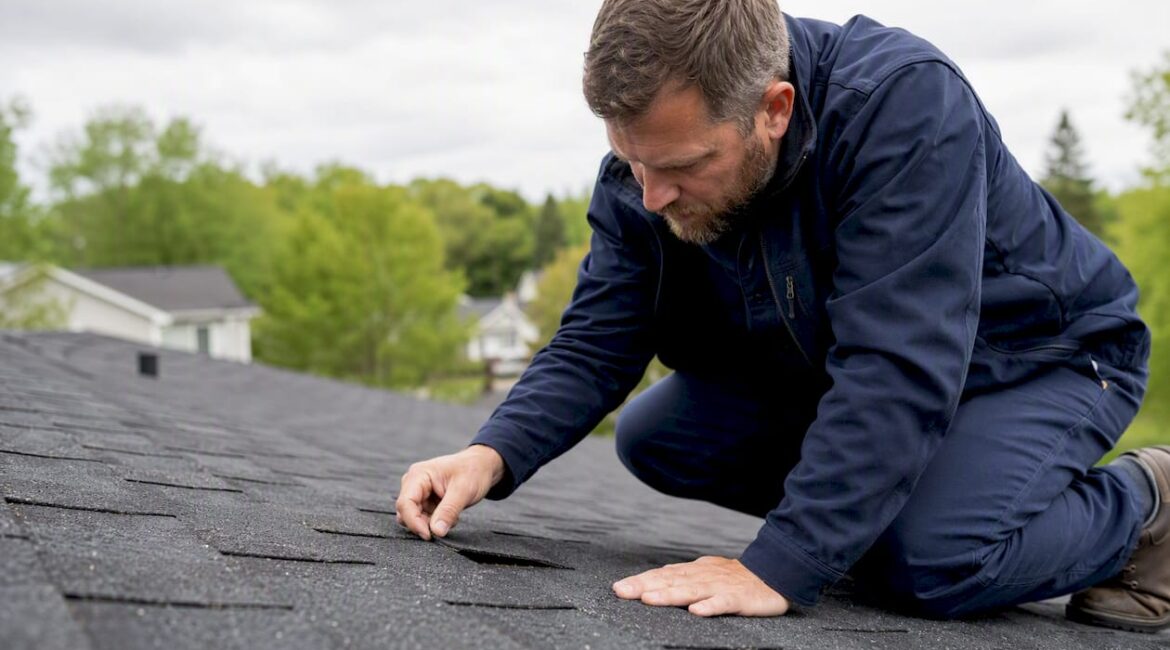
If two or more decision signals point to replacement, choose replacement. If only one signal is present, a targeted repair is usually the right call. The three signals to check are: how much of the roof’s expected lifespan has been used, how much of the roof surface is damaged, and whether your repair estimate is at or above 30% of a full replacement quote. When that repair-to-replacement ratio hits 30%, the math almost always favors starting fresh.
- Roof age: Has the roof used more than 75% of its expected lifespan?
- Damage extent: Does damage cover a significant portion of the roof surface?
- Cost ratio: Is the repair estimate a substantial fraction of a full replacement quote?
Statistic to know: Industry guidance puts the threshold clearly: repairs significantly below a third of replacement cost typically favor repair; at or near a third, replacement is usually the better financial choice; at very high fractions, replacement is almost always correct.
Pro Tip: Get both a written repair estimate and a like-for-like replacement estimate before deciding. You cannot apply the 30% rule without both numbers in hand.
Table of Contents
- What factors actually determine whether you repair or replace?
- What damage thresholds usually trigger a roof replacement?
- How do repair and replacement costs compare, and what is the 30% rule?
- When does a repair make sense?
- When does replacement become the responsible choice?
- How do you move from diagnosis to a confident decision?
- What are your material options if you decide to replace?
- What do insurance, permits, and warranties mean for your decision?
- Why a qualified contractor changes the outcome
- Key Takeaways
- The mistake most homeowners make with their roof
- Jaghomesnow handles roofing repairs and replacements across Bucks County
- Useful sources and further reading
What factors actually determine whether you repair or replace?
The roof repair vs replacement decision comes down to five variables. Each one shifts the math, and understanding them together gives you a clear picture before you spend a dollar.
Age as a percentage of expected lifespan matters more than raw years. A 15-year-old architectural asphalt roof with a 25-year lifespan has used 60% of its life. That same 15 years on a metal roof rated for 50 years represents only 30%. The key thresholds for asphalt roofs: under 10 years with isolated damage almost always favors repair; roofs between 10–15 years are a gray zone; over 20 years, replacement is usually the correct choice.
Extent of damage is the second axis. Localized damage, say two missing shingles over a 2,000 sq ft roof, is a fraction of 1% of the surface. Widespread granule loss across three slopes is a different story entirely. Estimating the percentage of affected area is something a qualified contractor can do during an inspection, and it directly feeds the replacement threshold.
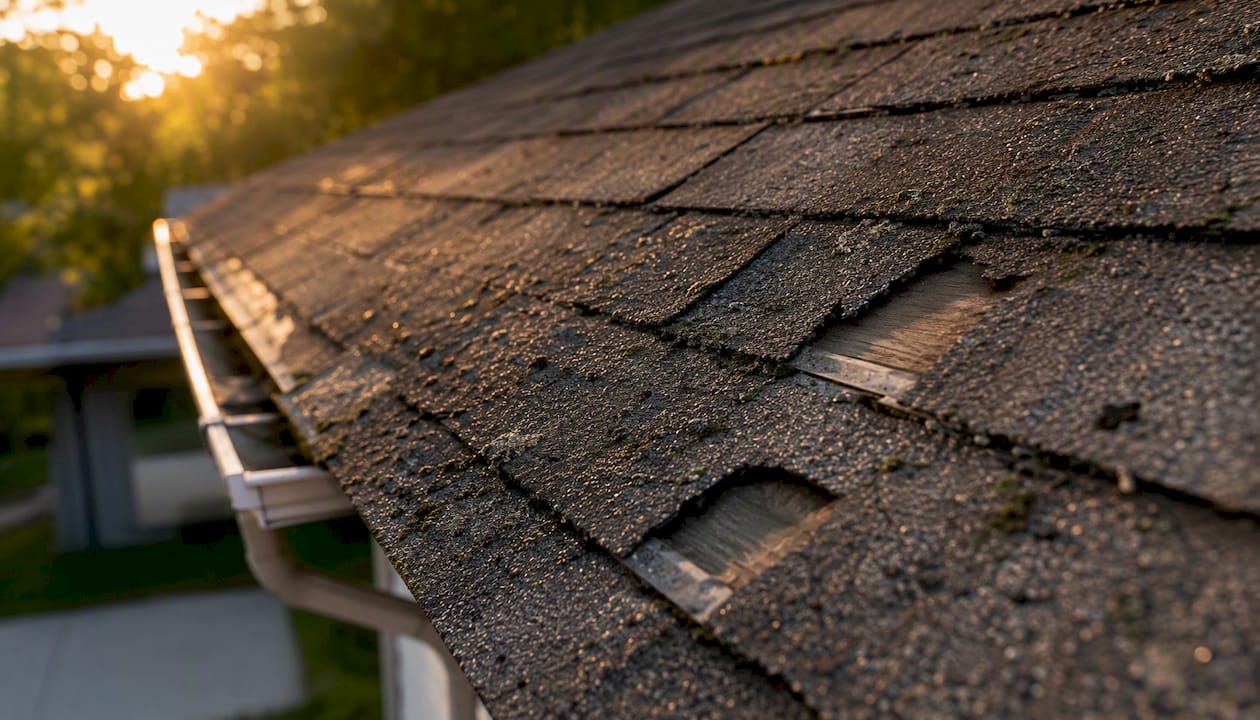
Type of damage separates cosmetic problems from structural ones. Algae streaks or a single missing shingle are cosmetic. Rotted decking, daylight visible from the attic, or water stains spreading across multiple rafters are structural, and structural damage changes the calculus regardless of age or percentage.
Repair history tells you whether you’re dealing with a single incident or a pattern. One repair in five years is normal. Three meaningful patches in two years signals a system that is failing, not just aging.
Your time horizon shapes the financial logic. Selling within two years? A targeted repair may be all you need to pass inspection. Staying 10 or more years? The long-term cost of repeated repairs on an aging roof often exceeds a single replacement done now.
What damage thresholds usually trigger a roof replacement?
Replacement is typically recommended when damage affects a substantial portion of the roof surface, or when the roof has exceeded most of its expected lifespan and shows systemic issues. Below 10% affected area, repair is almost always the right answer. Between 10% and 25%, the decision depends on age, damage type, and cost ratio. Above 25–30%, replacement is the standard recommendation.
Certain signs push past any percentage threshold. These structural red flags indicate system failure, not single-component failure:
- Multiple active leaks in different locations
- Daylight visible through the roof deck from the attic
- Sagging or spongy deck when you walk the roof
- Widespread granule loss and curling or cupping across multiple slopes
- Water stains spreading across several rafters or ceiling areas
When any of these structural signs are present, prioritize safety and schedule a professional inspection immediately. A compromised deck or multiple active leaks are not repair candidates — they are replacement triggers, full stop.
One more factor homeowners often miss: local building codes in many jurisdictions require a full replacement when more than 25% of a roof section is damaged within a 12-month period. A partial reroof that crosses that threshold may require a permit and a full tear-off anyway. Always check your municipality’s permitting rules before planning a partial fix.
How do repair and replacement costs compare, and what is the 30% rule?
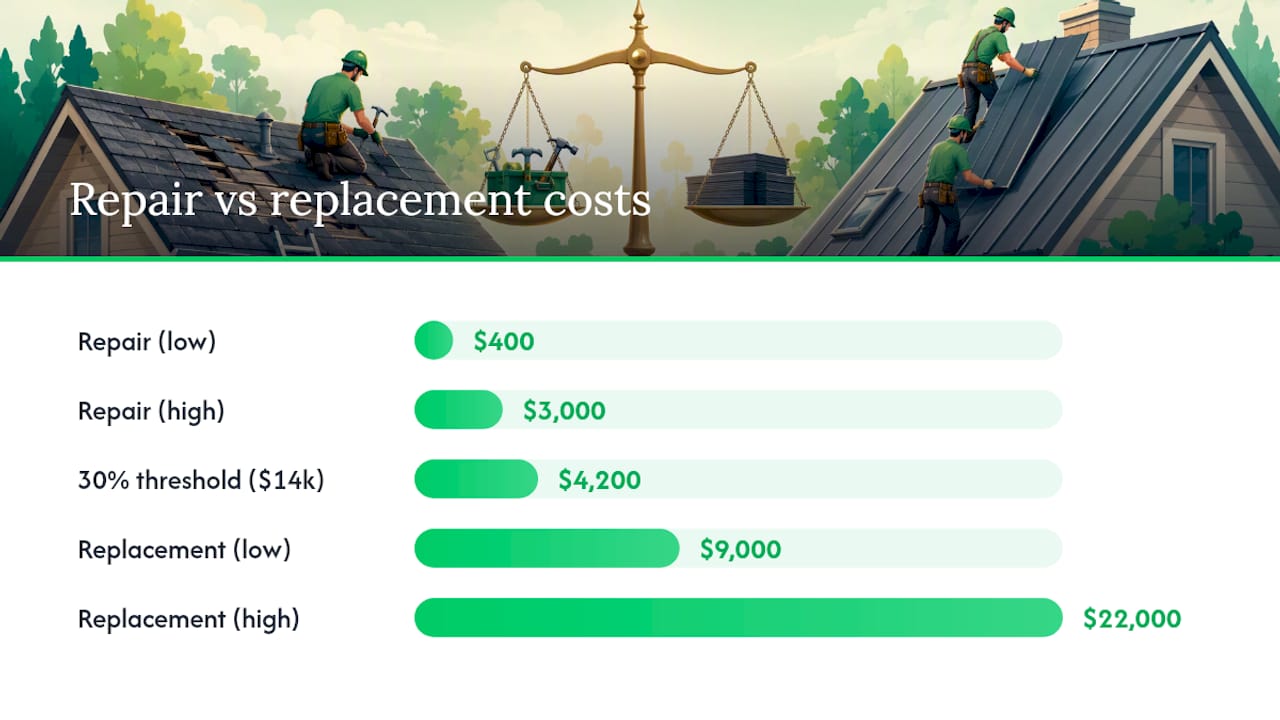
Most roof repairs range from about $400 to $3,000, while a full asphalt replacement for an average U.S. home commonly runs $9,000 to $22,000. The spread is wide because scope varies so much, from a single flashing repair at the low end to a full architectural shingle reroof with decking repairs at the high end.
The 30% rule removes emotional bias from the decision. Take your repair estimate, divide it by the replacement quote, and multiply by 100. If that number is 30 or higher, replacement is the financially sound choice. The rule works because it accounts for the repair-and-repeat trap: paying $2,500 today, then $1,800 next year, then $3,000 the year after adds up to more than a single replacement, with none of the warranty protection.
Worked example for a 2,000 sq ft home:
Assume a contractor quotes $14,000 for a full architectural asphalt replacement. The 30% threshold is $4,200. If your repair estimate is $4,200 or more, replacement is the better financial decision. If the repair is $2,000 for a localized fix on a 10-year-old roof, repair wins clearly.
| Item | Repair | Full Replacement |
|---|---|---|
| Typical cost range | $400–$3,000 | $9,000–$22,000 |
| Warranty coverage | Limited (repair area only) | Full material + workmanship |
| Expected additional life | 1–5 years (condition-dependent) | 20–50+ years (material-dependent) |
| Risk of interior damage | Ongoing if systemic | Eliminated at replacement |
Delaying replacement when systemic failure is already present carries a real financial penalty. Hidden interior costs from decking rot, insulation damage, and mold typically add 20–40% to the eventual replacement cost compared to acting promptly.
Pro Tip: Ask every contractor for an itemized written estimate, not a single lump sum. Itemized quotes let you compare line by line and apply the 30% rule accurately.
When does a repair make sense?
Repair is the right answer more often than many homeowners expect. Homeowners frequently overreact to isolated symptoms like a single missing shingle, when a targeted professional fix is all that is needed. The key is confirming the damage is truly localized and the underlying deck is sound.
Common repair scenarios where a fix preserves service life and budget:
- A few missing or cracked shingles after a windstorm, with no deck damage beneath
- An isolated flashing failure at a chimney, skylight, or wall transition
- A single pipe boot (the rubber seal around a plumbing vent) that has cracked or separated
- A small, localized leak with no signs of rot, mold, or widespread moisture in the attic
Age context matters here. Roofs under 10 years old with isolated damage almost always favor repair. The roof still has the majority of its service life ahead, and a professional repair preserves that value. Handling the repair promptly also protects your manufacturer’s warranty, since many warranties require documented professional maintenance. Waiting until a leak becomes obvious can invalidate some warranty remedies and complicate insurance claims.
One honest caveat on aesthetics: new shingles rarely match weathered ones due to UV fading. A repair on a visible slope will likely be noticeable. For homeowners planning to sell, that visual mismatch is worth factoring into the decision.
When does replacement become the responsible choice?
Replacement is the responsible call when the roof is failing as a system rather than at a single point. The distinction matters because patching a system failure produces diminishing returns quickly.
Systemic failures that warrant replacement include rotted or spongy decking, multiple leaks in different roof sections, visible daylight through the attic, and widespread curling or granule loss across the field. These are not isolated component failures. They indicate the roof’s structure and weatherproofing layer have degraded beyond what targeted repairs can address.
Age thresholds by material reinforce the decision. A standard 3-tab asphalt roof at 18 years has used roughly 90–100% of its expected 15–20 year lifespan. Repairing it is borrowing time, not solving a problem. The same logic applies to architectural asphalt past 25 years, or any material that has exceeded roughly 75% of its rated lifespan while showing systemic symptoms.
Repeat-repair economics make the case plainly. Three meaningful repairs totaling $6,000 on a roof that still needs replacement in two years cost more than a single replacement done at the right time, with no warranty and no long-term protection to show for it.
Insurance-triggered replacement is an opportunity worth understanding. When a covered storm event requires full replacement, insurers restore pre-loss condition, meaning you often receive a full replacement for the cost of your deductible rather than a patch. If your roof is aging and a qualifying storm event occurs, that claim can be the financially optimal moment to replace.
Replacement also opens the door to material upgrades. Switching to metal roofing in a climate with extreme temperature swings, or to architectural shingles from 3-tab, changes the long-term financial picture beyond just stopping leaks. A replacement is an opportunity to improve energy efficiency, extend service life, and potentially qualify for incentives that a repair never triggers. Proper roofing ventilation and insulation upgrades done at the time of replacement also extend the new roof’s service life significantly.
How do you move from diagnosis to a confident decision?
A structured approach keeps you from making an expensive call based on incomplete information. Follow these steps in order.
- Inspect the attic first. Look for daylight through the deck, water stains on rafters, soft or discolored wood, and any signs of mold or mildew. Attic evidence often reveals problems invisible from the ground.
- Walk the exterior perimeter. Check for granule accumulation in gutters, curling or cupping shingles, missing shingles, and whether the roofline is straight or shows any sagging.
- Check flashing at every penetration. Chimneys, skylights, vents, and wall transitions are the most common leak entry points. Lifted, cracked, or missing flashing is a repair trigger; widespread flashing failure is a replacement signal.
- Get 2–3 written estimates. Request both a repair estimate and a like-for-like replacement estimate from each contractor. Apply the 30% rule once you have both numbers.
- Ask every contractor these questions: Are you licensed and insured in Pennsylvania? What warranty do you offer on labor and materials? Will you do a full tear-off or an overlay? How do you handle decking damage found during tear-off? What permits will you pull?
- Watch for these red flags: High-pressure urgency to sign today, vague scope with no line-item breakdown, no written warranty offered, demand for more than 10–15% upfront in cash, or workers who cannot provide proof of insurance.
A preventive maintenance plan between major repairs or after a new installation also extends service life and keeps small problems from becoming expensive ones. For homeowners in Bucks County and surrounding areas, winter weather adds freeze-thaw stress that accelerates flashing failures and granule loss, making annual inspections especially worthwhile.
What are your material options if you decide to replace?
Choosing the right material at replacement time is a decision that compounds over decades. The upfront cost difference between 3-tab asphalt and standing seam metal, for example, can look large on day one but shrinks considerably when spread across a 50-year lifespan.
| Material | Typical Lifespan | Relative Cost (per sq ft) | Best For |
|---|---|---|---|
| 3-tab asphalt | 15–20 years | Low | Budget-conscious, shorter time horizon |
| Architectural asphalt | 22–30 years | Low-moderate | Most homeowners; best value for lifespan |
| Standing seam metal | 40 years | High | Long-term ownership, energy efficiency |
| Clay/concrete tile | 30–50+ years | High | Warm climates, Mediterranean aesthetics |
| Slate | 50 years | Very high | Premium homes, maximum longevity |
Architectural asphalt is the right choice for most homeowners replacing a standard residential roof. It delivers a meaningful lifespan improvement over 3-tab at a modest cost premium, and most manufacturers offer strong warranty coverage when installed by a certified contractor. Metal roofing makes compelling financial sense for homeowners planning to stay 20 or more years, particularly in climates with significant temperature variation.
One practical note on partial repairs: because UV fading makes shingle matching unreliable, a full replacement also resets your aesthetic baseline. A new roof looks uniform, carries a full manufacturer warranty, and eliminates the patchwork appearance that partial repairs leave behind.
What do insurance, permits, and warranties mean for your decision?
Insurance, permits, and warranties each carry real financial weight in the repair-or-replace decision, and overlooking any one of them can cost you.
Insurance coverage treats sudden storm damage and gradual wear-and-tear very differently. A hail event or windstorm that causes widespread damage is typically a covered loss. Normal aging, granule loss from years of sun exposure, and deferred maintenance are not. When a covered event occurs and the adjuster’s scope requires full replacement, you receive a replacement for your deductible. Understanding how insurance claims work before you file can protect both your coverage and your decision-making. The insurance repair vs replacement decision often hinges on whether the adjuster classifies the damage as localized or widespread, so having a contractor’s independent assessment before the adjuster visit is worth the effort.
Permit requirements vary by municipality, but the general rule is:
- Minor repairs (replacing a few shingles, sealing flashing) typically do not require a permit.
- Full replacements almost always require one.
- Partial reroofs that exceed local code thresholds, commonly around 25% of a section within 12 months, may trigger a full-replacement permit requirement.
Always confirm with your local building department before starting work. An unpermitted replacement can create title issues when you sell.
Warranties differ substantially between repair and replacement. A repair typically carries a limited warranty covering only the repaired area, often one to five years on labor. A full replacement resets both the material warranty (from the manufacturer, often 25–50 years on architectural asphalt) and the workmanship warranty (from the contractor). That reset is one of the most underappreciated financial benefits of timely replacement.
Why a qualified contractor changes the outcome
A professional inspection uncovers what a homeowner’s visual check almost never catches. Deck rot hidden beneath intact shingles, underlayment failure that has been wicking moisture for months, and flashing failures that only show up under specific wind conditions are all things a trained eye finds during a proper inspection. Waiting until a leak is obvious can invalidate warranty remedies and complicate insurance claims, since prompt professional documentation matters to both.
A qualified contractor’s workflow looks like this: written scope before any work begins, itemized estimate with line items for materials and labor, permit handling, full tear-off inspection to assess decking condition, decking repairs as needed, manufacturer-profiled installation to preserve warranty eligibility, and a written workmanship warranty at project close.
Choosing a contractor who skips the written scope or the permit is not saving money. It is transferring risk from the contractor to you — and that risk shows up in your home’s value, your insurance coverage, and your warranty.
Jaghomesnow follows this full workflow on every roofing project in Bucks County and the surrounding area. Written estimates, permit handling, and a clean job site are standard, not optional extras. For homeowners weighing when it’s time for a roof replacement in Yardley, Doylestown, or nearby communities, that documented process protects your investment from day one.
Key Takeaways
Replacing a roof is the right financial decision when two or more signals align: damage exceeds 25–30% of the surface, the roof has used more than 75% of its expected lifespan, or the repair estimate reaches 30% of the full replacement cost.
| Point | Details |
|---|---|
| The 30% rule | If your repair estimate equals or exceeds 30% of a full replacement quote, replacement is the better financial choice. |
| Damage threshold | Damage covering more than 25–30% of the roof surface typically triggers a replacement recommendation. |
| Age matters in context | Asphalt roofs over 20 years old showing systemic issues almost always favor replacement over further repair. |
| Delay costs more | Deferring replacement when systemic failure is present typically adds 20–40% to the eventual total cost. |
| Jaghomesnow | Jaghomesnow provides written scopes, itemized estimates, permit handling, and workmanship warranties for roofing projects across Bucks County and nearby areas. |
The mistake most homeowners make with their roof
The most common error is treating the repair-or-replace decision as an emotional one rather than a financial one. Homeowners get attached to the idea of avoiding a large expense, so they approve one repair, then another, then a third, and eventually spend more than a replacement would have cost while living with ongoing leak anxiety the entire time.
The 30% rule exists precisely to short-circuit that cycle. It is not a suggestion. It is a financial benchmark that removes the emotional variable from the equation. If the numbers say replace, replace. The roof is not a sentimental object. It is the primary moisture barrier protecting everything inside your home.
My practical rule of thumb: if you are asking yourself whether it is time to replace, get the replacement quote first. You cannot make a sound decision without it, and most homeowners are surprised to find the replacement is more affordable than they assumed, especially when insurance or a timely upgrade opportunity is in play.
Jaghomesnow handles roofing repairs and replacements across Bucks County
When the numbers point to replacement, or when you simply need a trustworthy second opinion on a repair, Jaghomesnow is the local team homeowners in Bucks County, Montgomery County, and nearby Pennsylvania communities call first. We provide a full inspection, a written itemized estimate for both repair and replacement options, permit handling, and a workmanship warranty on every roofing project we complete. No vague scopes, no pressure, and no surprise costs mid-project.
Our crew keeps job sites clean, communicates throughout the project, and treats your home the way we would treat our own. Whether you are dealing with storm damage, an aging roof approaching the end of its lifespan, or a leak you cannot pin down, we will give you a clear, honest assessment and a written plan. Choose the right contractor for your project and get a free estimate from Jaghomesnow today.
Useful sources and further reading
Use these resources to verify figures, check local permit requirements, and read further before making your decision. Always get written estimates and confirm current permitting rules with your local building department.
- GAF: Understanding Residential Roof Repairs — Manufacturer guidance on repair vs replacement factors, including age, damage extent, and repair history.
- The Roofing Brief: Roof Repair vs Replacement (2026) — Cost ranges, the 30% rule, and structural red flags explained with worked examples.
- Home Depot: Roof Repair vs Roof Replacement — Material lifespan ranges and a practical overview of when each option makes sense.
- Find Roofing Pros: Financial Decision Guide — Age thresholds by material and insurance-triggered replacement guidance.
- FORTIFIED Home Program — Insurance-backed standards for roof upgrades that can reduce premiums and improve storm resilience.
- Jaghomesnow: Roof Replacement Signs for Yardley and Doylestown — Local guidance for Bucks County homeowners on timing a replacement.
- Jaghomesnow: Roof Insurance Claim Process — Step-by-step guidance on filing a roofing insurance claim and documenting damage correctly.