

Home improvement financing falls into three buckets: equity-based loans (home equity loans, HELOCs, cash-out refinances), non-equity options (personal loans and credit cards), and government renovation programs (FHA 203(k), Title I, USDA Section 504). Equity-based loans fit medium-to-large projects when you plan to stay put; personal loans suit smaller jobs or fast timelines; government programs help when equity is thin. Interest may be tax-deductible under IRS rules, and funding timelines range from same-day to several weeks.
TL;DR:
- For projects under $7,500, cash or a personal loan can avoid closing fees; choose a 0% promotional card only if repayment precedes the rate reset.
- For projects from $7,500 to $75,000, compare equity loans, HELOCs, or Limited 203(k) financing; lower rates come with fees, weeks of processing, and foreclosure risk.
- With limited equity, FHA 203(k) finances rehabilitation through consultant review and staged inspections, while USDA Section 504 targets very low income rural homeowners.
- Home equity interest may qualify for a deduction when funds substantially improve the securing home, subject to the $750,000 limit on eligible debt.
- Personal loans can fund within a day or two, while equity loans and HELOCs often take weeks and require home collateral, appraisal, and closing costs.
Table of Contents
- 1. What are your main financing options for a remodel?
- 2. How do equity-based and non-equity options compare?
- 3. When do government renovation programs make sense?
- 4. What do fees, closing costs, and IRS rules really cost you?
- 5. What do lenders check before approving your loan?
- 6. How do you choose the right financing option for your project?
- 7. What does the application process actually look like?
- 8. How JAG Home Enhancements structures financed projects
- 9. Balancing cost, timing, and home value
- 10. How we help homeowners manage financed remodels
- FAQ
- Sources
1. What are your main financing options for a remodel?
Before you pick a lender, it helps to know how each financing type actually delivers money, because that shapes your timeline as much as your rate.
- Home equity loan: a lump sum secured by your home, repaid on a fixed schedule, typically used for a single large project like a full kitchen remodel.
- HELOC: a revolving line secured by your home, drawn as needed during a set period, well suited to phased projects or ongoing repairs.
- Cash-out refinance: replaces your existing mortgage with a larger one and pays you the difference in cash, often used when current rates make refinancing worthwhile anyway.
- Personal loan: an unsecured lump sum based on your credit profile, funded quickly and useful for smaller or time-sensitive jobs.
- FHA 203(k) loan: a government-insured mortgage that wraps purchase or refinance costs together with rehabilitation funds, disbursed through an escrow account tied to completed work.
- Title I loan: a smaller, often unsecured property improvement loan backed by HUD, useful when you need a modest amount without tapping equity.
- Contractor or store financing: payment plans offered directly by a remodeling company or retailer, sometimes with promotional 0% periods.
- Credit cards: convenient for small purchases or as a bridge, but usually the most expensive option once a promotional rate expires.
According to the CFPB’s explainer on home equity loans and HELOCs, secured loans generally carry lower rates than unsecured options because your home backs the debt, but they require an appraisal and a closing process that can take weeks. Personal loans, by contrast, can fund in as little as a day.
Reverse mortgages deserve a quick mention for homeowners age 62 and older: they let you borrow against home equity without monthly payments, with the loan repaid when you sell or move. They are a narrow fit, worth discussing with a counselor rather than a general-purpose renovation tool.
Pros and cons generally track collateral: secured loans trade lower rates for appraisal delays and foreclosure risk if you default, while unsecured loans trade speed and simplicity for higher APRs.
2. How do equity-based and non-equity options compare?
The honest answer is that neither category wins outright. Equity-based loans tend to carry lower interest rates because your home secures the debt, but that same collateral means missed payments put the house at risk. Personal loans skip the appraisal and closing process entirely, which makes them attractive for anything that needs to start soon.
- Rate range: secured products often price lower than unsecured loans, though your actual rate depends on credit, loan-to-value, and lender.
- Upfront costs: equity products involve appraisal, title, and closing fees; personal loans typically avoid most of these.
- Funding speed: personal loans can disburse within a day or two, while equity loans and HELOCs often take several weeks between application and closing, per the CFPB.
- Collateral risk: a home equity loan or HELOC is a second mortgage, so default puts your house at risk in a way an unsecured personal loan does not.
A useful figure to remember: unsecured personal loan APRs generally run from about 6% to 36% depending on your credit profile, a wide enough spread that shopping multiple lenders matters more than picking the first offer you see.
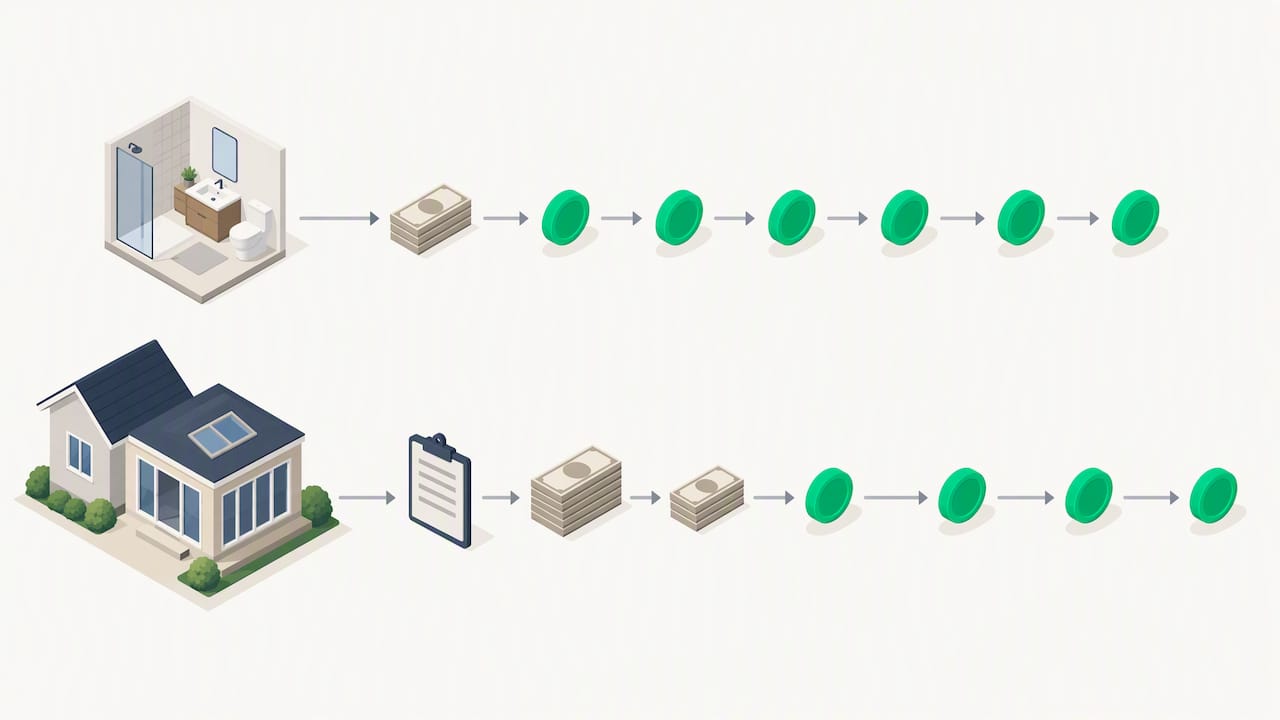
For a small project, say a $5,000 bathroom refresh, the appraisal and closing costs on a home equity loan can erase any rate advantage, making a personal loan the more efficient route. For a $60,000 addition, the lower rate on a HELOC or home equity loan usually outweighs the upfront costs over a multi-year repayment term. The deciding factor is rarely the headline rate alone: it is the rate weighed against fees, timeline, and how long you plan to carry the debt.
3. When do government renovation programs make sense?
Government-backed programs exist for homeowners who need structured financing for substantial rehabilitation or who don’t have enough equity for a conventional product.
- FHA 203(k): insures a mortgage that bundles purchase or refinance with rehabilitation funds. The Limited 203(k) covers rehabilitation costs up to a rehabilitation costs capped at a set limit for cosmetic or moderate repairs, while the Standard 203(k) handles larger structural work and requires a HUD consultant and a detailed work write-up.
- Title I loans: smaller, often unsecured property improvement loans backed by HUD, a fit when you need a modest sum for repairs and don’t want to refinance your whole mortgage.
- USDA Section 504: provides repair loans and grants up to combined assistance limits, to very-low-income rural homeowners; loans carry a fixed low interest rate over long term periods, and grants are reserved for elderly homeowners addressing health and safety hazards.
- VA-backed options: eligible veterans may access renovation financing tied to VA home loan benefits, though terms vary by lender and should be confirmed directly.
These programs trade speed for cost savings. A 203(k) loan requires a consultant, a work write-up, and staged inspections before each draw releases, which means a longer runway than a private loan but meaningfully lower costs for borrowers who qualify. If your project is substantial and your equity is limited, the paperwork is worth the savings; if you need to start next week, a commercial loan will usually get you there faster.
4. What do fees, closing costs, and IRS rules really cost you?
Headline interest rates only tell part of the story. Equity-based loans come with appraisal fees, title searches, and closing costs that can run into the thousands of dollars depending on your lender and location, and those costs raise your effective APR, especially on smaller loan amounts. Personal loans generally skip these fees but may charge origination fees deducted from your funded amount.
- Equity products: appraisal, title, and closing costs are paid upfront or rolled into the loan.
- Personal loans: fewer upfront fees, but origination fees reduce your net proceeds.
- Tax treatment: interest on a home equity loan or HELOC is deductible only when the funds buy, build, or substantially improve the home securing the debt, per IRS Publication 936, with an indebtedness limit of $750,000 for debt secured after December 15, 2017.
- FHA 203(k) fees: consultant and certain inspection fees can sometimes be financed into the loan under program rules.
One figure worth noting: the IRS caps deductible home equity indebtedness at $750,000 for loans secured after that December 2017 date, a ceiling that matters most for homeowners with larger mortgage balances.
Picture a $20,000 kitchen update. Financed through a HELOC, you’d pay appraisal and closing costs upfront but a lower rate over the repayment term, with potentially deductible interest if the funds go toward the kitchen itself. Financed through a personal loan, you’d skip the fees and close faster, but likely pay a higher rate with no deduction available. The math favors different borrowers depending on how long they plan to carry the balance.
5. What do lenders check before approving your loan?
Lenders evaluate a familiar set of factors, though the weight they give each one varies by product.
- Credit score: generally, higher scores unlock lower rates and larger loan amounts; borrowers with weaker credit still qualify for many personal loans, just at a higher APR.
- Debt-to-income ratio: lenders compare your monthly debt payments to your income to judge how much additional debt you can handle.
- Proof of income: pay stubs, tax returns, or bank statements confirm your ability to repay.
- Appraisal and title: home equity loans and HELOCs require a current appraisal and a clean title, both of which add time before closing.
Pro Tip: If you’re already stretched thin on your current mortgage payment, talk to a HUD-approved housing counselor before taking on a home equity loan, since it functions as a second mortgage and adds to your monthly obligations, as the CFPB recommends.
6. How do you choose the right financing option for your project?
Underestimating scope is one of the most common reasons financing falls short mid-project.
- For projects under $7,500, a personal loan or 0% promotional credit card often makes the most sense given the speed and minimal fees involved.
- For projects between $7,500 and $75,000, a home equity loan, HELOC, or Limited 203(k) usually offers the better balance of rate and access.
- For projects above $75,000, a cash-out refinance, Standard 203(k), or larger home equity loan typically fits best, provided you plan to stay in the home long enough to benefit.
Before signing anything, ask your lender how draws are disbursed and whether they’re tied to inspection milestones, and ask your contractor how their payment schedule lines up with those draws.
- Confirm your project’s true scope and build in a contingency.
- Match project size to the financing thresholds above.
- Ask about disbursement timing, fees, and whether the rate is fixed or variable.
- Decide whether a lower monthly payment or faster funding matters more for your situation.
7. What does the application process actually look like?
Each financing type follows its own rhythm, and knowing the steps ahead of time keeps your contractor’s schedule and your loan’s timeline from working against each other.
- Personal loans: request quotes from a few lenders, submit an application with income and identity documents, and expect funding anywhere from same-day to a few business days.
- HELOC or home equity loan: apply, undergo underwriting, schedule an appraisal, and close, a process that commonly takes several weeks; plan your contractor’s start date around that timeline rather than against it.
- FHA 203(k): work with a HUD consultant to prepare a detailed work write-up, get the loan approved with rehabilitation funds held in escrow, and expect disbursements tied to completed, inspected milestones, a longer process than a conventional loan but one built for structured rehab.
- Coordinating draws with contractors: share your lender’s draw schedule with your contractor early, so milestone payments and loan disbursements land on the same timeline instead of leaving either side waiting on funds.
A homeowner’s checklist for hiring a contractor is a useful companion step here, since the contractor you choose needs to work within whatever draw schedule your financing requires.
8. How JAG Home Enhancements structures financed projects
We build our payment schedules around clear, documented milestones, which align with what lenders and FHA 203(k) escrow accounts expect before releasing funds. Our milestone payment approach ties each payment to a completed, inspectable stage of work rather than an arbitrary date, so a financed project moves forward without a funding gap.
- We provide detailed estimates upfront, which can serve as documentation lenders request before approving disbursements.
- Our basement finishing timeline, typically 4 to 12 weeks with built-in inspection points, mirrors the staged-draw structure that 203(k) and HELOC lenders use.
- We keep invoices transparent and itemized to support documentation requirements for government-backed rehab loans.
- We recommend homeowners keep a contingency fund and document any change orders in writing, since both can affect draw amounts and timing.
9. Balancing cost, timing, and home value
If I’m being direct: pay cash for small projects when you can. HUD itself says cash is generally the thriftiest way to finance improvements, and I’d rather see a homeowner skip a loan on a $4,000 bathroom refresh than pay fees on it. For larger investments, like an addition or a full kitchen overhaul, a secured loan usually makes sense if you’re staying in the home long enough to benefit from the lower rate.
Shop multiple lenders, keep your contractor’s documentation tight, and watch for lenders charging unusually high fees or contractors pushing financing deals that feel rushed. Renovation scams often start with pressure to sign financing on the spot.
— Jeff
10. How we help homeowners manage financed remodels
Once you’ve lined up financing, the next decision is who actually does the work, and that’s where clear communication and a milestone-friendly payment structure save you from the gap between draws and deadlines. We manage projects from consultation through completion, with transparent invoices that help align with how lenders and escrow accounts release funds.
Whether you’re financing a kitchen or bathroom remodel, a basement remodel, or a home addition, we keep job sites clean, schedules realistic, and paperwork ready for your lender’s review. If you’re ready to put a financed project in motion, request a consultation and we will prepare an estimate that aligns with your financing timeline.
This article is general information, not a substitute for advice from a qualified financial advisor. Consult a qualified financial professional about your own circumstances before acting on anything here.
FAQ
Do home improvement loans exist?
Yes, several types exist, including home equity loans, HELOCs, cash-out refinances, personal loans, and government-backed programs like FHA 203(k) and Title I. The right one depends mainly on your project size, timeline, and how much home equity you have available.
What credit score do you need to get a $30,000 loan?
Credit score requirements vary widely by lender and loan type, with higher scores generally unlocking lower rates and more loan options. A home equity loan or HELOC may accept a wider range of scores than some personal loans since your home secures the debt, but you’ll still need to show steady income and manageable debt levels.
What are the four types of loans?
For home improvement purposes, the main categories are equity-based loans (home equity loans, HELOCs, cash-out refinances), non-equity personal loans, contractor or retail financing, and government-backed programs such as FHA 203(k) and Title I. Each fits a different combination of project size, timeline, and available equity.
Which bank is best for a renovation loan?
There isn’t one best lender for every homeowner, since rates, fees, and approval criteria vary by credit profile and loan type. Comparing offers from a few banks, credit unions, and online lenders for the specific loan type you need, whether that’s a HELOC or a personal loan, helps you find the most efficient option for your situation.
Is home improvement loan interest tax deductible?
Interest may be deductible when the loan funds are used to buy, build, or substantially improve the home securing the debt, subject to an indebtedness limit of $750,000 for debt secured after December 15, 2017. Consult a tax professional to confirm how the rule applies to your specific loan and project.
Sources
- What is the difference between a home equity loan and a home equity line of credit (HELOC)? | CFPB
- Publication 936 (Home Mortgage Interest Deduction) | IRS
- FHA 203(k) rehabilitation mortgage insurance program | HUD
- Single Family Housing Repair Loans & Grants | USDA Rural Development
- Fixing up your home and how to finance it | HUD