
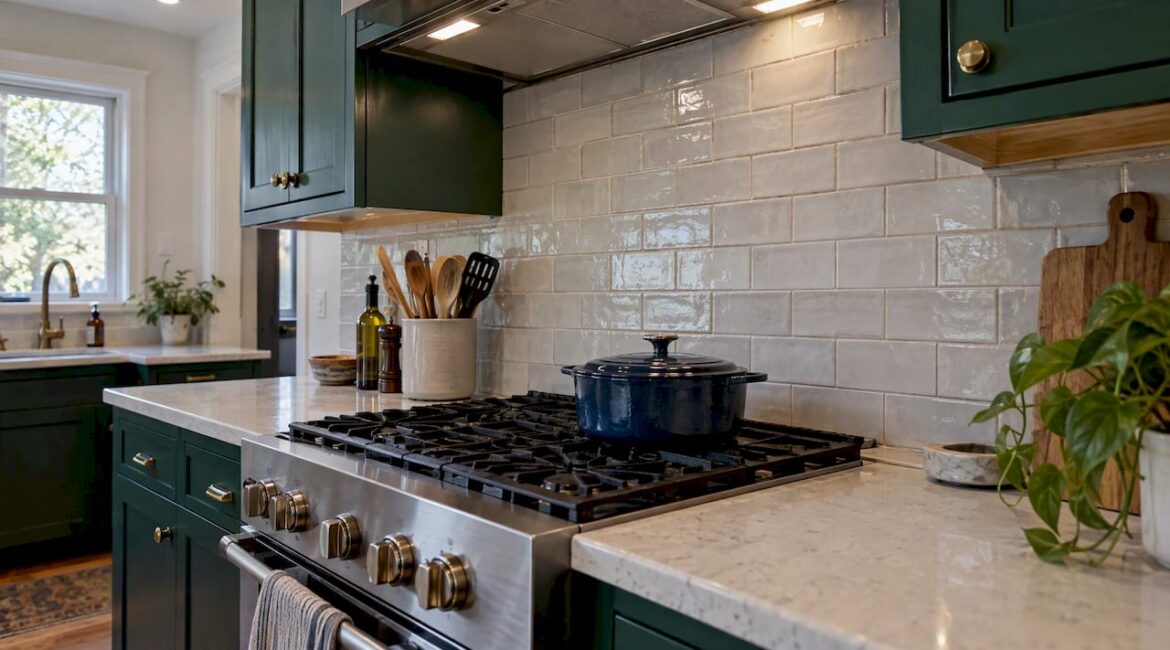
The best kitchen backsplash material is the one that fits how you cook, how much cleaning you want to do and the countertops and cabinets around it. Ceramic and porcelain tile suit most budgets and most kitchens. Glass and stainless steel are the easiest to wipe down. Natural stone and slabs look the richest but ask more of you in sealing and cost. Below we compare each option, explain how high to take it and what to put behind the range, and show where 2026 trends are heading.
TL;DR
- Ceramic and porcelain tile are the safest all-around choice: nonporous, stain-resistant and available in nearly any style.
- Glass and stainless steel are the lowest-maintenance options, with no grout lines to scrub in the case of steel and sheet glass.
- Marble and other porous stone look beautiful but need diligent sealing to resist stains.
- Most designers end the backsplash at the bottom of the wall cabinets. Full height to the ceiling is a bolder choice that costs more.
- Behind a gas range, check clearance rules with your local code office before you pick anything flammable.
Table of Contents
- What a backsplash actually has to do
- Ceramic and porcelain tile
- Glass tile and sheet glass
- Stainless steel and metal
- Natural stone: marble, granite and others
- What to use instead of tile
- Slab backsplash vs. tile
- What to put behind the range
- How high should a backsplash go?
- Match the backsplash to your countertops and cabinets
- Backsplash trends for 2026
- Our perspective
- Planning a kitchen update with JAG
- A quick way to decide
- FAQ
- Sources
What a backsplash actually has to do
A backsplash is a working surface before it is a design feature. It protects the wall from grease, steam, splashes and the occasional tomato sauce eruption. Drywall and paint do not hold up to that for long, and the seam where countertop meets wall is the first place water finds.
So judge every material on four things before you look at color:
- Cleaning: Can you wipe it in thirty seconds, or will grout lines hold on to grease?
- Heat and moisture: Is it safe and stable next to the cooktop and the sink?
- Upkeep: Does it need sealing, polishing or touch-ups?
- Fit: Does it work with your countertop, cabinet color and the amount of pattern already in the room?
If you are planning a full kitchen update, the backsplash is one of the last choices you make but one of the most visible. Our kitchen remodel timeline shows where it falls in the sequence, so you can order material in time.
Ceramic and porcelain tile
Ceramic is the classic. Porcelain is its denser, harder cousin. Both are naturally nonporous and stain-resistant, which is why metal, glass, porcelain and ceramic tiles are described as among the easiest backsplash materials to maintain. Both also come in an enormous range of sizes, from small mosaics to large-format rectangles, and finishes from glossy to matte to handmade-looking.
What to know:
- Best for: Most households, most budgets, and anyone who wants flexibility in style.
- Watch for: Grout. Grout is the part that stains and collects grease. Choose a grout color a shade or two darker than the tile if you cook heavily, and ask your installer about sealing it. Larger tiles mean fewer grout lines, which means less scrubbing.
- Layout matters: A simple tile laid well looks better than an expensive tile laid badly. Straight stack, offset and herringbone layouts each change the feel of the room with the same tile.
Subway tile remains popular because it is forgiving, affordable and fits traditional farmhouse kitchens as well as modern ones. If you want something quieter, a large-format porcelain in a solid color nearly disappears and lets cabinets and counters lead.
Glass tile and sheet glass
Glass is non-porous, easy to clean, reflects light and handles heat well, according to Better Homes and Gardens. That reflectivity is useful in a dark galley kitchen or one with little natural light.
There are two forms:
- Glass tile or mosaic: Small pieces with grout lines. Beautiful, with a lot of sparkle, but you still have joints to clean.
- Sheet or back-painted glass: One continuous panel in a color you choose. No grout at all, so cleanup is a quick wipe. It needs precise measuring and cutouts for outlets, so it is installed after templating rather than improvised on site.
The tradeoff is that glass shows fingerprints and water spots, and a single large panel is less forgiving of walls that are out of square. Plan the outlet positions early. Our kitchen lighting plan guide explains why electrical locations need to be settled before walls close, and the same logic applies to glass.
Stainless steel and metal
Stainless steel is a restaurant-kitchen staple for good reason. Architect Natalia Miyar notes that stainless steel is easy to clean, antimicrobial and free of grout lines, and she likes how its reflectivity picks up views and surrounding wood. Metal tile is also easy to keep clean and relatively impervious to damage.
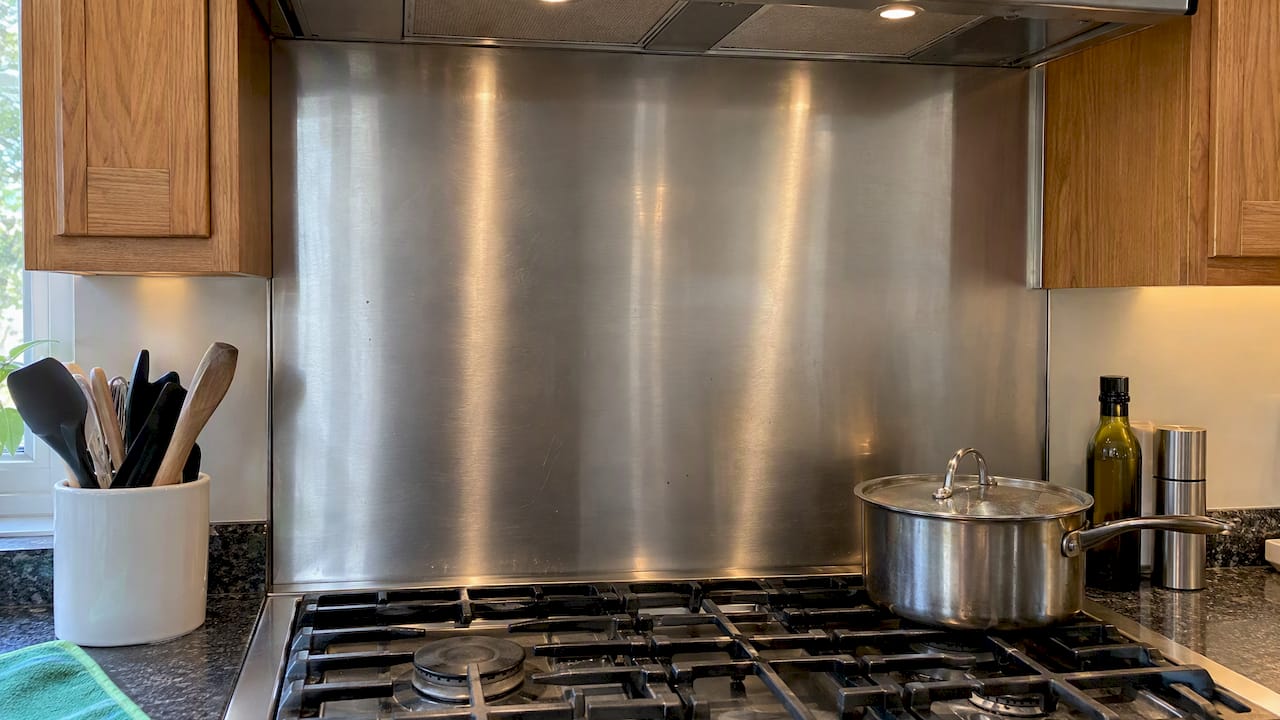
Best for modern, industrial or professional-style kitchens, and especially for the zone behind a range. The downsides are cosmetic: brushed finishes hide scratches better than mirror-polished ones, and a large steel panel can feel cold in a warm, traditional kitchen. Pair it with wood or a soft-colored cabinet to balance it.
Natural stone: marble, granite and others
Natural stone gives you something no manufactured tile quite matches: real variation and depth. It is also demanding. Marble in particular is porous and vulnerable to staining, so it requires diligent sealing. Oil near the cooktop and acidic splashes such as lemon juice or wine can mark an unsealed surface.
If you love stone, you have options:
- Stone tile: Easier to install and replace than a slab, but with grout lines.
- Stone slab: Continuous and dramatic, but more expensive and more complex to fabricate and install.
- Harder stones such as granite: Generally more forgiving than marble, though still worth sealing as your installer recommends.
Be honest with yourself about upkeep. If you will not reseal, choose a different material and get the look through color instead. Stone that you maintain will age gracefully. Stone that you ignore will show it.
What to use instead of tile
Sometimes tile is not the answer. Maybe you want a cleaner look, fewer seams or a more unusual texture. Common alternatives include full-height stone slabs, sheet or back-painted glass, stainless steel, concrete or beadboard. Family Handyman also points to brick veneer, pressed tin and stone facing.
A few notes on the less common ones:
- Painted or raw beadboard: Charming in cottage-style kitchens. Because kitchen moisture can make wood less durable and harder to clean, Family Handyman advises protecting it with washable paint or marine varnish. Keep it away from the cooktop.
- Brick veneer: Adds warmth and texture. Textured surfaces hold grease, so they suit areas away from the stove or kitchens where you accept a more lived-in look.
- Pressed tin: A vintage look that works in older homes, which describes many houses across Bucks County.
- Sealed Venetian plaster: When sealed and burnished, it can be cleaned no more difficultly than grouted tile. It is a specialty finish, so hire someone who has done it before.
Paint alone is the cheapest option, but it is the weakest protection. We would use it only in a low-splash area, not behind a sink or range.
Slab backsplash vs. tile
A slab backsplash carries your countertop material up the wall. It has few or no seams, which makes it a favorite for people who dislike scrubbing grout. A tile backsplash gives you more variety and a lower cost to change later.
| Slab | Tile | |
|---|---|---|
| Seams | Few to none | Grout lines throughout |
| Cleaning | Wipe-down surface | Grout needs attention |
| Look | Continuous, modern | Customizable, pattern and texture |
| Cost | Generally higher, more material and labor | Wide range, from budget to premium |
| Replacing later | Harder | Easier |
Reporting from U.S. News says full-height backsplashes can create a focal point and need less maintenance than tile, but they generally cost more because they use more material and labor. It also notes that heat near a range can cause problems for some quartz installations, so ask your fabricator about the manufacturer’s heat guidance before you put quartz behind the cooktop.
What to put behind the range
The wall behind the stove takes the worst of it: grease, steam and heat. Many homeowners treat that zone differently from the rest of the backsplash. Options that work well include:
- Metal tile or a stainless panel: Easy to wipe and tough.
- Glazed ceramic or porcelain: A durable choice that fits most styles.
- Slab or full-height stone: Dramatic, with no grout behind the pots.
One safety point matters more than any style decision. Fire codes typically require clearance between gas burners and flammable surrounding materials, so check local code. That means wood, beadboard and some panels need extra thought near a gas cooktop. In Pennsylvania, your township or your contractor can tell you what applies to your project. We handle those questions as part of planning, so you do not have to chase them yourself.
How high should a backsplash go?
A standard backsplash generally runs 15 to 18 inches between the countertop and the bottom of the upper cabinets. A short option is about 4 inches, which is a small lip rather than a full wall treatment. Behind the stove, a taller section can be useful because cooking is messy.
Three common endings:
- To the bottom of the wall cabinets. Designers commonly recommend ending the backsplash at the end of the wall cabinet for a clean vertical line and simpler installation, according to HGTV.
- Only behind the range. A taller feature panel frames the cooktop and keeps the rest simple. This is a good place to spend on a premium material.
- To the ceiling. Extending it creates a more dramatic effect, though HGTV notes it needs more planning and material. This also applies to open shelving, where the wall is exposed.
Where a backsplash ends on a side wall matters too. A clean stop at the cabinet edge looks intentional. A tile that ends in the middle of an open wall can look unfinished, so we usually plan a trim piece or carry it to a corner. If your kitchen opens into other rooms, the open concept kitchen pros and cons guide explains how visible walls change these choices.
Match the backsplash to your countertops and cabinets
When busy elements compete, the kitchen feels chaotic. A simple rule: let one surface lead. If your cabinets are a bold color, keep the backsplash and countertops to neutral solid shades without a lot of veining. If the cabinets are neutral, you have room for a patterned or textured backsplash.
A few pairings that tend to work:
- Veined stone counters with a plain, light tile.
- Solid quartz counters with a handmade-look or patterned tile.
- Dark cabinets with a light, simple backsplash that bounces light back.
Bring samples home. Look at them in your kitchen in morning and evening light, next to your actual cabinet door and countertop sample. Showroom lighting is kind to everything. Also think about flooring, since the two surfaces share sightlines. Our kitchen flooring options guide can help you avoid clashing finishes.
Backsplash trends for 2026
The trend with the most momentum is color with depth. Architectural Digest reports that kitchens are turning toward deeper, earthier hues, with red marble such as Rouge Griotte appearing on a countertop and backsplash. Designer Tina Ramchandani says earthy reds resonate because they connect to nature and offer a warm departure from stark white and grey kitchens. The same article notes ceramics appearing beyond the conventional backsplash.
What that means for you:
- Warm over stark: Terracotta, clay and deep stone tones in place of all-white.
- Stone and slab statements: Often behind the range, where one dramatic piece goes a long way.
- Handmade character: Ceramics with variation in glaze.
Trends fade, so use them where change is easy. A bold slab is a commitment. A tile accent or a painted wall elsewhere is not. If you plan to sell in a few years, keep the permanent surfaces timeless and add the trend through lighting, hardware and accessories. Our Bucks County kitchen remodel ROI guide covers how to think about return on a remodel.
Our perspective
We see the same pattern in kitchens across Bucks County. Homeowners pick the backsplash last, in a hurry, from a tiny sample. Then they live with it every day. The best results come from slowing down at that point.
Our advice is simple. Choose for cleaning first, then for beauty. A material you enjoy wiping down will look good for years, and one you dread cleaning will not. Spend your budget where it counts: behind the range and on the installation. A well-laid, modest tile beats an expensive one with crooked lines. And be honest about upkeep. If you know you will not seal marble, we will tell you so, and suggest a durable alternative that gives you a similar feel.
We also recommend deciding the backsplash early, before cabinets are ordered, because height, outlets, lighting and trim all depend on it. Good planning keeps a project on schedule and within budget, and it avoids the costly rework that comes from changing your mind once tile is up.
— Jeff
Planning a kitchen update with JAG
If a new backsplash is part of a bigger kitchen plan, we handle it from consultation through completion: layout, cabinets, counters, tile and the clean-up afterward. We keep the job site tidy and stay available to answer questions. See our kitchen and bathroom remodeling services or read more about kitchen remodeling in Bucks County.
Thinking about sizing your layout first? The kitchen layout types guide and the kitchen island dimensions guide are good places to start.
A quick way to decide
Use this short checklist before you buy:
- Do you cook with a lot of oil or high heat? Choose metal, glazed porcelain or slab behind the range.
- Do you hate scrubbing grout? Choose sheet glass, stainless steel or a slab, or large-format tile.
- Do you want warmth and character? Choose handmade-look ceramic or sealed natural stone, and accept the upkeep.
- Is your budget tight? Choose standard ceramic or porcelain and put the savings into good installation.
- Is the cabinet color bold? Keep the backsplash a quiet solid.
Write down your answers and bring them, with samples, to your contractor. It turns a vague wish into a clear specification.
FAQ
What is the best backsplash material for a kitchen?
For most homes, ceramic or porcelain tile. It is nonporous, stain-resistant, affordable and available in nearly any style. If you want the least cleaning, sheet glass or stainless steel have no grout lines to maintain.
What can I use for a kitchen backsplash instead of tile?
Popular alternatives include stone slabs, sheet or back-painted glass, stainless steel, concrete, beadboard, brick veneer and pressed tin. Wood products need washable paint or marine varnish to handle moisture, and they should stay away from the cooktop.
How high should a kitchen backsplash be?
The common range is 15 to 18 inches, from the countertop to the bottom of the wall cabinets. Many designers stop it at the cabinet bottom for a clean line. You can also go full height behind the range or all the way to the ceiling for more drama, at a higher cost.
What is the best material behind a range?
Metal tile, stainless steel, glazed porcelain or ceramic, and stone slab all work well. Check local fire code for clearance rules around gas burners, and ask your fabricator about heat limits if you are considering quartz.
What is the new backsplash trend for 2026?
Deeper, earthier colors, including red stone on countertops and backsplashes, and handmade-style ceramics. Keep permanent surfaces timeless if resale matters to you.
Sources
- Kitchen splashback ideas, Better Homes and Gardens
- 10 Cool Ways to Use Stainless Steel in Home Design, Architectural Digest
- All About Kitchen Backsplashes, This Old House
- 5 Stunning Alternatives to the Tile Backsplash, Houzz
- 20 Amazing Kitchen Backsplash Ideas, Family Handyman
- How to Apply Real Venetian Plaster, Family Handyman
- This Kitchen Design Is Trending, U.S. News
- Standard Backsplash Height, Hunker
- Where Should Your Backsplash End?, HGTV
- Kitchen Trends for 2026, Architectural Digest
- Before & After Kitchen: Streamlining for Workflow, This Old House