
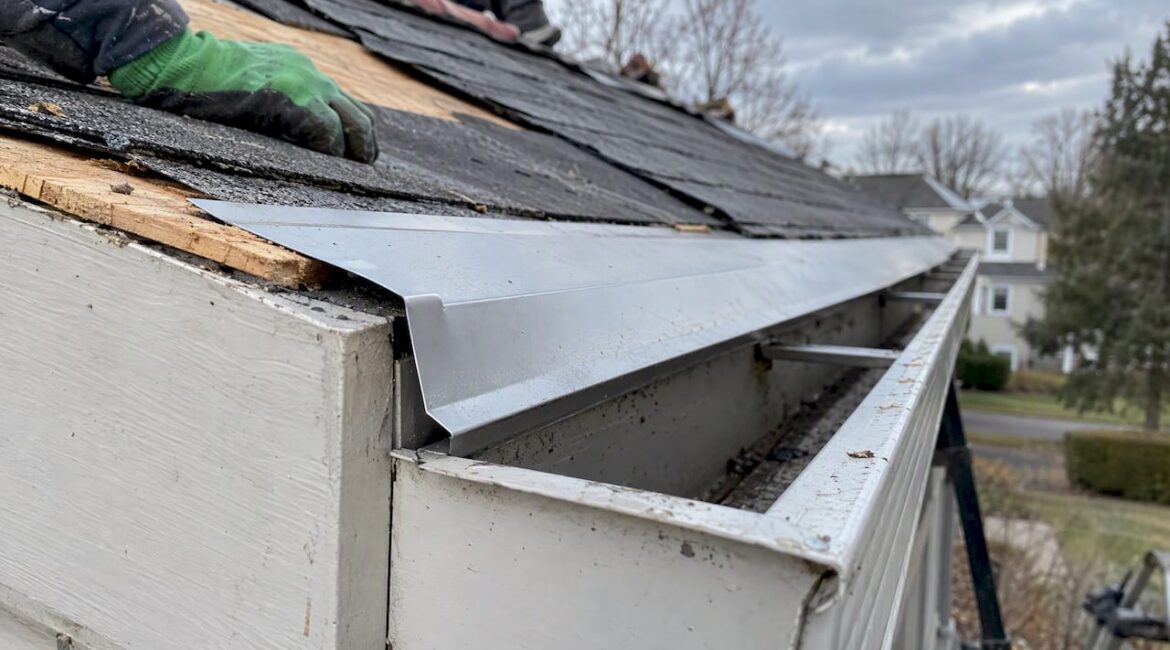
A drip edge is metal flashing along the edges of your roof, at both the eaves and the rakes. A gutter apron is an extended version made for guttered eaves. Its job is to bridge the gap between the roof edge and the back of the gutter. If your house has gutters, you usually want edge metal that does the gutter apron’s job at the eaves. You also need ordinary drip edge on the rakes.
The names cause most of the confusion. Roofers, manufacturers and online guides use them loosely. This guide explains how the two differ, what Pennsylvania’s residential code says, and what to ask your contractor before a new roof goes on.
TL;DR
- Drip edge is the broader term: edge flashing at eaves and rakes, with or without gutters. A gutter apron is an eave-only profile that reaches over or into the gutter.
- The labels overlap. Type F extended drip edge is often called a gutter apron, so ask to see the actual profile.
- Pennsylvania’s 2021 residential code requires drip edge at eaves and rakes on shingle roofs. Confirm the edition and any local rules with your township.
- On a new roof with gutters, the answer is rarely either/or. Use the right edge metal on each edge and have the layer order explained before work starts.
- Neither piece fixes bad gutters, missing kick-out flashing or rotted fascia.
Table of Contents
- What a drip edge does
- What a gutter apron does
- Drip edge vs. gutter apron side by side
- The naming problem: ask for the profile
- What Pennsylvania requires
- Do you need a gutter apron if you have gutters?
- Questions to ask your roofer
- What edge metal will not fix
- Our perspective
- Roof edge work with JAG Home Enhancements
- Signs your roof edge needs attention
- FAQ
- Sources
What a drip edge does
A drip edge is a strip of metal, usually L-shaped, fastened at the edge of the roof deck. It is also called drip edge flashing or D-metal. It sends water off the shingles and away from the fascia, the vertical board behind the gutter. Without it, water can curl under the shingle edge by capillary action and soak the deck edge and fascia.
It also does a quieter job. The U.S. Department of Energy’s Building Science Education pages describe correctly installed edge metal as part of a storm-resistant roof, because it helps lock the roof edge in and cuts moisture intrusion in high winds.
Drip edge goes on two kinds of edges:
- Eaves: the low edges where water runs off, and where gutters usually hang.
- Rakes: the sloped edges on the gable ends. No gutter hangs here, so no apron is needed.
What a gutter apron does
A gutter apron is made for the eave only. Its lower flange is longer, so it extends over the back of the gutter or into it. That closes the gap where water could otherwise run behind the gutter and onto the fascia.
This matters because a gutter is a trough. Mark Petersen, technical editor at Fine Homebuilding and a former seamless-gutter installer, explains that rain can splash back toward the fascia and that snow and ice buildup can make it worse. His conclusion is that guttered eaves deserve their own attention rather than being treated like every other roof edge.
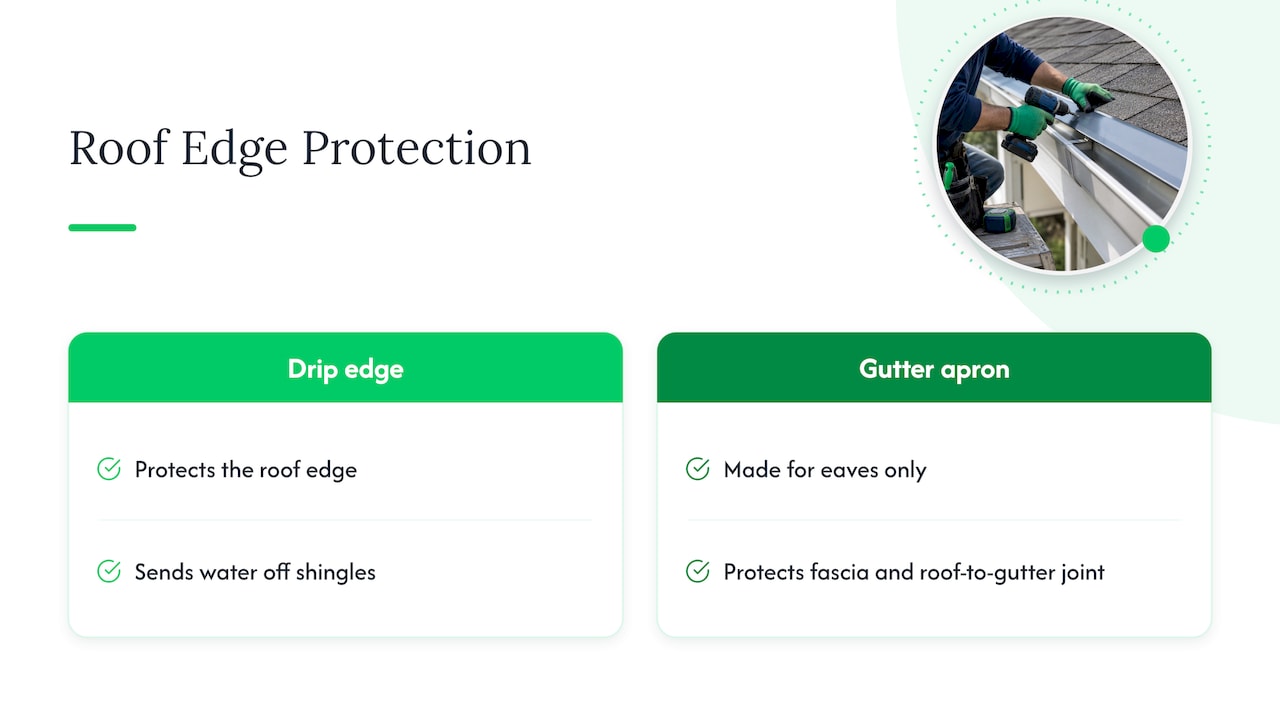
In short, the drip edge protects the roof edge. The apron protects the fascia and the roof-to-gutter joint. Fascia that stays wet for years rots, and rot behind a gutter is easy to miss until a board gives way. If you want a sense of how quickly moisture damages exterior wood, this guide to exterior wood rot repair shows the typical progression and why stopping water first matters.
Drip edge vs. gutter apron side by side
| Drip edge | Gutter apron | |
|---|---|---|
| Where it goes | Eaves and rakes | Eaves with gutters |
| Typical shape | L-shaped (Type C) or T-shaped (Type D) | Extended lower flange (Type F) |
| Main job | Shed water off the roof edge, away from the fascia | Direct water into the gutter and close the gap behind it |
| Needed without gutters? | Yes | No |
| Material cost range | $3 to $15 per linear foot | $3 to $10 per linear foot |
Treat the prices as national material and style ranges from a consumer guide, not a quote. Labor, access, shingle removal, fascia repair, gutter work, permits and disposal can change the total a great deal. We don’t publish prices for roofing work, because every roof is different. We quote after an inspection.
The naming problem: ask for the profile
Ask three roofers and you may get three definitions. The IKO guide to drip edges sorts the types this way:
- Type C: the classic L-shape, common at eaves without gutters.
- Type D: T-shaped, which keeps water farther from the fascia. Angi’s overview says it is most common where there is no roof overhang.
- Type F: extended, and frequently called a gutter apron or F-style.
So a quote that says “drip edge” might include an apron-style piece, and a quote that says “gutter apron” might mean a Type F drip edge. The label tells you little. Ask for a product name, a profile drawing or a sample piece, plus the places on the house where each profile will go.
What Pennsylvania requires
For shingle roofs, the 2021 International Residential Code as adopted in Pennsylvania says a drip edge must be provided at eaves and rake edges. The section also sets these details:
- Adjacent pieces overlap by at least 2 inches.
- The metal extends at least 1/4 inch below the sheathing.
- It runs at least 2 inches back onto the roof deck.
- Fasteners are spaced no more than 12 inches on center.
- Underlayment goes over the drip edge at the eaves and under it at the rakes.
The model text is also available on the ICC’s digital code site. Note the last point. Drip edge is required whether or not you have gutters, so the choice is never “drip edge or nothing.”
Local handouts can add to this. Lower Gwynedd Township’s published roofing requirements, for example, call for drip edge metal at eaves and gable ends and also cover when a roof permit is needed. Adopted editions and permit triggers can differ by municipality, so confirm what your building department enforces. Our guide to PA roofing code and failed inspections goes further into what inspectors look for.
High-wind building-science guidance is stricter than the code minimum. It suggests details such as 3-inch joint overlaps and fastening at a maximum of 4 inches. That is not a Pennsylvania requirement, but it shows that fastening and overlap matter as much as the product name.
Do you need a gutter apron if you have gutters?
In most cases you want that function at the eave. Fine Homebuilding’s answer to the question is a clear yes: the apron protects the fascia and roof decking from moisture and keeps water from running behind the gutter. Here is how the choice usually plays out.
New roof, existing or new gutters
This is the easiest case. The old roof is stripped down, so the installer can set the right edge metal on every edge before underlayment and shingles go on. At guttered eaves, that means an apron-style or extended Type F piece where the geometry calls for it. At the rakes, it means standard drip edge.
Reroof where drip edge is already on the eaves
If eave drip edge is already in place, the gutter can often tuck up under it, so the existing metal works as the gutter apron. Ask your roofer to check whether the metal is long enough to reach the gutter and whether it is in good shape.
Underlayment already down
If the underlayment is installed, pulling it up just to slide apron metal beneath is generally impractical. The top flange may sit over the underlayment instead. That is a judgment call, so ask the contractor to explain the exact layer sequence before work begins and why it won’t create a new leak path.
Existing roof, no new shingles
Adding or replacing edge metal on a roof you are keeping can mean lifting shingles and underlayment along the edge. A contractor should first decide whether the current flashing can be integrated cleanly. In some cases the best advice is to wait until the roof is replaced.
Questions to ask your roofer
Use these at the estimate. A good contractor will answer without hesitation.
- Which edge profile goes on the eaves, and which on the rakes?
- Will the eaves get an apron-style piece, and how will it meet the gutter?
- In what order do the layers go: deck, metal, ice and water membrane, underlayment, shingles?
- What is the fastener spacing, and how much do the sections overlap?
- Are the fascia and roof deck edge inspected for rot before metal goes on?
- Is the gutter pitch, size and discharge being checked, or only the visible metal?
Those last two questions catch the most expensive mistakes. A neat strip of aluminum can hide a soft fascia board.
What edge metal will not fix
Neither piece solves every leak. Consider the common problems on Bucks County homes.
Gutters that are the real problem
A gutter apron does not make up for gutters that are undersized, clogged, badly sloped or discharging at the foundation. Federal construction guidance recommends that downspouts empty at least 5 feet from the foundation. Have the pitch, outlets and downspouts checked whenever the roof edge is open.
Roof-to-wall intersections
Where a roof meets a sidewall, such as at dormers, additions or a second story over a porch, water needs a path into the gutter. The Building Science Education pages say kick-out flashing should be installed at the eaves of roof-wall intersections to divert runoff into the gutter and protect the wall. If you see staining or peeling siding below a roof edge, kick-outs are a likely culprit. Our checklist for water behind your siding explains what to do next, and our guide to house wrap under siding covers the layer behind it.
Ice at the eaves
Winters in our area are hard on roof edges. Snow melts on the warm part of the roof and refreezes at the cold eave. Edge metal helps shed water, but it is not an ice dam solution. Ventilation, insulation and an ice and water membrane do that work. See our guides on stopping ice dam roof damage and ice dam prevention in Bucks County.
Fascia that is already damaged
If the board behind the gutter is soft, new metal over it only hides the problem. Replace the damaged wood first. Our fascia and soffit repair cost checklist shows how to budget for it.
Our perspective
When we look at a roof edge, we start from a plain question: where will the water go when it rains hard, and again when it freezes? The edge metal is the answer to only part of it.
We see the same patterns on Bucks County homes. A new roof goes on, but the fascia behind the gutter was never checked. Or the roofer installed a nice-looking edge piece without explaining how it relates to the gutter. We would rather talk through the whole edge with you: deck, metal, underlayment, shingles, gutter and wall. We do the work as one managed project, from consultation to completion.
We also give honest recommendations. If your existing eave metal is sound and your gutters tuck up under it correctly, we will tell you so rather than sell you a part you don’t need. If a section of fascia has to be replaced first, we will show you why before we price it.
A clean job site matters here too. Roof edges involve old metal, nails and rotted trim, and we keep the work area tidy and safe around your family and your yard.
— Jeff
Roof edge work with JAG Home Enhancements
If you are planning a roof replacement, a repair after storm damage, or new siding and want the edge details done correctly, we can help. Our roofing, siding and roof repair services serve homeowners in Bucks County, Montgomery County and nearby areas. We inspect the edge, explain which profile goes where, and put the scope in writing. If your roof edge work is part of a bigger exterior update, our exterior renovations page shows how we handle it. Before you sign anything, our roofing warranties explained guide helps you ask the right questions about coverage.
Signs your roof edge needs attention
You don’t need to climb a ladder. From the ground, look for:
- Water stains or peeling paint on the fascia board.
- Gutters pulling away or sagging at the back.
- Dark streaks or staining on the siding below the roof edge.
- Shingles that droop over the edge or curl upward.
- Ice that builds up along the eaves every winter.
- Soft or crumbling wood when you press the underside of the fascia or soffit.
If you see a few of these, schedule an inspection before the next freeze. If water is already coming inside, our roof leak first-48-hours guide tells you what to do right away.
FAQ
Can a gutter apron go over a drip edge?
Sometimes, but it depends on the sequence of layers. If drip edge is already on the eave, the gutter can often tuck under it and the existing metal serves as the apron. Stacking a separate apron on top of existing metal can trap water, so ask your roofer to explain exactly how the pieces will overlap.
Do I need a drip edge if I have gutters?
Yes. Pennsylvania’s 2021 residential code requires drip edge at eaves and rakes on shingle roofs, whether or not gutters are present. Gutters do not replace edge flashing. Confirm the code edition your township enforces.
Do you need a gutter apron?
On a guttered eave, you generally want that function, either as a separate apron or as an extended drip edge. It keeps water from running behind the gutter and rotting the fascia. If the existing eave metal already reaches the gutter correctly, a separate apron may not be needed.
What are the common problems with drip edge on a roof?
The usual issues are poor overlap, too few fasteners, the wrong layer order with the underlayment, and metal that is too short to reach the gutter. Rotted fascia hidden behind new metal is another. Have a contractor check the whole edge, not just the visible strip.
What does a drip edge or gutter apron cost?
A 2023 consumer guide puts materials at $3 to $15 per linear foot for drip edge and $3 to $10 for gutter apron. The real cost depends on labor, access, fascia repair and gutter work, so get a written estimate for your roof.
Sources
- Do I Need a Gutter Apron? Fine Homebuilding
- Guide to Drip Edges for Shingle Roofs (IKO)
- Chapter 9 Roof Assemblies: Pennsylvania Residential Code 2021, UpCodes
- IRC 2021 R905.2.8.5, ICC Digital Codes
- Roofing Requirements, Lower Gwynedd Township
- Drip Edge at Roof Eaves and Rakes, Building Science Education
- Kick-out Flashing at Roof-Wall Intersections, Building Science Education
- Construction Specifications, U.S. Department of Energy
- Gutter Apron vs. Drip Edge: Key Differences, Angi
- 3 Roof Drip Edge Types, Angi