

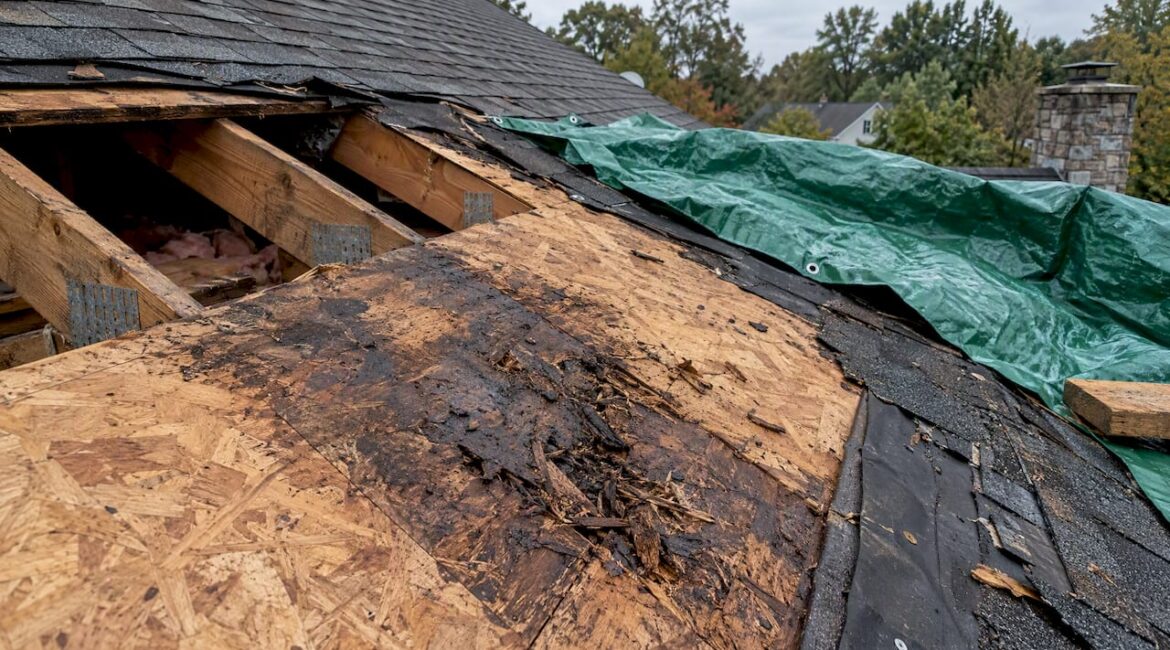
Roof sheathing rot is fungal decay in the wood panels under your shingles, and it only happens when that wood stays wet for a long time. The fix has two parts: cut out and replace the damaged decking, and stop the water or moist air that soaked it. Skip the second part and the new wood will go the same way, often out of sight.
This guide walks you through what rot looks like, where it comes from in a Pennsylvania house, what a proper repair involves, what it can cost, and when a spot is small enough to leave alone. We build and repair roofs for homeowners in Bucks and Montgomery counties, so we use what we see on local roofs alongside the building science.
TL;DR
- Soft, spongy or sagging spots on a roof, dark stains on attic wood and a musty smell are the classic signs of rotted decking.
- Rot is a symptom. Wood decays only when it stays wet, so the leak, condensation or exhaust problem has to be found and fixed first.
- Replacement means stripping the shingles over the damaged area, cutting out bad panels, fastening new ones over solid framing and re-covering with a waterproof membrane.
- Nobody can say how much decking needs replacing until the old roofing is off. Expect a scope that can change.
- Small, localized rot is a repair. Widespread rot usually points to a full roof replacement.
Table of Contents
- What roof sheathing rot actually is
- Signs you may have rotted roof decking
- Where the moisture comes from
- How serious is it? A quick triage
- How rotted sheathing is replaced
- Why the final scope surprises people
- What does it cost?
- Timing and permits in Bucks County
- Preventing rot from coming back
- Our perspective
- Working with JAG on roof and decking repair
- FAQ
- Sources
What roof sheathing rot actually is
Roof sheathing, also called roof decking, is the layer of plywood or oriented strand board (OSB) nailed across your rafters or trusses. Shingles attach to it, and the whole roof leans on it for stiffness. When it gets wet and stays wet, fungi that feed on wood move in and the panel loses strength.
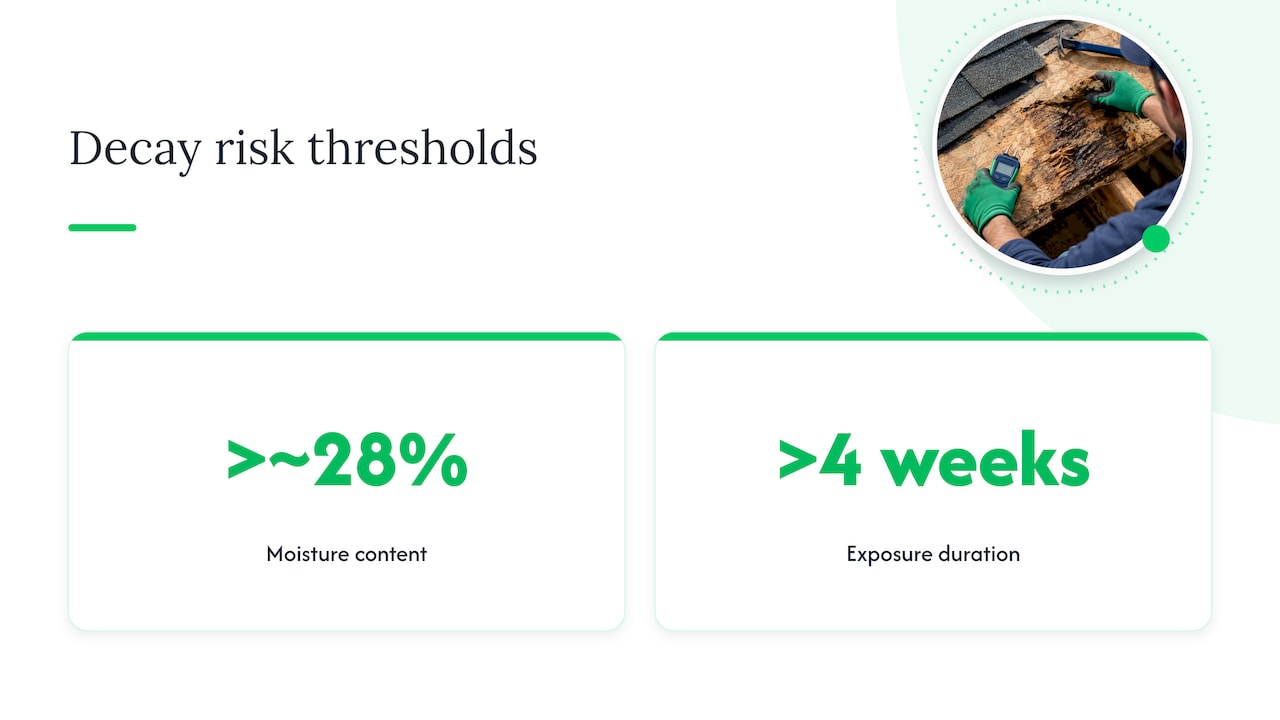
Research summarized in the Department of Energy’s Building America program gives a sense of the thresholds: wood sheathing held above roughly 28% moisture content for more than four weeks is at real risk of decay. A single wet afternoon does not rot a roof. Slow, repeated or constant dampness does.
That is why the damage is so often hidden. The top of the deck is covered by underlayment and shingles, and the underside sits in an attic most people visit twice a year.
Signs you may have rotted roof decking
You can spot many of the signs without climbing onto the roof. Start from the ground and the attic.
From the yard or driveway
- A sag or dip between rafters, or a wavy look along the roof plane.
- Shingles that look uneven, curled or lifted in one section.
- Dark staining or moss concentrated on one slope.
- Rot at the roof edge or fascia, where water often gets behind the gutter.
From inside the attic
Bring a flashlight and look at the underside of the roof deck.
- Dark, blotchy or black staining on the wood.
- Wood that looks crumbly, delaminated or discolored.
- A musty smell.
- Frost or damp insulation in winter, or rusty nail tips poking through the deck.
Industry guidance describes rotted decking as typically soft or spongy, sagging, discolored or accompanied by a musty attic odor. If you see signs of water inside the house too, our list of signs of a roof leak will help you narrow down where it is coming from.
Soft spots on the roof itself
Soft spots are the sign people search for most. If a section of roof feels springy or gives under your weight, the decking beneath is no longer doing its job. Do not walk on it to test it. A roof with compromised plywood can fail under a person, and a fall is a far bigger problem than a rotten board. If you suspect soft spots, check from the attic with a flashlight, or have a roofer inspect it.
Where the moisture comes from
Finding the source is the most important step in the whole job. The rule from building scientists is simple: rot is a symptom, not a diagnosis. If you replace wet wood and leave the water supply running, you have only bought a few more years.
The usual suspects, according to industry guidance on rotting roof decks, are these.
| Moisture source | What it looks like | Typical clue |
|---|---|---|
| Roof leaks | Failed flashing, cracked pipe boots, ice dams, worn shingles | Stains concentrated below a chimney, valley or vent |
| Interior air leakage | Warm, humid house air escaping into the attic through recessed lights, duct penetrations, the attic hatch | Frost on the deck in winter, widespread dark staining |
| Vapor diffusion | Moisture moving slowly through ceiling materials | Damp insulation, staining across a whole slope |
| Unvented exhaust | Bathroom fans or dryer vents that dump into the attic | Staining and mold around the vent |
| Poor ventilation | Blocked soffits, too few vents | Hot, stuffy or damp attic |
Why Pennsylvania roofs are prone to condensation
Our winters matter here. When warm indoor air reaches a cold roof deck, the water vapor in it condenses on the underside of the wood, much like water forming on a cold glass. The Department of Energy’s building science materials note that in colder climates like ours, condensation under the sheathing is a primary cause of widespread decay, which often calls for air sealing at top plates, hatches and penetrations.
The same sources warn about the opposite approach too. Unvented, conditioned attics can work, but an assembly that is not designed carefully can hide long-term decay. If your home has had spray foam added under the deck, rot can be harder to catch, so ask a professional to look before assuming it is fine.
Leaks, ice dams and storms
On the leak side, the weak points are the same on most homes: flashing around chimneys and walls, valleys, plumbing vent boots and the edge of the roof near the gutter. Ice dams push meltwater up under shingles. After a hard storm, a lifted shingle or torn flashing can let water in for weeks before a stain shows on the ceiling. Our first 48 hours checklist after a storm covers what to document and what to do right away.
How serious is it? A quick triage
Not every dark patch means a new roof. Here is how we think about severity when we walk a job.
- Surface staining, wood still hard. Often old moisture that has dried. Fix the cause, monitor it, and you may not need to replace anything.
- Localized soft or crumbling wood. Replace those panels as part of a repair.
- Several areas of rot, or rot across a full slope. Usually means the moisture problem has been long-running. A larger decking replacement, often with a new roof, is the sensible path.
- Rot reaching rafters or trusses. The framing needs to be assessed and reinforced. Sistering a damaged rafter with a new one alongside it is a common method, but structural framing is a job for an experienced contractor and sometimes an engineer.
If you are weighing patching against starting fresh, our guide to roof repair vs replacement lays out the decision criteria.
How rotted sheathing is replaced
A proper repair follows a sequence. Here is the version we would want any contractor to follow on our own house.
- Find and fix the source. Before any wood is cut, locate the leak or the interior moisture path. Without this, the repair is cosmetic.
- Remove the roofing over the damaged area. Shingles and underlayment come off the affected section, and a margin around it, so the extent of the damage is visible.
- Cut out the rot without harming the framing. The bad sheathing is cut out, taking care not to cut into the rafters below. Replacement panels should meet local code for thickness and fastening.
- Install new decking over solid support. Panel edges must land on rafters or blocking. You cannot just drop a patch in with nothing underneath it. Installers typically leave a gap of about 1/8 inch between panels for expansion, since panels set too tight can buckle as the wood moves. A common nailing pattern is 6 inches along panel edges and 12 inches in the field, though wind zones and local requirements can change that.
- Add a waterproof membrane. An ice and water protector type membrane helps keep moisture out of the new deck.
- Re-roof the area. New underlayment, flashing and shingles go on, matched as closely as possible to the rest of the roof.
- Correct the ventilation or air sealing. Open blocked soffits, redirect exhaust fans outdoors, and seal gaps where house air leaks into the attic.
The nailing and gap details above come from the Sheffield Metals decking guide, written for metal roof prep but applicable to most sheathing work. Your township and your manufacturer’s instructions have the final word. For a more homeowner-oriented overview of roof decking replacement, that guide covers what to expect and when the work is needed.
Can you just fix it from the inside?
Sometimes a small area of rot at an eave can be reinforced from the attic, for instance by sistering a rafter. But the roof covering above a rotten deck is still sitting on weak wood, and you cannot confirm what is under the shingles without taking them off. For anything beyond a very small area, the repair is done from the top.
Why the final scope surprises people
Homeowners often ask whether the roofer will replace all of the decking or just some. The honest answer is that nobody knows until the old shingles are stripped. A contractor can estimate from the attic and from experience, but the final scope is only revealed once the deck is exposed, according to roofing professionals in a trade discussion.
That means finding more rot than expected is a normal part of the job, not a trick. What matters is how it is handled:
- Ask before the job how decking is priced. Many contractors quote a price per sheet or per square foot for added replacement.
- Ask to be called and shown photos when extra rot is found.
- Get the added work in writing before it is done.
A contractor who explains this up front is one worth trusting.
What does it cost?
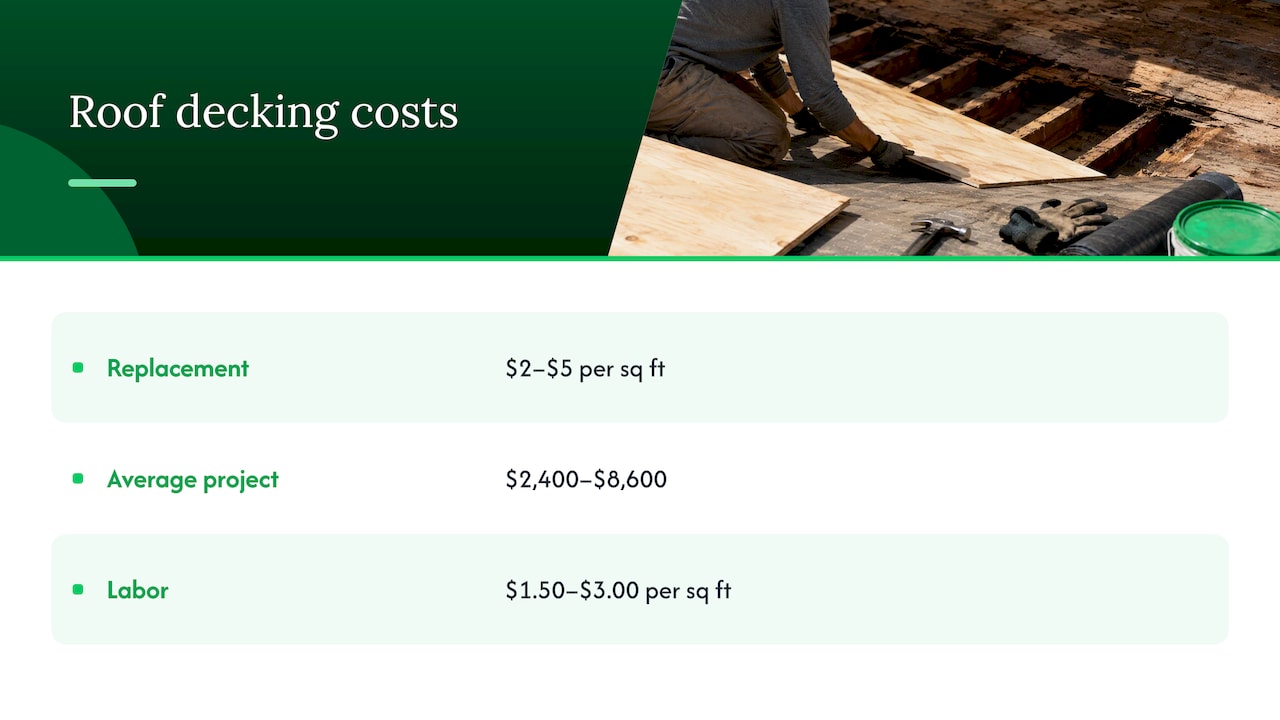
Costs vary by roof size, pitch and material, and your actual quote will depend on what is found under the shingles. As a general national benchmark, HomeGuide reports that roof decking replacement runs about $2 to $5 per square foot, or $2,400 to $8,600 on average, with labor around $1.50 to $3.00 per square foot. Treat that as a ballpark, not a local price. We do not publish fixed prices for roofing, because every roof is different, and we give written estimates after seeing the house.
If the damage came from a storm, your homeowners policy may respond. See our guide on Pennsylvania roof insurance claims for deadlines and documentation. Long-term rot from slow leaks or poor ventilation is generally treated differently from sudden storm damage, so ask your insurer how your policy handles each.
Timing and permits in Bucks County
If rot is active, do not wait for the perfect season. A temporary tarp and leak repair can hold things until the work is scheduled. For planned work, early fall is a favorite window with local roofers because of mild weather. We cover the reasoning in the best time to replace a roof in Bucks County.
Permit rules for roofing differ from township to township. Some municipalities need a permit for a reroof or structural decking work and others treat minor repairs differently, so call your local code office before work starts. For a broader look at the state-level picture, see our summary of the Pennsylvania roofing code.
Preventing rot from coming back
Once the new decking is in, a few habits and upgrades keep it dry.
- Air-seal the ceiling plane. Seal around recessed lights, wire and duct penetrations, the attic hatch and the tops of walls so house air cannot reach the attic.
- Vent exhaust fans outside. Bathroom and laundry fans should never terminate in the attic.
- Keep soffit vents clear. Blocked insulation at the eaves stops airflow.
- Maintain flashing and pipe boots. Inspect them every year and after major storms.
- Clean gutters. Overflowing water can back up at the roof edge and rot the fascia and the edge of the deck.
- Check the attic each winter. Frost or dampness on the underside of the deck is an early warning, long before it turns to rot.
The Building America Solution Center explains how condensation forms in attics in cold weather if you want the physics behind these steps.
Our perspective
We see the same pattern again and again on older homes in Bucks County. A homeowner notices a stain or a soft spot and asks for a patch. We could patch it. But if the attic is still pumping humid air against a cold deck, or a flashing is still failing, that patch is a few good years at most. So we start with the question: where is the water coming from?
Our approach is to be honest about what we can see and what we cannot. We will tell you if a small repair is the right answer, and we will tell you when it is not. We prefer you hear that on day one rather than discover it mid-job. That means explaining that the deck’s true condition is revealed only once the shingles are off, showing you what we find, and keeping the job site clean and safe while the roof is open.
We also think rot repair is a good moment to look at the whole roof system: ventilation, flashing, drainage and the age of the shingles. If the covering is near the end of its life anyway, replacing it together with the damaged decking can save you from paying for the same tear-off twice.
— Jeff
Working with JAG on roof and decking repair
JAG Home Enhancements handles roofing, roof repair and storm damage work, along with siding, windows and exterior renovations, for homeowners across Bucks and Montgomery counties. If you have soft spots, stains or a leak you cannot trace, reach out through our site and we will look at the roof and talk through your options with you. You can also browse our exterior renovation services if the roof is one part of a bigger plan.
FAQ
Can rotted roof decking be saved?
Once wood is soft, crumbly or spongy from fungal decay, it has lost strength and should be replaced. Wood that is merely stained or damp but still hard can sometimes dry out and stay in service once the moisture source is fixed. A roofer or inspector should confirm by pressing on it and checking how widespread the damage is.
Do I need to replace all the roof decking if some is rotted?
Not necessarily. Localized rot can be cut out and patched with new panels fastened over framing. If rot is spread across a slope or several areas, replacing more or all of it is usually wiser. The true extent is only clear after the shingles come off.
Why is the roof sheathing in my attic moldy or black?
Mold on the underside of the deck usually means moisture is reaching it, either from warm indoor air condensing on a cold surface or from a slow leak. Staining alone does not prove rot, but it is a sign to find the source. Poor ventilation, bathroom fans venting into the attic and air leaks from the house are common causes.
Can I replace roof plywood myself?
People do, but it means working on a roof with compromised decking, stripping and matching roofing, and meeting local code for panel thickness, spacing and fastening. Mistakes such as tight panel joints or unsupported edges can cause buckling and new leaks. For anything beyond a small, safely accessible spot, hire a licensed, insured contractor.
Sources
- Rotting Roof Decks: Causes, Mitigation and Code Rules
- Moisture-Safe Unvented Wood Roof Systems, Building America
- Removing, Repairing and Replacing Plywood Decking 101, Sheffield Metals
- How to replace plywood on roof? Roofing Talk
- 2026 Cost to Replace Roof Decking & Plywood Sheathing, HomeGuide
- Condensation Control in Attics and Roofs in Cold Weather, Building America Solution Center